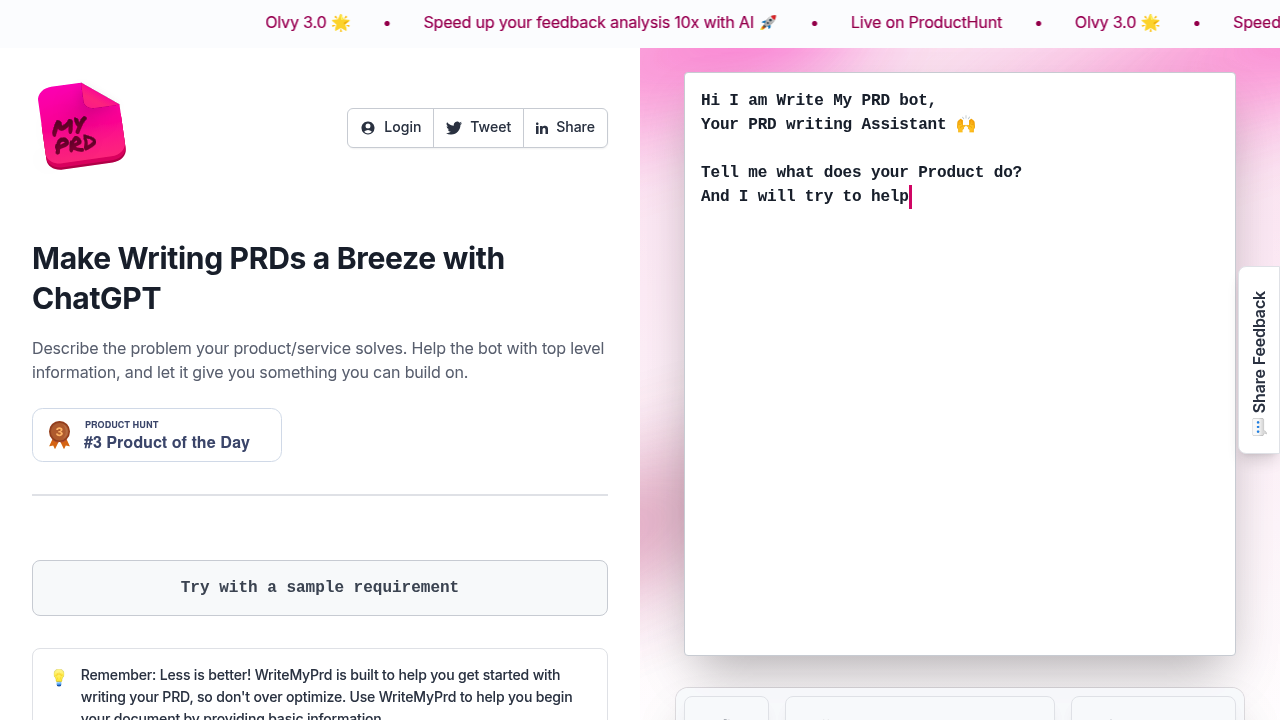
Product managers often face the challenge of staring at a blank page when drafting Product Requirements Documents. Write My PRD tackles this by using AI to transform basic product inputs into a foundational PRD structure. Users enter their product name, feature name, overview, and requirements—including feature lists and user feedback—and it generates a starting document they can refine. Write My PRD includes an interactive bot assistant, copy-to-Slack functionality for team sharing, and download options for further editing. It also provides curated PRD templates and resources from sources like Razorpay and Lenny's Newsletter. Write My PRD is free to use, offering full access to its AI-powered generation capabilities without paid tiers.
This service targets product managers and product builders who need to draft PRDs regularly but want to avoid the time sink of starting from scratch. It's particularly useful for PMs managing multiple features simultaneously, those new to writing PRDs who need structural guidance, and teams that value speed in their documentation process. Write My PRD suits individual contributors working independently as well as collaborative teams that use Slack for communication. Product managers in fast-moving environments—where getting requirements documented quickly matters more than perfection on the first pass—will find the approach aligns with their workflow.
Write My PRD fits into the early stages of product development when teams are defining what to build. A PM preparing for sprint planning can input feature concepts and user feedback collected from customer interviews, generating a draft to circulate among engineers and designers. Teams using Slack can copy generated PRDs directly into channels for immediate feedback. This service also works for PMs conducting sample requirement testing to validate whether their feature descriptions are clear enough before formal documentation. Because it emphasizes starting rather than finishing, it's designed for workflows where the PRD evolves through iteration with stakeholders. The curated resources help teams adopt best practices from established product organizations while the AI integration keeps the generation process conversational and adaptable to different product contexts.