
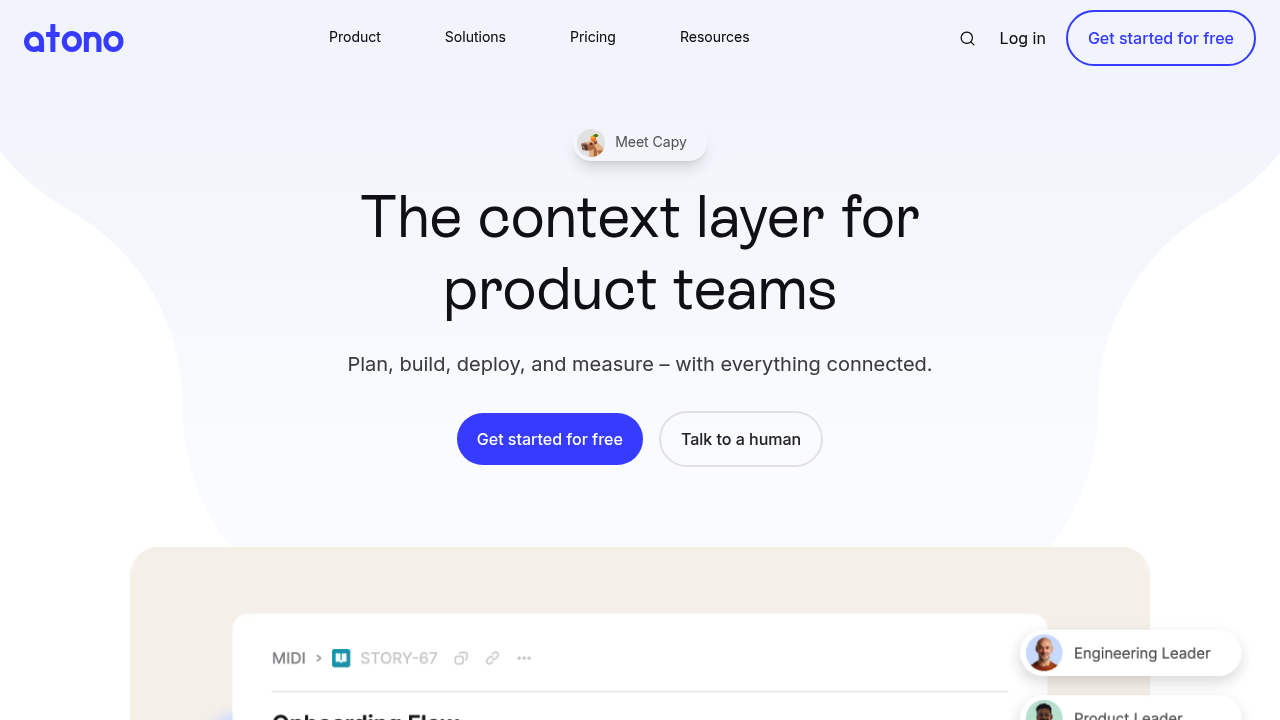
Atono connects the entire product development cycle in a single platform, treating stories as the central context layer that persists from planning through deployment to measurement. Instead of scattering information across multiple tools, it keeps requirements, decisions, feature flags, bugs, and usage analytics tied to the same user story throughout its lifecycle.
This Living Stories concept means every story maintains its full history. When someone opens a story, they see the original requirements, design decisions made during development, deployment configurations through feature flags, bugs reported after release, and actual usage data from production. This eliminates the typical context-rebuilding process that happens when engineers revisit old work or new team members join.
Feature flags integrate directly into the story workflow rather than existing as a separate system. Teams configure flag conditions and attributes, set user targeting rules, and control rollouts from within the story that defined the feature. Atono supports environment-specific configurations across dev, test, staging, and production. When something goes wrong, rolling back doesn't require hunting through a separate feature flag dashboard. Everything's in one place.
Bug management includes diagnostic context automatically. When users report issues, the system connects them to the relevant stories and flags, making triage faster. Engineers see which feature flag configuration was active when the bug occurred, what the original story requirements were, and how the feature's actually being used in production.
The feature engagement analytics track real usage patterns and feed them back to the originating stories. Product teams see which features get adopted, which sit unused, and how user behavior compares to initial assumptions. This data retention varies by plan: 30 days on the free tier, 90 days on Starter, and a full year on Growth.
Ask Capy functions as an AI assistant that searches through historical context. It retrieves past decisions, finds related stories, and surfaces relevant context without manual digging. Atono also includes MCP integration, allowing external AI tools to access Atono's data directly through the Model Context Protocol.
ML-informed planning helps with story refinement and sizing, though the specific models and training data aren't disclosed. Visual timelines show delivery plans and dependencies, while cycle time reporting tracks how long work actually takes versus estimates. Teams can use Kanban or Scrum workflows depending on preference.
The free plan supports up to 25 users with 150 backlog items, 5 GB storage, and feature flags serving up to 5,000 monthly active users. That's enough for small teams to test the full workflow. Starter costs $19 monthly and removes those caps entirely, adding unlimited users, backlog items, storage, and feature flags. It includes SSO and SAML authentication, which typically gets locked behind enterprise tiers elsewhere. Growth runs $39 monthly and extends feature engagement retention to one year with enhanced support.
Technical limitations appear mainly in the free tier. The 150 backlog item cap means active teams will hit that ceiling quickly. The 5,000 MAU limit for feature flags restricts usage for products with larger user bases. Storage caps at 5 GB, and workspace access limits to one. Premier AI features get 30 days of access on the free plan before requiring an upgrade.
Atono addresses the problem of fragmented toolchains where different systems handle tickets, flags, and analytics separately. That fragmentation creates constant context switching. Atono's approach keeps everything connected to the story to reduce overhead through consolidation, even if individual components might not match specialized tools feature-for-feature.