
Dify logo
AI Agent FREEMIUM from $590/mo

Dify

AI apps without code

Agentic workflows separate Dify from other no-code builders. You're building AI agents that make decisions. They take actions without constant human oversight. Think beyond simple chatbots. Beyond basic automation. Dify…

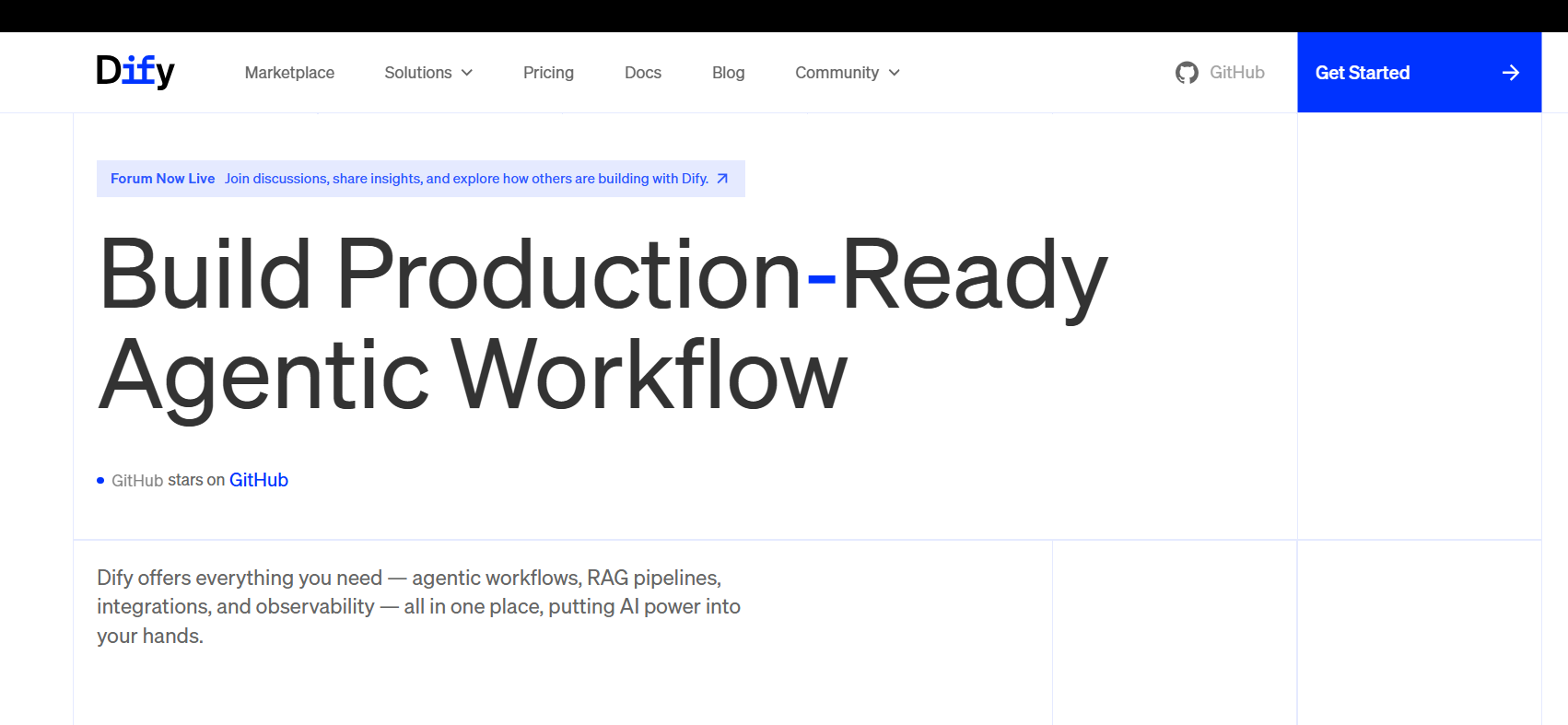
Dify screenshot

Agentic workflows separate Dify from other no-code builders. You're building AI agents that make decisions. They take actions without constant human oversight.

Think beyond simple chatbots. Beyond basic automation. Dify lets you construct workflows where AI agents evaluate situations. They choose next steps. They execute complex sequences. A DevOps engineer managing multiple deployment pipelines could set up agents that monitor system health. Detect anomalies. Automatically trigger rollbacks or scaling decisions.

Dify targets workflow complexity that breaks simpler tools.

You can chain multiple AI models together. Create decision trees that branch based on real-time data. Build agents that learn from previous interactions. Scale becomes the real test though — simple workflows work fine, but complex multi-agent systems can become unwieldy fast without proper planning.

Dify positions itself as a leader in this space. That matters when you're betting your infrastructure on agentic automation. It handles orchestration between different AI models and external systems so you don't have to write custom integrations for every connection.

You're not coding from scratch with the workflow builder approach. You're not stuck with rigid templates either. You get that middle ground where technical teams can build sophisticated AI systems without diving into pure development work. Just don't expect it to handle every edge case your production environment throws at it.

Dify alternatives

See all →

Frequently asked

7 questions
How does Dify handle multi-agent coordination when several AI agents need to work together?
Dify's orchestration layer handles the communication between agents and external systems automatically. You won't need to write custom integrations for each connection. But here's the thing - complex multi-agent workflows can turn into a real mess if you don't plan your architecture properly from day one.
Can I connect multiple AI models from different providers in a single Dify workflow?
Absolutely! You can chain models from different providers in one workflow. Use GPT-4 for reasoning, Claude for writing, and specialized models for specific tasks - all in the same process. The platform takes care of API connections and passes data between models.
What happens when Dify agents encounter edge cases or unexpected situations in production?
Here's the reality - Dify won't handle every edge case production throws at you. Complex real-world scenarios often break automated decision-making completely. You'll definitely need fallback mechanisms and human oversight for critical processes (especially in early deployments).
How much coding knowledge do I need to build effective agents with Dify?
You don't need to code from scratch, but technical understanding really helps. The visual workflow builder covers the basics. However, designing effective decision trees and agent logic requires thinking like a developer - non-technical users often struggle with complex workflows.
What's the learning curve like for setting up decision trees that branch based on real-time data?
Initial setup's pretty straightforward with Dify's visual interface. The real challenge? Mapping all possible decision paths and handling data quality issues. Most users totally underestimate how many edge cases they'll need to account for when agents make autonomous decisions.
How does Dify compare to simpler automation tools for workflow complexity?
Dify shines where basic automation tools completely break down. We're talking complex multi-step processes with branching logic and AI decision-making. Simple tools work fine for linear workflows, but Dify targets scenarios where you need agents that evaluate, decide, and adapt based on changing conditions.
Can Dify agents actually learn and improve from previous interactions over time?
Yes, you can build agents that reference historical data and past decisions to inform future actions. This isn't true machine learning though - it's more like sophisticated memory and pattern matching. The agents get better at following the rules you've defined, not at discovering new strategies on their own.

Traffic

Estimated monthly website visits · last 10 months

1M visits/mo
Monthly visits
1M
↓ 16.6% MoM
Global rank
#39,510
CN #2,972
Category rank
#25
AI Agent
1.5M 1.4M 1.2M 1.1M 1M Nov 2025: 1.1M visits Nov 2025 Dec 2025: 1.2M visits Dec 2025 Jan 2026: 1.3M visits Jan 2026 Feb 2026: 1.1M visits Feb 2026 Mar 2026: 1.5M visits Mar 2026 Apr 2026: 1.2M visits Apr 2026 May 2026: 1.1M visits May 2026 Jun 2026: 1.2M visits Jun 2026 Jul 2026: 1.2M visits Jul 2026 Aug 2026: 1M visits Aug 2026

Reviews (0)

Write review

No reviews yet. Be the first to share your experience.