
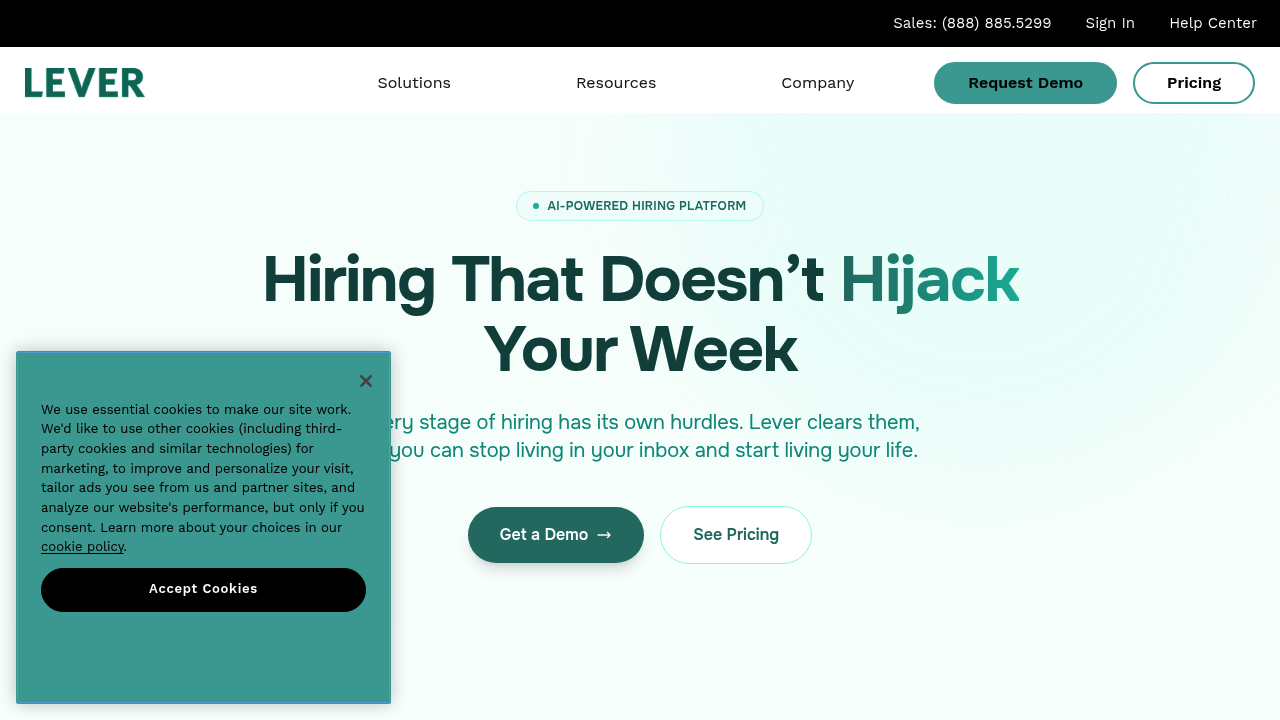
Opening Lever drops you into a recruiting dashboard where candidate profiles stack up with AI-generated fit scores next to each name. The system's already pulled resumes from job boards, parsed them, and ranked applicants before you've touched anything. Click a candidate and the interface shows why they got their score — years of relevant experience, skill matches, previous role alignment. It's reading between resume lines to flag who actually fits versus who just keyword-stuffed their application.
Scheduling interviews usually means endless email threads about availability. Here you click to schedule and the system checks everyone's calendars, sends options to the candidate, and books the slot when they pick one. Works in 60% less time according to their metrics. The automation extends to follow-ups too — nurture sequences fire off on their own to keep passive candidates warm without you setting reminders.
The fraud detection layer runs quietly in the background. It catches identity mismatches and flags when someone's resume conflicts with their application answers before you waste time on a phone screen. This isn't common in recruiting tools but makes sense given how many fake applications flood systems now.
When interview time hits, Lever generates meeting agendas automatically. After interviews wrap, it pulls together scorecard summaries and preps debrief materials without manual compilation. The system spots salary misalignments too — if a candidate's expectations don't match your range, you'll see an alert before extending an offer. Speaking of offers, templates auto-generate offer letters once you're ready to move forward.
Lever claims 42% faster time to hire and doubles the number of qualified applicants reaching your pipeline. Teams report saving 12 hours weekly, which tracks if you're not manually screening hundreds of resumes or coordinating schedules across time zones.
Where things get murky is the "Collective Intelligence" concept — apparently it learns from thousands of customers across industries to improve screening accuracy. Sounds useful but it's hard to tell how much of the AI's performance comes from this shared data versus standard machine learning. The 87% automation rate they advertise also isn't clearly defined. Does that mean 87% of tasks or 87% of candidates processed without human input?
The interface itself doesn't stand out. Functional but not particularly intuitive if you're switching from another ATS. Companies across 20-plus industries use it, from tech startups to healthcare systems, which suggests it adapts reasonably well to different hiring needs. Still feels built for teams already comfortable with structured recruiting processes rather than scrappy early-stage companies.