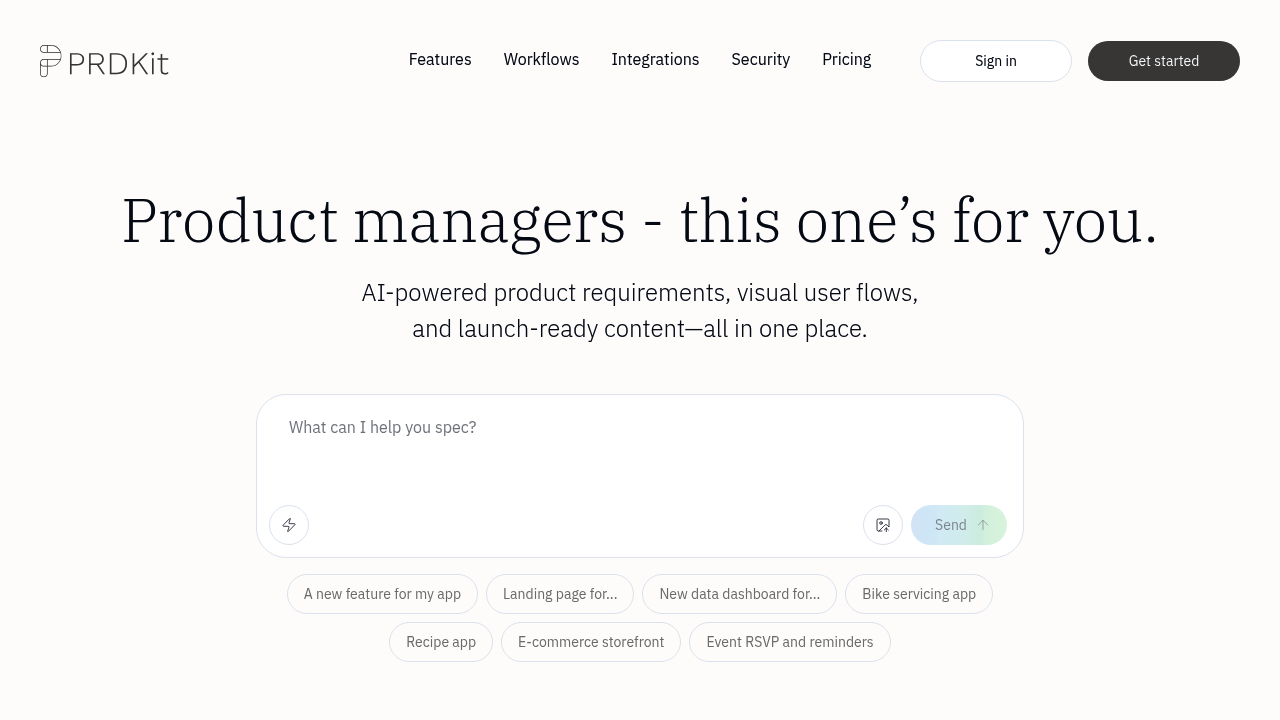
Product managers spend hours crafting requirements documents that translate vision into executable specs. PRDKit turns that multi-day process into a conversation with AI, generating structured PRDs alongside the visual artifacts teams need to move from concept to development.
PRDKit's core function centers on conversational document creation. Product managers describe their product ideas through chat, and PRDKit structures those inputs into complete requirements documents. This is not just text generation. The system pulls context automatically when you provide a homepage URL, analyzing existing product information to ground its outputs in your actual business. You can also upload product screens for the AI to analyze, letting it understand your current interface before suggesting improvements or new features.
Beyond text-based PRDs, PRDKit generates visual user flows and wireframes. These diagrams give developers and designers concrete references for building features. The visual aids come packaged with the written requirements, creating a complete specification bundle rather than forcing teams to jump between tools.
The Knowledge Hub functions as a repository for product context. Teams store personas, user journeys, and business objectives here. The AI references this shared knowledge when generating documents, maintaining consistency across multiple PRDs and ensuring new requirements align with established user profiles and company goals.
Launch preparation gets automated treatment through social media post generation and AI-simulated product reviews. The simulated reviews predict how users might respond to a feature based on the PRD's specifications. This feedback loop happens before development starts. Press release and demo script generation sit in the coming soon category.
Export options target the modern development workflow. PRDKit outputs documents in formats optimized for Bolt, Loveable, v0, and Cursor, tools developers use to turn specifications into code. You can also copy outputs directly into Notion or Confluence, fitting into existing documentation systems without format wrestling.
Sharing works through public and private links. Teams can circulate PRDs to stakeholders without forcing everyone onto PRDKit. The team workspace feature lets multiple product managers collaborate with shared knowledge and admin controls for access management.
The free plan provides 10 credits covering AI-powered PRDs, visual user flows, launch content, and export functionality. All sharing features come included. Premium runs $15 per seat monthly when billed yearly, multiplying the monthly limit by 10 and adding team workspace capabilities with shared knowledge pools. Slack integration appears in Premium tier descriptions but carries a coming soon tag. Enterprise pricing requires direct contact and promises higher usage limits, custom integrations, and dedicated onboarding sessions.
Several features remain in development. Press releases, demo scripts, Slack integration, and Microsoft Teams integration all show coming soon labels. The 10-credit cap on free accounts limits experimentation scope for teams evaluating PRDKit.
PRDKit carries Y Combinator backing and makes a specific privacy commitment: customer data never trains public AI models. This matters for companies handling sensitive product information who need documentation tools without data leakage concerns.
PRDKit targets product managers and teams building software products who need structured documentation fast. It is built for environments where requirements drive development sprints and visual specifications prevent miscommunication between product and engineering. Teams already using Notion or Confluence for documentation can slot PRDKit into existing workflows through direct copy-paste compatibility.