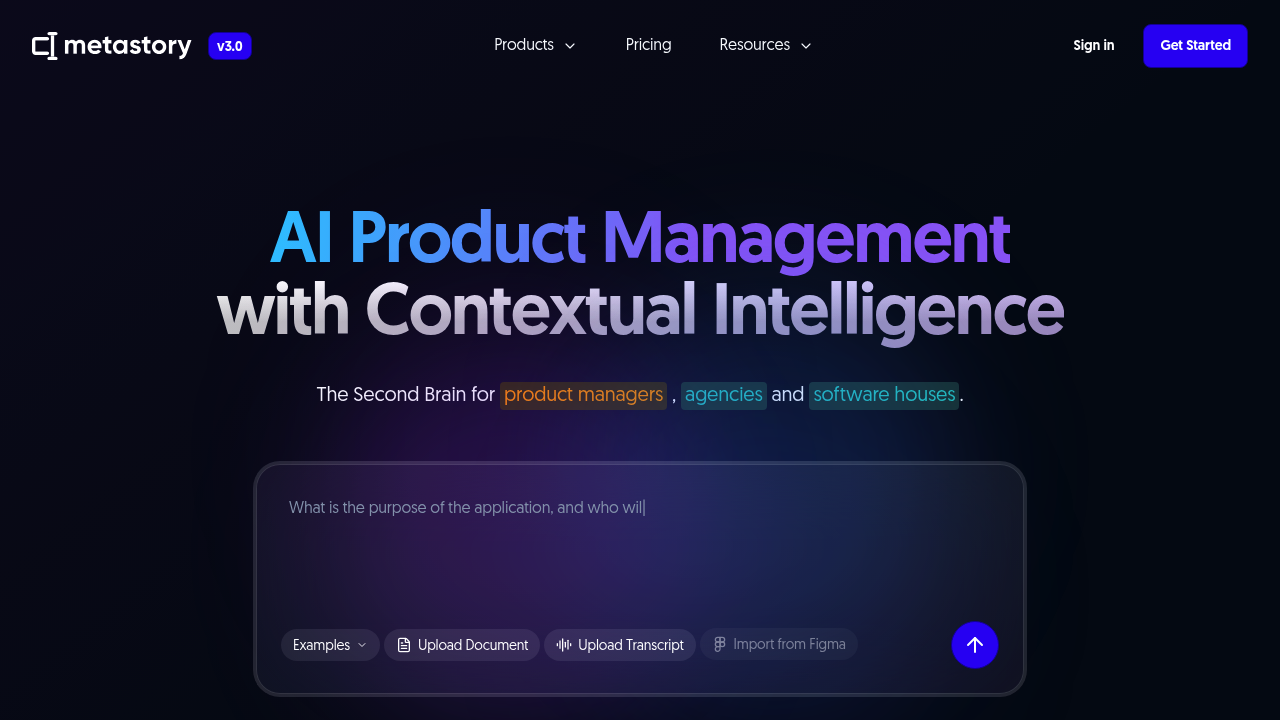
Product managers juggling scattered documents, meeting notes, and Figma files now have a dedicated AI workspace that consolidates everything into structured product requirements. metastory AI positions itself as the world's first AI-based PRD tool with MCP Server support, meaning it connects product documentation directly to what it calls Meta Coding workflows.
This system generates product requirements through a step-by-step process that breaks down projects into modules, features, and subfeatures. You maintain control throughout with human-in-the-loop oversight, so the AI suggests structure while you validate decisions. The Context Engine sits at the core, collecting information from uploaded documents, transcripts, and Figma imports to build a unified knowledge base. This contextual foundation feeds every other function in the software.
UI Screen Management ties directly to product vision, letting teams map screens to specific requirements. The interactive screen-to-requirement mapping creates visual connections between what users see and what developers build. When you import Figma designs with one click, those screens populate automatically and link to relevant modules in the logical hierarchy. Parent-child structures keep everything organized as projects grow.
The AI Estimation Board delivers fast quotes and cost predictions broken down by module and feature. It calculates hours and costs automatically, then separates totals by role: Frontend, Backend, and QA. Teams see live totals that update as requirements change. MoSCoW prioritization and priority-driven accuracy help refine estimates based on what's actually critical versus nice-to-have.
Jira integration works bidirectionally, syncing requirements both ways so product and engineering teams stay aligned. The MCP Protocol support extends connectivity to other tools, though specific additional integrations beyond Figma aren't detailed. Teams can build a reusable library of modules and components, avoiding repetitive documentation work across similar projects.
This system generates documentation views automatically from the structured requirements. Visual project boards display linked modules in one interface. Everything traces back to that Context Engine, which the company describes as enabling "MetaCoding as your documented VibeCoding."
Product managers at agencies and software houses represent the primary audience, particularly those coordinating between design, development, and stakeholder requirements. Teams working on multiple projects simultaneously benefit from the reusable library feature. The software assumes users already work with Figma for design and Jira for task management, making it a middle layer that connects product thinking to execution planning. API access and team features support collaborative workflows across distributed product teams.