
Subtitle Edit logo

Subtitle Edit

Subtitle Edit is a free, open source editor for video subtitles that runs on Windows.

It lets you adjust subtitles that are out of sync with a video, create new ones from scratch using a waveform and spectrogram view, translate them, and convert between more than 300 formats including SubRip, WebVTT,…

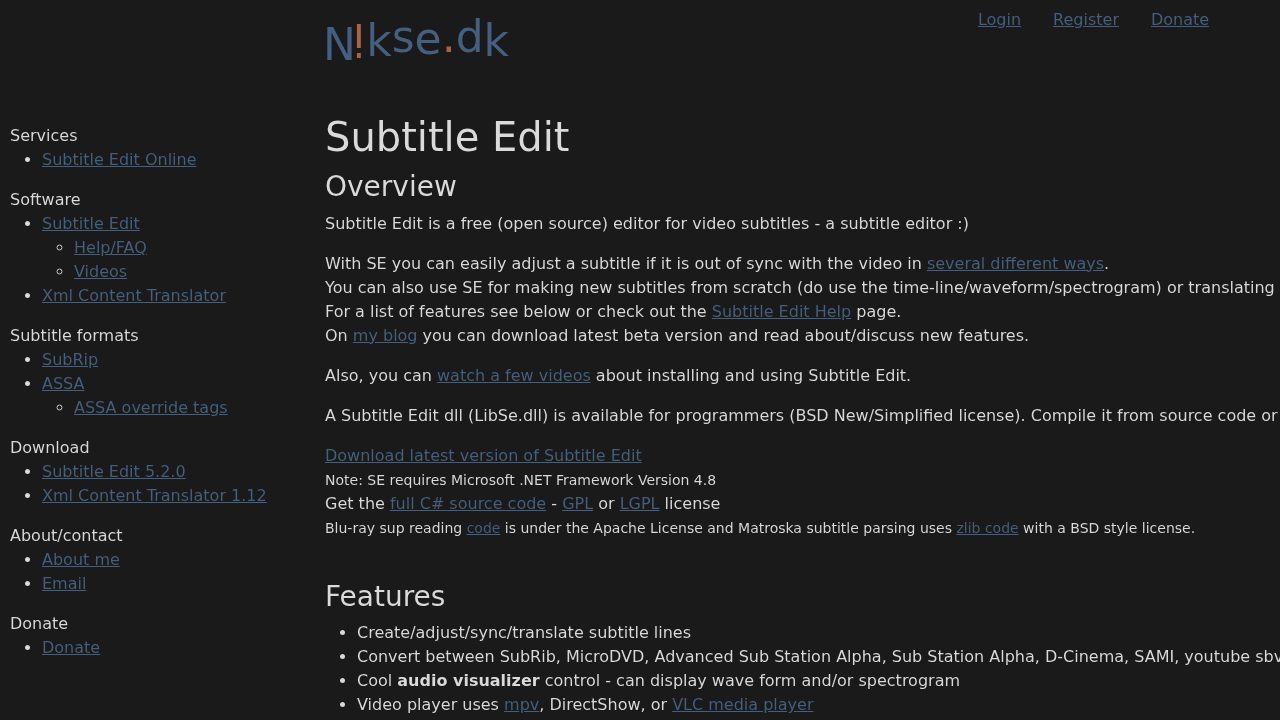
Subtitle Edit screenshot

Subtitle Edit is a free, open source editor for video subtitles that runs on Windows. It lets you adjust subtitles that are out of sync with a video, create new ones from scratch using a waveform and spectrogram view, translate them, and convert between more than 300 formats including SubRip, WebVTT, Advanced Sub Station Alpha, TTML and EBU STL. Speech recognition through Whisper, text to speech through several engines, and automatic translation through services such as Google Translate and DeepL are built in. There is no paid plan, and the full C# source code is available under a GPL or LGPL license.

The audience is anyone who works with captions and subtitles at a hands-on level: fansubbers and translators, video editors, post-production staff, accessibility specialists, archivists, and developers who need a subtitle library. Beginners can sync a file with a few clicks, while professionals rely on the fix-common-errors wizard, spell checking with LibreOffice dictionaries, merge and split tools, and batch conversion from the command line. The interface is available in 32+ languages, which helps translators and international teams work in their own language.

Typical jobs include shifting a subtitle file that runs late, point-synchronizing it against the video, and fixing line lengths and reading speed before release. A localization team can translate a track through DeepL or a local model and review it side by side. A broadcaster can export EBU STL or PAC files, and a disc archivist can rip subtitles from a decrypted DVD or run OCR on VobSub and Blu-ray image subtitles. Creators can generate a video with burned-in subtitles, or with subtitles on a transparent background, and programmers can embed the LibSe.dll library in their own software.


Subtitle Edit alternatives

See all →

Frequently asked

6 questions
What can Subtitle Edit do besides editing text?
Visual syncing against a waveform or spectrogram is built in, along with merging, splitting, an error-fixing wizard and spell checking. It also converts between 300+ formats, runs speech recognition through Whisper, and translates automatically. It can generate video with burned-in subtitles too.
Who uses Subtitle Edit?
Translators, fansubbers, video editors, accessibility staff and archivists are the typical users. Developers can also use the LibSe.dll library under a BSD license. The 32+ interface languages suit international teams.
How do I fix subtitles that are out of sync?
Open the subtitle file with the video loaded and use the show earlier or later option, point synchronization, or synchronization against another subtitle. You can also adjust start and end positions and speed visually on the waveform.
What does Subtitle Edit cost?
Nothing: it is free and open source. The source code is published under a GPL or LGPL license, and there is a donate link for supporters. No paid plans are listed.
What are the limitations of Subtitle Edit?
Desktop use requires the dotNET Framework 4.8 from Microsoft, so it is aimed at Windows. DVD ripping works only on decrypted discs. Some formats are read-only, such as DVD Vob and Ultech.
Which video players and AI services does Subtitle Edit connect to?
Playback can use mpv, DirectShow or VLC. Text to speech works through ElevenLabs, Azure, Google or local engines, and automatic translation uses Google Translate, DeepL, or local models run with Ollama and LM Studio.

Reviews (0)

Write review

No reviews yet. Be the first to share your experience.