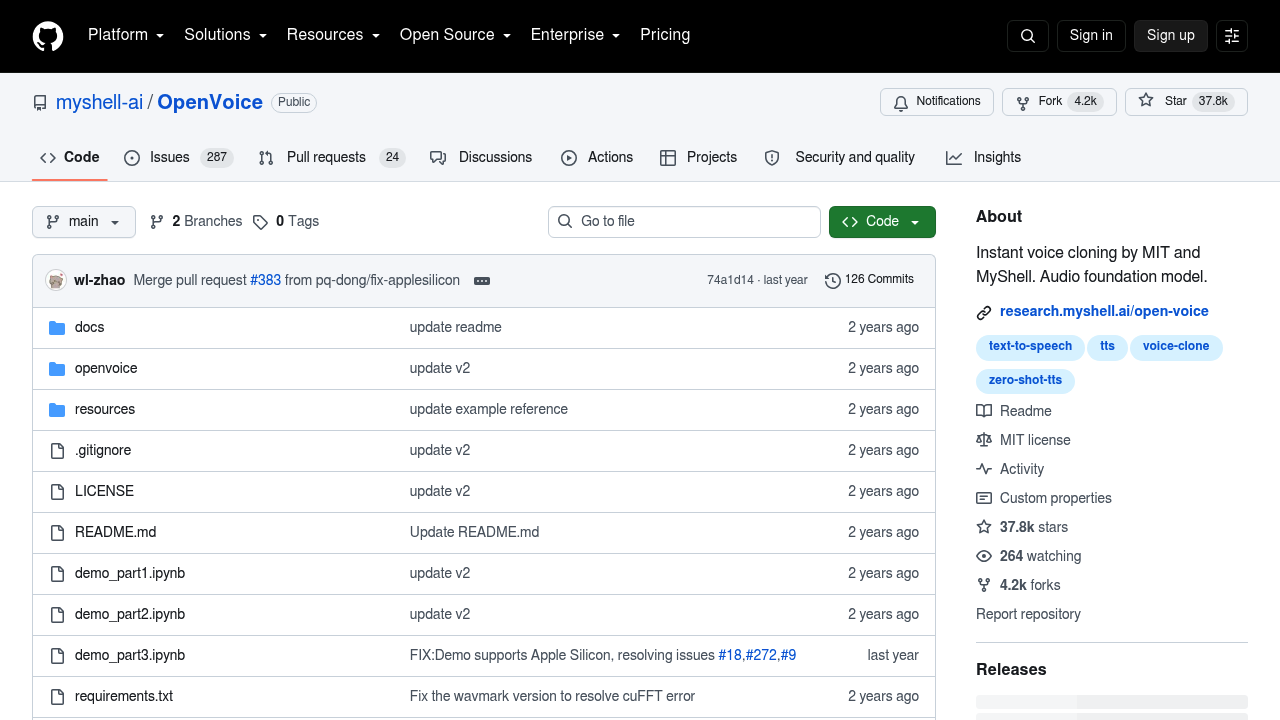
OpenVoice is an open-source instant voice cloning model created by researchers at MIT and Tsinghua University together with MyShell. From a short reference clip it reproduces the speaker's tone color and then generates speech in multiple languages and accents. Users also control emotion, accent, rhythm, pauses and intonation. Version 2, released in April 2024, improved audio quality and natively supports English, Spanish, French, Chinese, Japanese and Korean. Both versions use the MIT License, so the code is free for research and commercial use.
OpenVoice is aimed at machine learning researchers, speech engineers and developers who want to embed voice cloning in their own products. Teams that need cross-lingual output benefit from its zero-shot design, which clones a voice into a language that was never in the reference speaker's data. Content studios and app builders can prototype character voices, while hobbyists can follow the demo notebooks to try it. It has powered the voice cloning on myshell.ai since May 2023 and was used tens of millions of times by Nov 2023.
Typical use cases include producing multilingual narration in a consistent voice, building voice-enabled characters or assistants, localizing audio content without recording a new speaker, and adjusting emotion or pacing in generated speech. Developers install it from the repository, follow the usage guide, and run the demo notebooks to clone a reference voice and synthesize new sentences. Researchers cite the accompanying paper and extend the model for experiments with style control. Because the license permits commercial use, startups can integrate the model into apps without licensing fees, provided they handle consent for any cloned voice.