
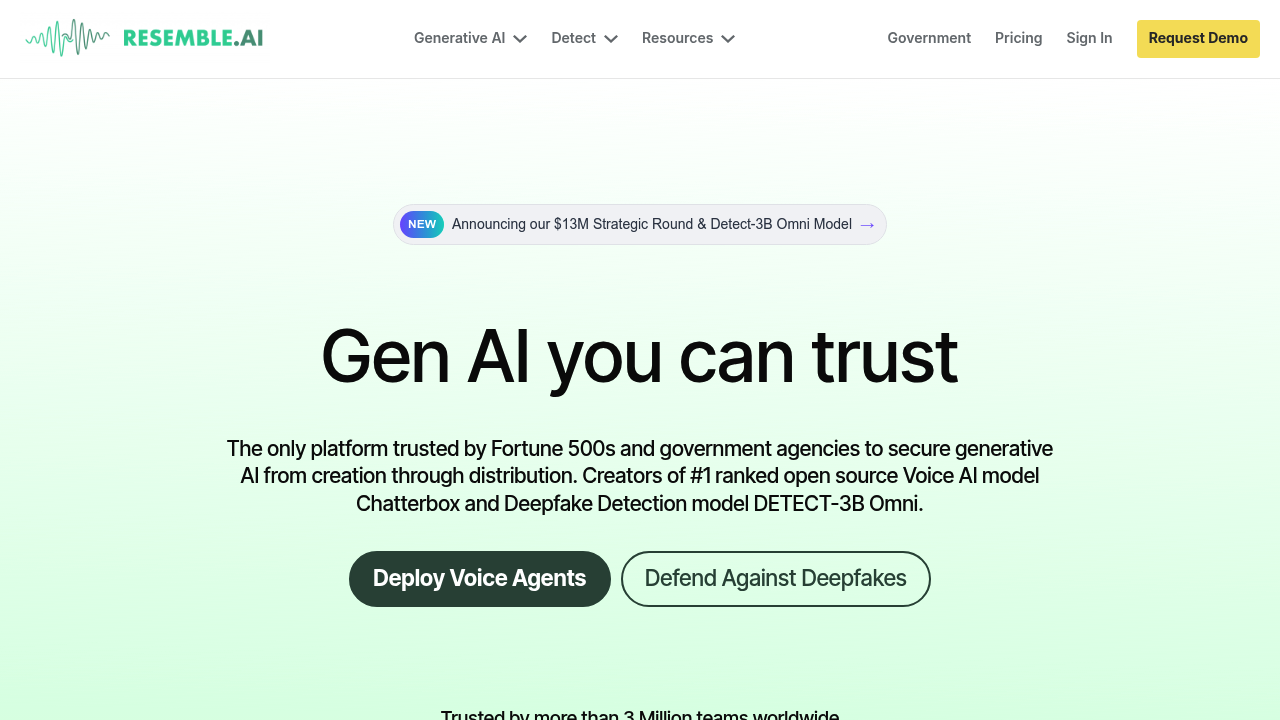
Developers get API access to voice cloning and text-to-speech models that actually sound human. Resemble AI builds the infrastructure so you don't have to train your own models from scratch. It handles 60+ languages. Scales to enterprise levels. Companies like Zomato already run thousands of voice interactions through their system.
Want to clone a voice? Upload audio samples and you're done. Speech-to-speech conversion works in realtime. You can even prompt-generate entirely new voices from text descriptions without needing source audio.
Content creators building apps with synthetic voices will find the most value here. Think a podcast producer who needs consistent narrator voices across multiple episodes or languages. Audio editing tools let you tweak generated speech without bouncing between different software.
Deepfake detection feels like an afterthought compared to the generation features. Resemble AI's DETECT-3B model spots synthetic audio across different creation methods, but most developers probably want this for making voices rather than detecting them.
Gaming studios and educational apps make up a chunk of the user base. One case study mentions thousands of children using Fabler bedtime stories powered by Resemble AI voices.
There's a free open-source model called Chatterbox if you want to test the waters first. You'll need technical chops to integrate this properly — API documentation assumes you know what you're doing with voice synthesis pipelines.