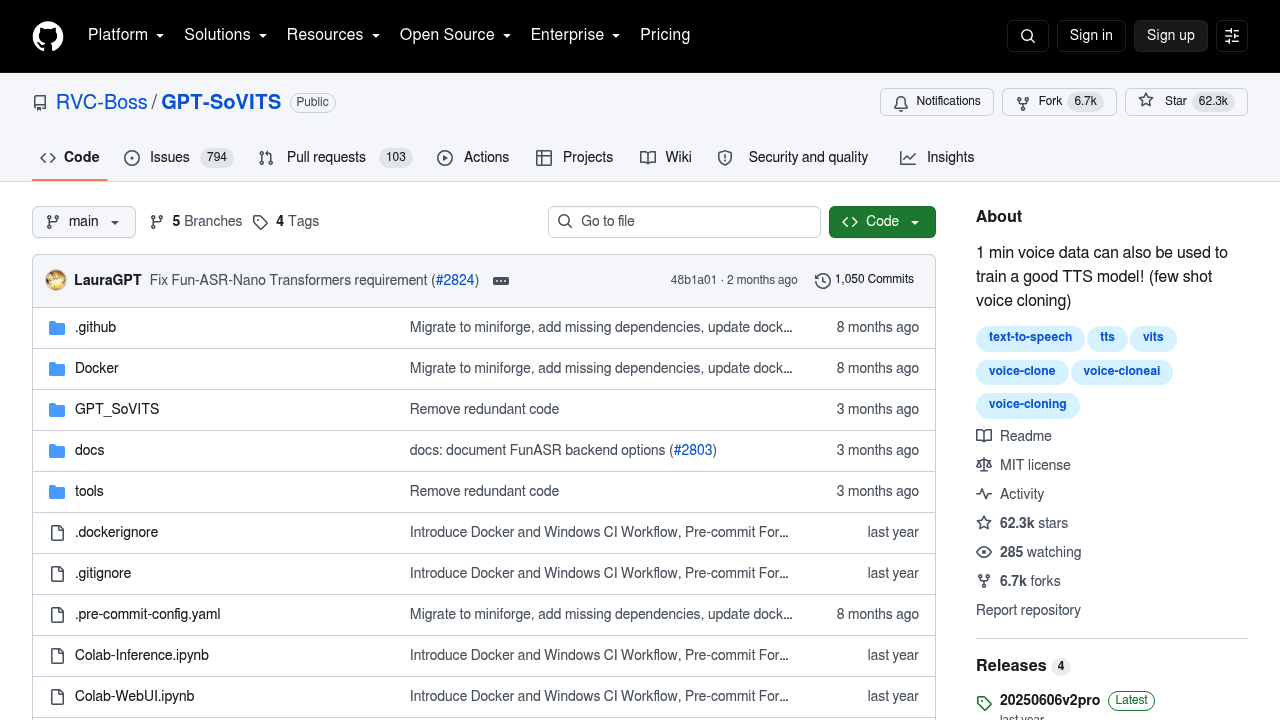
GPT-SoVITS is an open-source WebUI for few-shot voice conversion and text-to-speech. It can produce speech in a target voice from a five-second sample in zero-shot mode, and fine-tuning with about one minute of training data improves similarity and realism. Inference works across languages, with English, Japanese, Korean, Cantonese and Chinese supported. Built-in tools separate vocals from accompaniment, segment training audio automatically, run multilingual speech recognition with Fun-ASR-Nano, SenseVoice and FunASR, and label text, which helps beginners build their own datasets. The project is free to download and run, with installers for Windows, Linux and macOS and a Docker setup.
The project is aimed at developers, machine learning hobbyists and content creators who want a custom voice without paying for a hosted service. Beginners can follow the packaged Windows download and the WebUI workflow, while experienced users run the API scripts, Docker images or Colab notebooks. Researchers and tinkerers appreciate the open code and the range of pretrained models across its versions. Running it well takes a computer with a recent GPU, though a CPU-optimized fork and Apple silicon builds exist for lighter setups.
Typical uses include cloning a voice for narration from a short recording, preparing a training dataset from raw audio using the separation and segmentation tools, and fine-tuning a model to match a specific speaker. Developers wire the included API scripts into apps that need speech synthesis, and creators produce multilingual voice-overs by synthesizing text in a language different from the training data. Users with limited hardware try the Hugging Face demo or Colab notebooks before installing locally. Inference is fast on modern GPUs, with a real-time factor of 0.028 on a 4060Ti, so longer scripts can be generated in a few seconds.