
Hunyuan 3D logo

Hunyuan 3D

This software converts text prompts or images into production-ready 3D assets using a 10 billion parameter model

The v2.5 release runs on consumer hardware with just 6GB of VRAM, making it accessible without cloud dependencies. On an RTX 3060 with 12GB memory, the average generation takes around 30 seconds from input to finished…

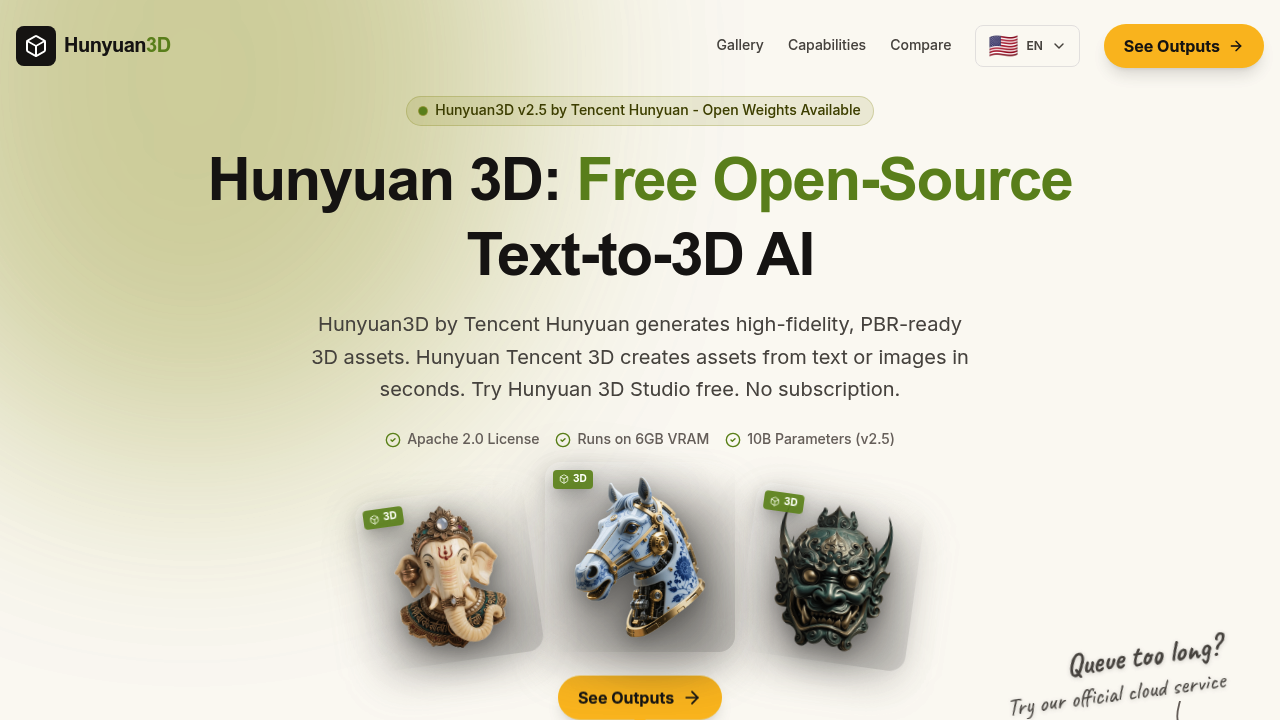
Hunyuan 3D screenshot

This software converts text prompts or images into production-ready 3D assets using a 10 billion parameter model. The v2.5 release runs on consumer hardware with just 6GB of VRAM, making it accessible without cloud dependencies. On an RTX 3060 with 12GB memory, the average generation takes around 30 seconds from input to finished asset.

The pipeline accepts either text descriptions or reference images as input. It processes these through the model and outputs PBR-ready assets, meaning they include physically based rendering maps like albedo, normal, and roughness. These assets don't need additional cleanup or post-processing before use in production environments. The system handles multiple asset categories including creatures, characters, vehicles, objects, and architecture.

Technical implementation runs locally. The model's parameter count sits at 10 billion for version 2.5, which balances output quality against hardware requirements. That 6GB VRAM minimum means it'll run on mid-range GPUs rather than requiring enterprise-grade cards. The 30-second generation time on modest hardware suggests optimized inference, though this likely varies based on asset complexity.

The outputs are truly production-ready. PBR maps come pre-generated, which matters because manually creating these texture sets typically takes hours. The software eliminates that bottleneck entirely. Artists get game-engine-ready or render-ready assets directly from the generation process.

Integration happens through HuggingFace Spaces, where you can access Hunyuan 3D Studio. The service is free to use without subscriptions. You won't hit paywalls for basic functionality. The underlying model carries an Apache 2.0 license with open weights available, so developers can modify or deploy it independently if needed.

Queue management presents the main operational limitation. When too many users access the service simultaneously, you'll encounter queue wait times. The system suggests switching to their official cloud service when queues get long, though specifics about that service aren't detailed in the technical documentation.

The open-source nature means you're not locked into proprietary formats or hosting. Download the weights, run inference locally, and integrate the generation pipeline into existing workflows. This matters for studios with specific data handling requirements or teams that need on-premise deployment.

The combination of fast generation, low hardware requirements, and PBR-ready outputs addresses a real production gap. Traditional 3D modeling takes hours or days per asset. This compresses that timeline to under a minute while maintaining production standards.


Hunyuan 3D alternatives

See all →

Frequently asked

6 questions
Can you run Hunyuan 3D locally without cloud services?
The model runs entirely on local hardware with a minimum of 6GB VRAM, which covers most mid-range GPUs from the past few years. Version 2.5 uses 10 billion parameters but they've optimized inference enough that an RTX 3060 with 12GB generates assets in roughly 30 seconds. You can download the open weights under Apache 2.0 license and deploy it on-premise without relying on external APIs or cloud infrastructure. The only cloud dependency is the optional HuggingFace Spaces interface, but that's just one access method.
Does Hunyuan 3D cost money or require a subscription?
Access through Hunyuan 3D Studio is completely free with no subscription tiers or payment requirements. There aren't any paid plans limiting features or generation counts based on the available documentation. Queue limitations exist when too many users access the service simultaneously, at which point they suggest their official cloud service, though pricing details for that aren't specified. The open-source weights mean you can also bypass queues entirely by running it locally.
What file formats does Hunyuan 3D output for game engines?
The system generates PBR-ready assets, which means physically based rendering texture maps like albedo, normal, and roughness come pre-baked into the output. These maps are standard across game engines like Unity and Unreal, though the specific export formats aren't detailed in technical documentation. The 'production-ready' designation indicates the assets drop directly into rendering pipelines without additional texture work. No post-processing is required, so you're getting engine-compatible files straight from generation.
How does Hunyuan 3D handle text-to-3D versus image-to-3D generation?
The pipeline accepts both text prompts and reference images as input, processing them through the same 10 billion parameter model architecture. Text inputs get parsed and translated into 3D geometry with corresponding PBR textures, while image inputs use the visual reference to guide mesh and material generation. Both methods produce the same PBR-ready output format with similar generation times around 30 seconds on mid-range hardware. The model supports multiple asset categories including creatures, characters, vehicles, objects, and architecture regardless of input type.
What are the main limitations of Hunyuan 3D for production work?
Queue congestion is the primary operational bottleneck when using the hosted service, forcing wait times during peak usage periods. The system doesn't specify geometric complexity limits or polygon count constraints, so you might hit undefined boundaries with highly detailed assets. There's no information about batch processing capabilities, which matters for studios needing to generate asset libraries at scale. The 30-second generation time is based on RTX 3060 benchmarks, so older or lower-spec GPUs will see longer processing times.
Can Hunyuan 3D replace traditional 3D modeling workflows?
It compresses initial asset creation from hours to under a minute, which handles blocking out environments or generating placeholder models effectively. The PBR-ready outputs work for background assets, props, and concept visualization without manual texture painting. However, hero assets or character models requiring specific artistic direction still need traditional modeling for precise control over topology and UV layouts. The tool fits best as a rapid prototyping system or asset library generator rather than a complete replacement for skilled 3D artists.

Traffic

Estimated monthly website visits · last 0 months

565 visits/mo
Monthly visits
565
Global rank
#2,758,858

Not enough historical data for a chart yet.

Reviews (0)

Write review

No reviews yet. Be the first to share your experience.