
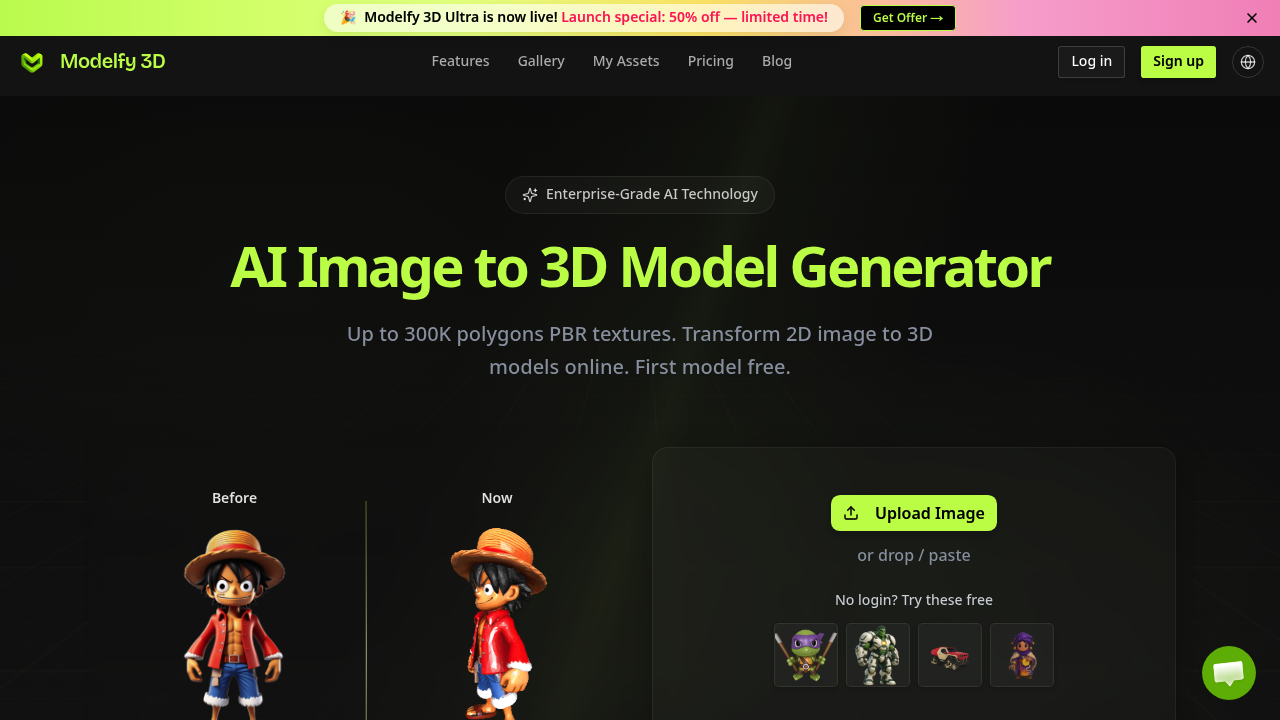
This service converts 2D images into 3D models using proprietary AI algorithms developed by computer vision researchers and 3D graphics engineers. The system applies breakthrough octree resolution technology to generate models with polygon counts ranging from 15,000 to 300,000 depending on the selected quality tier.
The conversion pipeline works through a one-click process that analyzes input images and reconstructs them as three-dimensional geometry. The AI generates physically-based rendering textures alongside the mesh data, producing GLB, OBJ, and STL file formats. Each conversion takes two to three minutes and includes texture maps plus preview images in the output package.
Quality tiers determine polygon density. Standard outputs lower-resolution meshes while Pro and Ultra settings push toward the 300,000 polygon ceiling. The system maintains a 99.9% success rate across conversions, which suggests reliable error handling in the pipeline. Average conversion cost sits at fifty cents per model.
This service runs unlimited concurrent conversions on enterprise-grade infrastructure, meaning users can queue multiple jobs simultaneously without throttling. An intelligent quality control system evaluates outputs before delivery, though the specific validation criteria are not detailed in technical documentation.
Asset management operates through a database system with filtering, favorites, and archiving functions. Users can attach custom titles, descriptions, and tags to projects for organizational purposes. This metadata layer sits separately from the conversion pipeline itself.
The first model converts free without requiring account creation. This lets users test the pipeline before committing to paid conversions. The free tier provides full access to the conversion engine, not a reduced-quality demo.
Technical limitations aren't specified in available documentation. The system doesn't expose polygon count controls beyond the three preset quality levels, so users cannot fine-tune mesh density to exact specifications. Format support covers the three most common 3D file types but doesn't extend to industry-specific formats like USDZ or FBX.
No integrations exist with third-party software or APIs. This service operates as a standalone web service without plugins for Blender, Unity, Unreal Engine, or CAD applications. Output files require manual import into downstream workflows.
The octree resolution approach represents the core technical differentiator. Traditional photogrammetry requires multiple input angles, while this single-image method reconstructs depth information through learned spatial relationships. The proprietary algorithms trained on undisclosed datasets enable this reconstruction without multi-view capture setups.