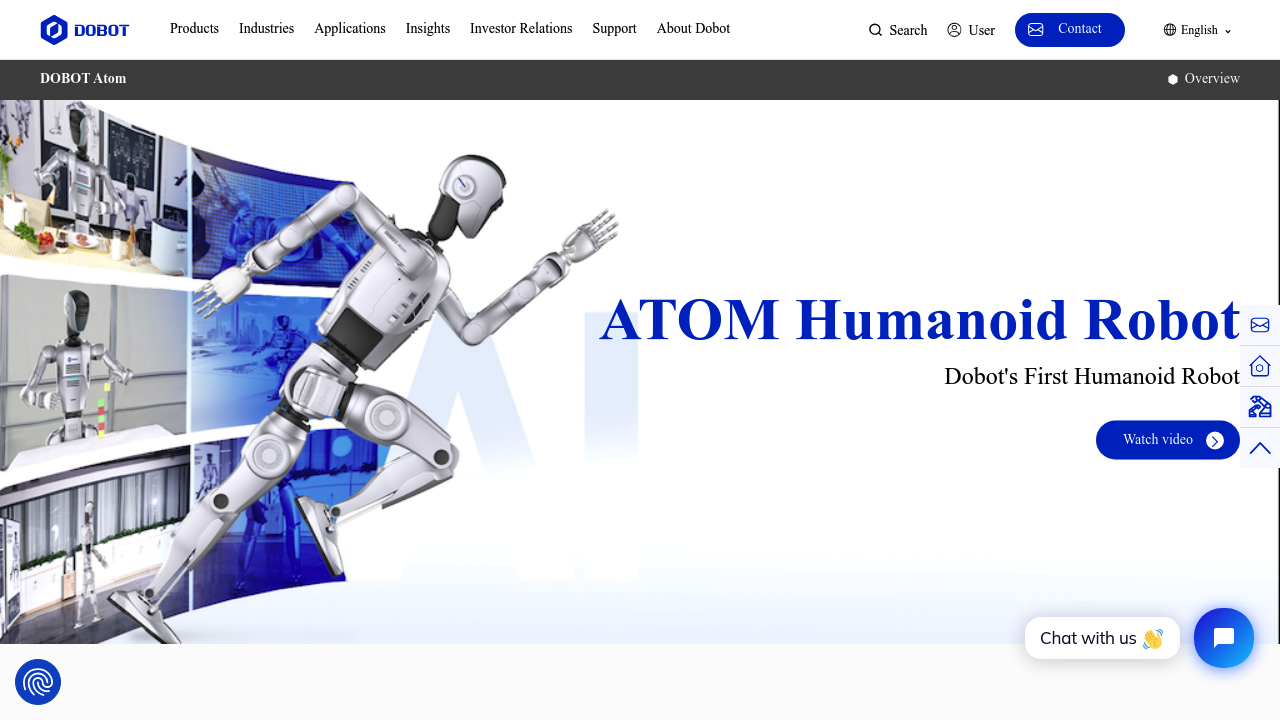
DOBOT has built what they call the world's first full-sized humanoid robot capable of dexterous manipulation across industrial environments. The machine handles assembly work, operates tools, and manages products of varying specifications using brain-hand co-evolution principles that mirror human motion strategies through imitation and reinforcement learning.
The Neuro-Driven Dexterity System provides 28 degrees of freedom in the upper body alone. This system combines transformer-based architecture with binocular RGB vision, creating what amounts to sophisticated hand-eye coordination for industrial tasks. Control happens at 200Hz with servo-level vibration suppression, meaning the robot can execute precise movements without the shakiness that typically plagues mechanical systems during delicate operations. The Robot Operator Model-1 processes decisions using 100 million parameters and delivers end-to-end control at 24Hz, translating sensor input into physical action with minimal lag.
Walking gets handled through the Anthropomorphic Walking System, which uses straight-knee locomotion instead of the bent-knee approach most humanoid robots employ. This design choice cuts energy consumption by 42% compared to traditional methods while maintaining stability across varying floor surfaces. The robot adapts to workstation heights between 700mm and 1000mm, accommodating different table and counter configurations without requiring environmental modifications.
Computational power reaches 7.7 times the industry standard through an advanced edge computing system built into the robot itself. This local processing capability means the machine doesn't need constant cloud connectivity to function, reducing latency and dependency on network infrastructure. Multiple units can collaborate on shared tasks, coordinating movements and handoffs between robots on production lines or service environments.
Real deployment scenarios include automotive assembly lines where the robot handles parts installation, beverage preparation stations requiring precise pouring and mixing, pharmacy operations involving medication sorting and packaging, and production lines managing multi-device workflows. The system integrates human-robot interaction protocols and safety technologies, though specific details close to collision avoidance or emergency stop mechanisms aren't provided in technical specifications.
The robot's design philosophy centers on replicating human manipulation capabilities rather than simply automating repetitive motions. This approach allows adaptation to tasks that previously required human workers because of complexity or variability. Industrial customers get a platform that theoretically slots into existing workflows without extensive retooling, though actual implementation requirements would depend on specific facility layouts and operational demands. The technology represents a shift from purpose-built industrial arms toward general-purpose humanoid platforms in commercial settings.