
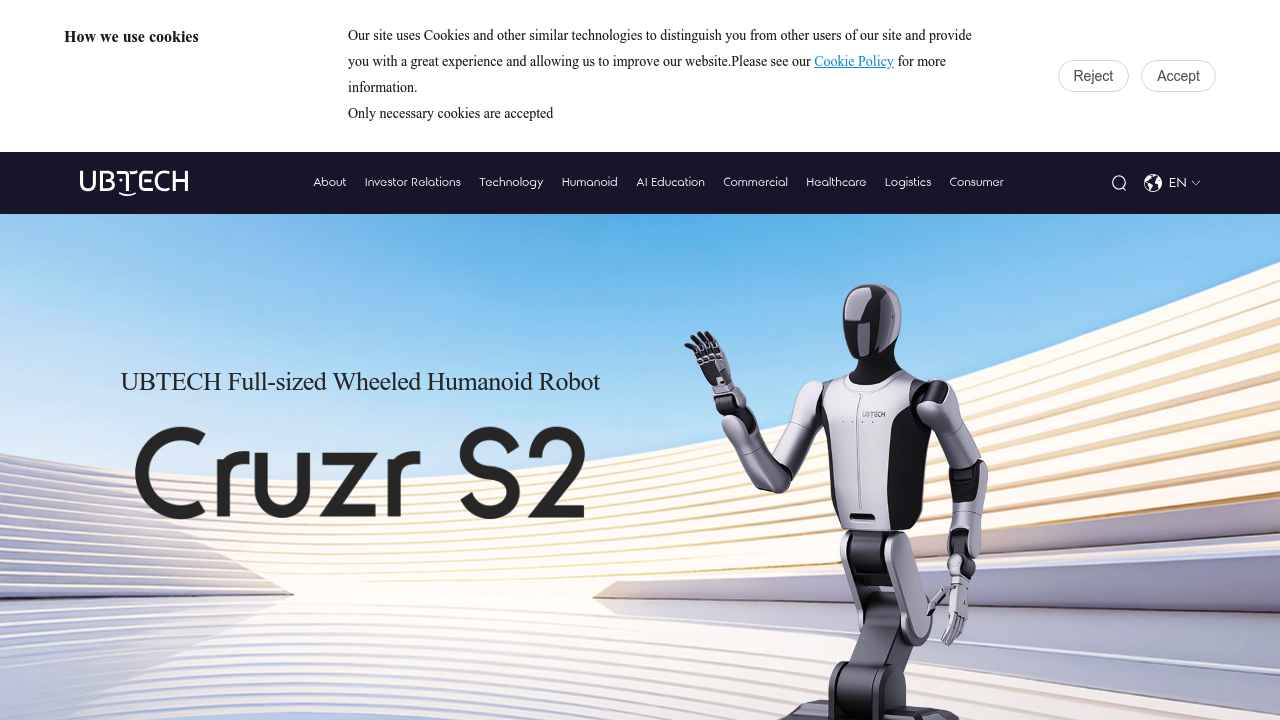
The UBTECH Cruzr S2 tackles industrial automation through a wheeled humanoid design built for sorting, component assembly, and handling operations across varied terrains. This isn't a stationary arm bolted to a factory floor. It moves at 2m per second while maintaining self-balanced stability on complex surfaces.
The robot's symmetrical body bends bidirectionally, letting it rotate ±170° within passages as narrow as 0.8m. That rotation range matters in crowded warehouse aisles or tight manufacturing spaces where traditional robots can't maneuver. The design handles a 15kg payload across a 0-1.8m workspace, with a 0-40cm lifting range that covers everything from ground-level pallets to mid-height conveyor systems.
Manipulation precision reaches sub-millimeter levels through Gen-4 industrial dexterous hands. These aren't simple grippers. They handle component assembly tasks requiring exact positioning, the kind of work that previously demanded human workers or specialized machinery for each product variant. The hands work across the robot's full spatial range, meaning it can reach low, high, or laterally without repositioning its base.
Vision processing runs through a pure RGB binocular stereo system mounted in the head unit. UBTECH developed a passive binocular vision approach that generates real-time high-precision left-aligned dense depth maps using deep learning-based stereo depth estimation. This human-eye binocular perception lets the robot judge distances and identify objects without requiring expensive LIDAR arrays or structured light projectors.
The sim-to-real embodied intelligent data system connects virtual training environments with physical operations. Robots learn tasks in simulation, then transfer that knowledge to real-world execution through learning-based motion control technology. This approach cuts deployment time for new tasks compared to manual programming of every movement sequence.
UBTECH calls their Co-Agent system the world's first industrial agent for humanoid robots. It handles decision-making for multi-scenario operations, determining which tasks to prioritize and how to execute them based on environmental conditions and operational demands.
Human-robot collaboration safety features let workers operate alongside the Cruzr S2 without caging or extensive safety zones. The robot's human-like dynamic balancing prevents sudden movements that could startle or endanger nearby personnel.
Industrial and commercial enterprises needing flexible automation across sorting facilities, assembly lines, and material handling environments represent the target deployment scenarios. The robot suits operations where task variety makes dedicated single-purpose machinery impractical, or where space constraints prevent traditional automation solutions.