
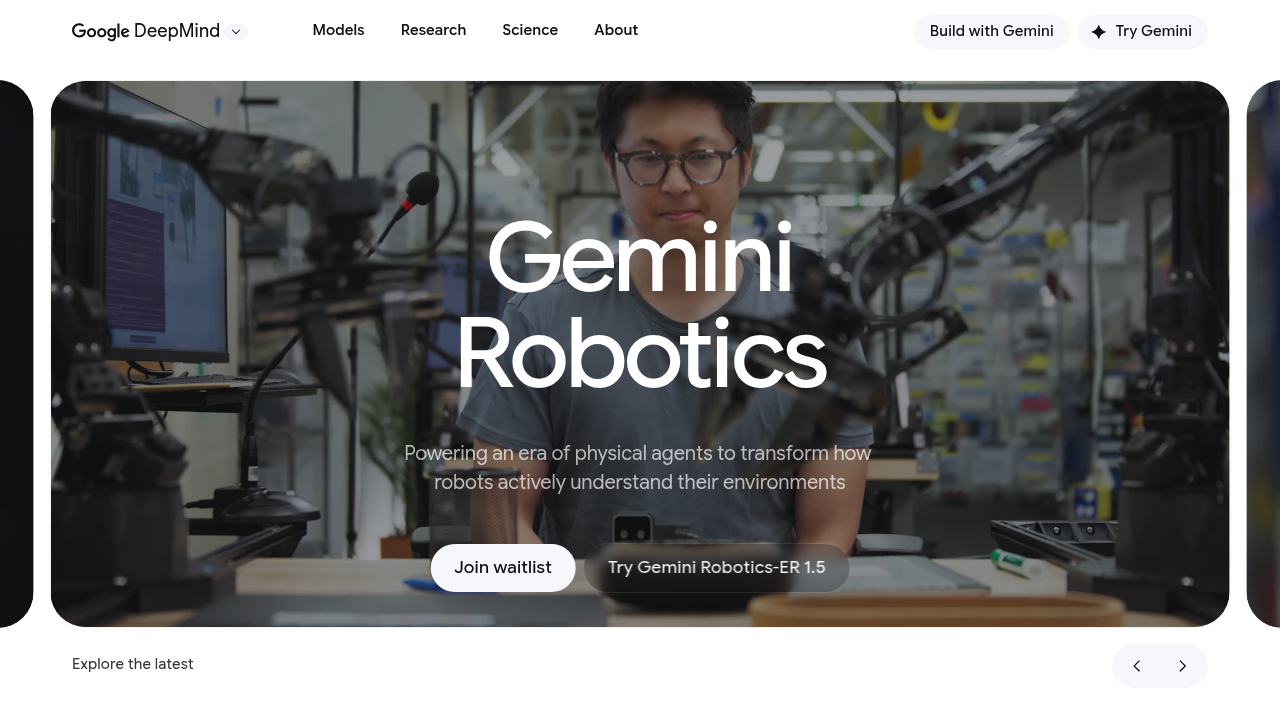
Google doesn't say how developers actually access this system or what hardware it runs on, which matters when you're building physical robots that need to work in real environments. The documentation lives alongside other research projects but skips implementation details that teams would need to deploy.
What's here centers on multimodal understanding for robotics. The system processes visual input, reasons close to physical tasks, manipulates tools, and responds to interaction. That's the core capability set: perception feeding into reasoning feeding into action. It's built for robots that need to understand their surroundings and make decisions about what to do next.
The positioning is interesting. Google lists this under world models and embodied AI, which suggests it's focused on robots that build internal representations of their environment rather than just following preset commands. It also appears in their breakthroughs section, indicating they consider this research-grade work rather than a production API.
Target use is robotics applications and what Google calls "next-generation helpful robots." That's vague but points toward assistive robots rather than industrial automation. Think robots that need to adapt to home environments or assist people, not factory arms repeating the same motion.
The gap between announcement and deployment path remains wide. There's no mention of how robotics teams would integrate this, what compute requirements look like, or whether this is something you can test today or just read about. For researchers tracking where robot intelligence is headed, it maps the capability territory. For teams building robots now, it's less immediately useful without access details or technical specifications about running the system.