
Unitree H1 logo

Unitree H1

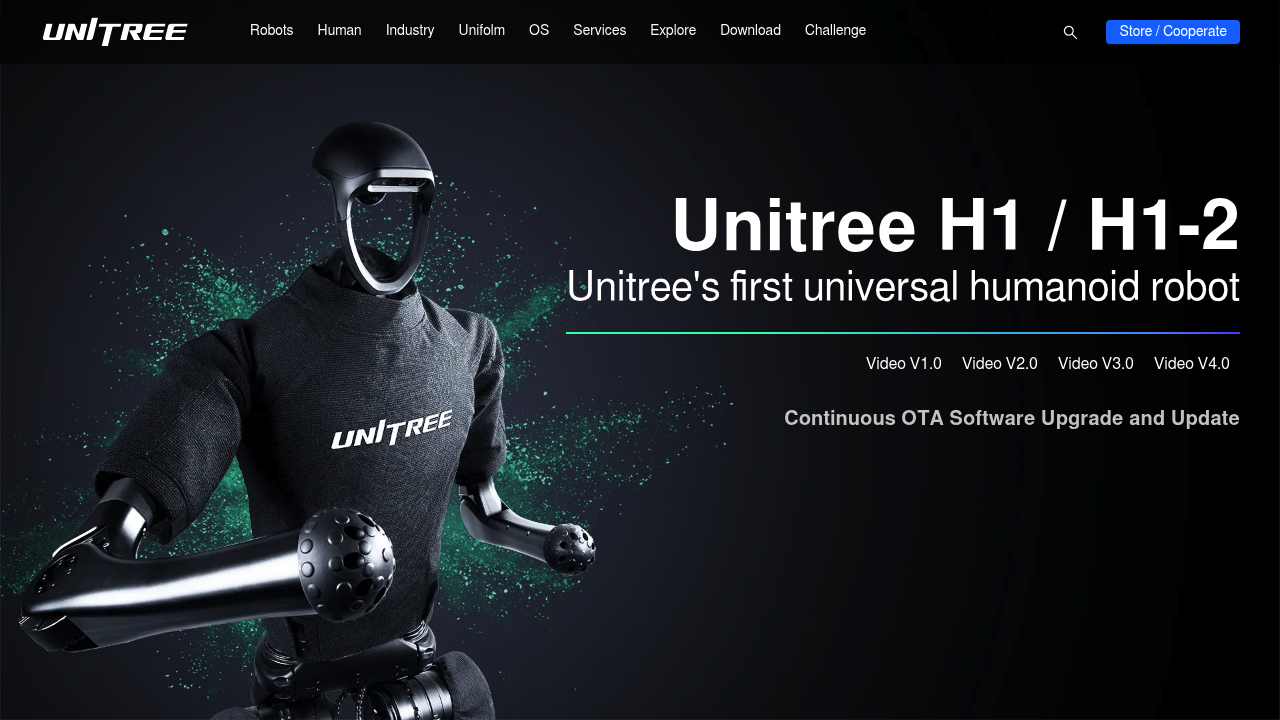
Unitree H1 is a full-size general-purpose humanoid robot from Unitree Robotics.

It stands about 180cm tall, weighs roughly 47kg and reaches a moving speed of 3.3 m/s, with potential mobility above 5 m/s. Joint motors deliver up to 360 N.m of torque with a peak torque density of 189 N.m/Kg, and a…

Unitree H1 screenshot

Unitree H1 is a full-size general-purpose humanoid robot from Unitree Robotics. It stands about 180cm tall, weighs roughly 47kg and reaches a moving speed of 3.3 m/s, with potential mobility above 5 m/s. Joint motors deliver up to 360 N.m of torque with a peak torque density of 189 N.m/Kg, and a 864Wh battery can be swapped quickly. A 3D LiDAR plus depth camera gives 360-degree depth perception. The H1-2 variant weighs about 70kg and offers 27 degrees of freedom with 7-DOF arms.

Robotics researchers, university labs and engineering teams are the intended users, since the robot ships with Intel Core i5 compute for platform functions and Intel Core i7 for user development, with optional Orin NX modules. Developers who want to write locomotion or manipulation software can add optional dexterous hands such as the Dex5-1. Unitree notes the humanoid industry is in an early stage and advises individual buyers to understand the limits of the machine before purchase.

Typical projects involve gait and balance research, perception and navigation experiments using the LiDAR and depth camera, and manipulation studies with dexterous hands attached. The H1 suits dynamic tasks that demand speed and power, while H1-2 targets work needing more arm freedom and a higher payload, with arms rated at about 7kg and a peak of about 21kg. Continuous over-the-air software upgrades let teams keep a purchased robot current, and demonstrations of the robot running across complex terrain show its locomotion capability.

Unitree H1 alternatives

See all →

Frequently asked

6 questions
What can the Unitree H1 do?
H1 is a full-size humanoid that walks and runs autonomously across complex terrain. It reaches 3.3 m/s and senses surroundings with 3D LiDAR and a depth camera.
Who is the Unitree H1 for?
Researchers, labs and robotics developers who need a capable humanoid platform are the target. Compute options include Intel Core i7 and optional Orin NX modules for user development.
What practical experiments suit the H1-2 version?
H1-2 has 27 degrees of freedom and 7-DOF arms with about 120 N.m peak shoulder and elbow torque. That suits manipulation research, especially with optional Dex5-1 dexterous hands.
How long does the H1 battery last and can it be swapped?
The battery holds 864Wh (15Ah, up to 67.2V) and is quickly replaceable. Runtime figures are not stated on the page.
What limitations does the Unitree H1 have?
Moving speed on H1-2 is under 2 m/s, slower than the original H1. Unitree describes it as a civilian robot and asks users not to make dangerous modifications.
What does the H1 ship with for development?
Standard configuration is an Intel Core i5 for platform functions and an Intel Core i7 for user development. Continuous OTA upgrades keep the software current.

Reviews (0)

Write review

No reviews yet. Be the first to share your experience.