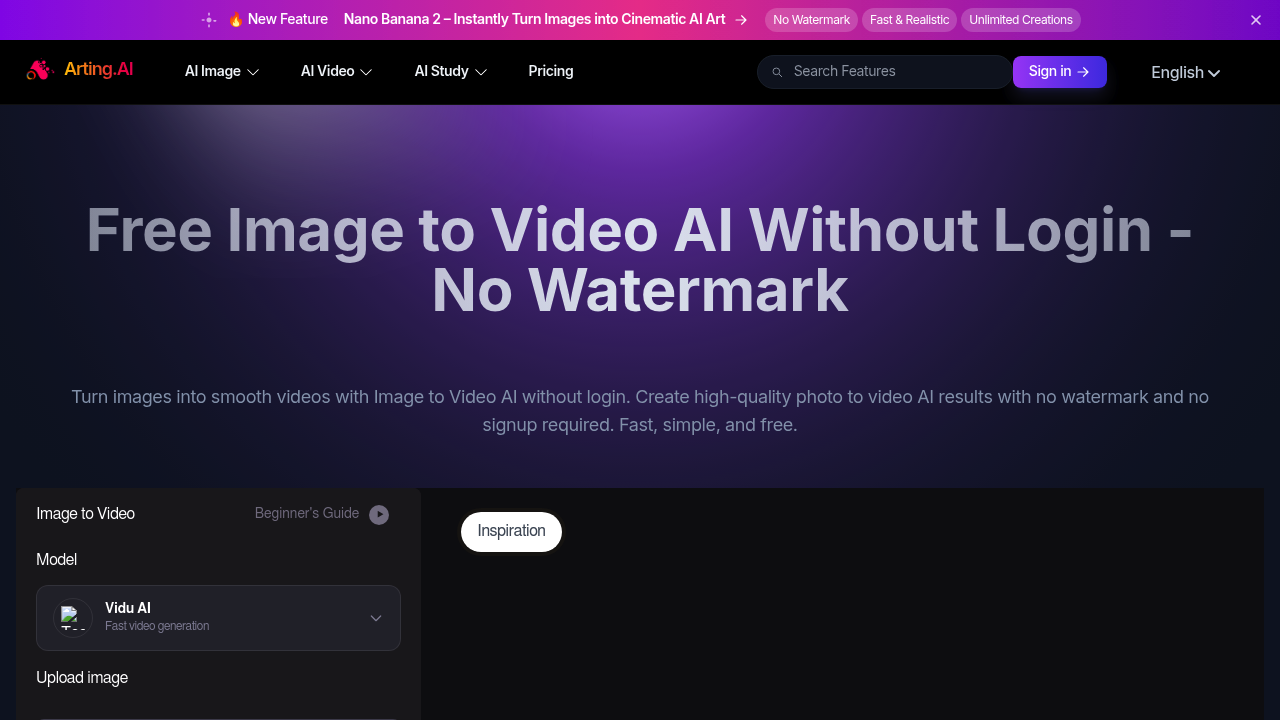
Arting.AI transforms static images into animated videos through a collection of advanced AI models. Users upload a photo, select from models like Kling 2.6, Veo 3, Runway Gen-4, or Seedance 2.0, then watch their still image come to life as smooth video footage. The service doesn't require login for basic use and doesn't stamp watermarks on generated content, removing two common friction points that slow down creative workflows.
The conversion process centers on flexibility. Creators choose between 5-second or 10-second video durations and pick from three aspect ratios: standard widescreen 16:9, vertical 9:16 for mobile platforms, or square 1:1 for social feeds. Text prompts guide the animation style and movement, accepting up to 2000 characters of instruction. Negative prompts work alongside these, letting users specify what to avoid in the final output with up to 500 characters of exclusions. This dual-prompt system gives precise control over how static elements should animate and what visual artifacts to suppress.
Audio generation adds another dimension. The Kling 2.6 model specifically creates cinematic videos with synchronized audio, turning silent animations into complete audiovisual pieces. The service calls this output "cinematic AI art," positioning the results beyond basic animation into more polished territory. A feature called Nano Banana 2 handles instant image-to-cinematic-art conversions, though specifics on how it differs from standard conversion aren't detailed.
The credit system governs usage. Each video generation consumes 35 credits from a user's balance. A free tier provides credits without payment, though the exact allocation isn't specified. Silver coins exist within the system's economy but can't be spent on video generation, creating a split currency system where only certain tokens enable the core feature.
Thirteen different AI models populate the selection menu. Beyond the mentioned Kling variants and Veo 3, options include Hailuo AI, multiple Wan versions (2.1, 2.2, 2.5), and Kling iterations spanning 2.0 through O1. Each model likely produces different animation styles, speeds, or quality levels, though those distinctions aren't documented. The sheer variety suggests users can experiment until they find the model that matches their aesthetic goals.
Video duration caps at 10 seconds maximum. That's enough for social media clips or quick animations but won't accommodate longer storytelling. Prompt length restrictions at 2000 characters should accommodate detailed instructions for most scenarios, while the 500-character negative prompt limit might feel tight when excluding multiple unwanted elements.
Content creators building social media assets, digital artists exploring motion, and video makers prototyping concepts form the natural audience. The no-watermark policy matters most to professionals who can't publish branded output.