
A podcast host records three hour-long interviews each week and used to spend eight hours manually transcribing them for show notes and social media clips. She uploads her audio files to Turbo Transcription AI, which converts them to text in minutes. She can grab quotes for Instagram, create blog posts from the content, and generate subtitles for video clips without replaying recordings over and over. The service handles MP3, WAV, MP4, M4A, and MOV formats through drag-and-drop uploads.
A legal assistant in a small law firm transcribes client consultations and depositions. She records meetings directly through the microphone feature, and the service converts everything to text with claimed 99% accuracy. She exports to TXT for case files or PDF for client records. The translation feature supports 130+ languages, helpful when the firm occasionally handles cases involving non-English speakers. She processes multiple recordings at once through batch transcription rather than handling them one by one.
A freelance journalist covers international stories and needs to transcribe YouTube interviews posted by news outlets in different languages. He pastes YouTube links directly into the system instead of downloading videos first. The service supports 100+ languages on higher plans and provides AI summaries that give him quick overviews before he reads full transcripts. He exports to SRT format when he needs subtitles for video projects.
The daily file limits create friction for heavy users. The Basic plan allows one file per day with a two-hour maximum, which does not work if someone needs to transcribe a three-hour conference panel. The Pro plan bumps this to ten files daily with three-hour maximums, but a documentary producer working with dozens of interview recordings would hit that ceiling fast. The Ultimate plan offers fifty files daily and four-hour maximums, though that $100 monthly price point targets professional operations rather than individual creators.
The 40-language limit on the Basic plan feels restrictive since competitors often include full language libraries at entry-level pricing. Someone transcribing content in less common languages needs to pay for Pro or Ultimate. The service doesn't mention team features, shared workspaces, or collaboration tools. A production company with multiple editors can't easily share transcripts or assign tasks within the system.
No API access appears in the feature list, so developers can't build the transcription into their own applications. The absence of mobile apps means working from a phone requires browser access. Someone recording field interviews on their phone can't quickly transcribe on the device itself.
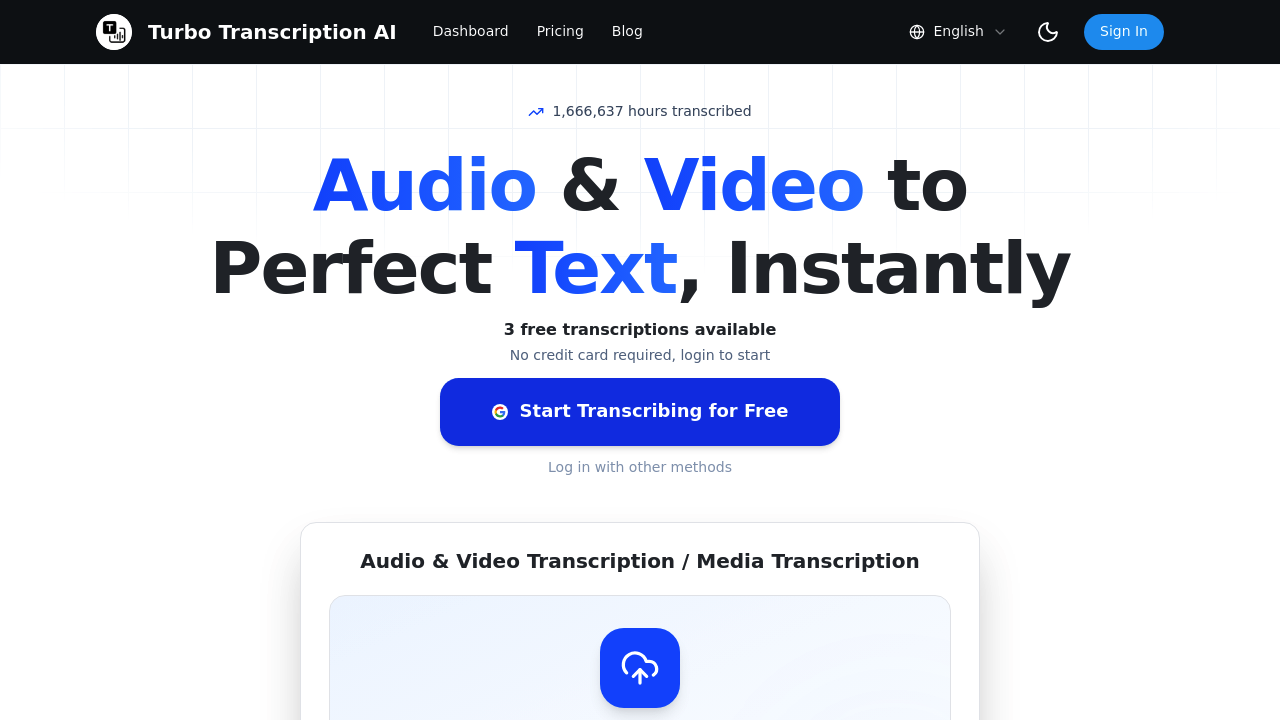
New users get three free transcriptions without entering payment information, enough to test accuracy and speed with real files. The Basic plan costs $16 monthly. Pro runs $20 monthly. Ultimate hits $100 monthly. The service claims over 1.6 million hours transcribed and 100,000+ users.
This works for content creators and professionals who regularly convert audio to text but don't need team collaboration or custom integrations. It doesn't fit agencies requiring API access, teams wanting shared workspaces, or anyone needing unlimited daily processing. The YouTube integration proves particularly valuable for journalists and researchers working with online video content, while the translation feature helps anyone dealing with multilingual recordings.