
A podcast producer records a two-hour interview with three guests and needs it transcribed by morning. She drops the MP3 into UniScribe, and the transcript appears in under two minutes with each speaker labeled separately. She exports it as a Word doc for her editor and generates a summary to pull quote highlights for social media. The mind map feature gives her a visual breakdown of topics discussed, which she uses to plan episode timestamps.
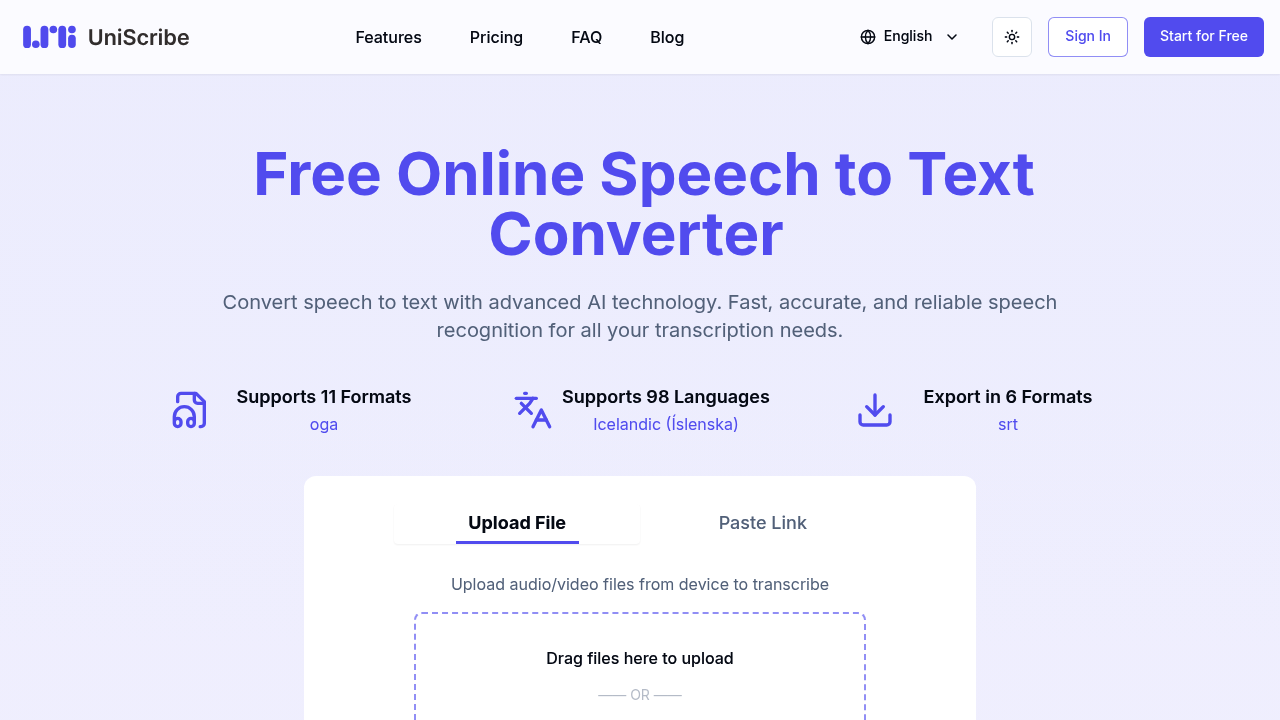
UniScribe converts audio and video files into text across 98 languages. It handles 11 different file formats from MP3s to MOV files, processes a one-hour file in under a minute, and spits out transcripts in six formats including SRT for subtitles and VTT for web video. You can paste a YouTube link directly instead of downloading the video first.
A market researcher conducts 40 customer interviews per month in Spanish and English. She uploads all the recordings at once using bulk transcription, gets speaker-labeled transcripts for each, and uses the Q&A extraction to automatically pull out every question she asked with the corresponding answer. The API integration feeds transcripts directly into her analysis software. Without bulk upload and speaker ID, she'd be manually sorting through hours of mixed voices.
The automatic summary and mind map features work best for structured content like interviews, lectures, or presentations. A creative writing professor records his lectures and uses the mind map to see how he covered different literary concepts throughout the semester. But these features struggle with casual conversations or rambling podcast discussions where topics bounce around.
Free tier problems show up fast. You get 120 minutes monthly, but files can't exceed 30 minutes each and you're capped at three files daily. Upload one file at a time only. The basic transcription model works fine for clear audio but misses nuances in accented speech or noisy environments. Media files disappear after 30 days, so you can't revisit old transcripts. No summaries, mind maps, Q&A extraction, speaker identification, YouTube links, or API access on free.
A legal assistant transcribing depositions needs the Premium model's better accuracy and speaker identification, which only comes with paid plans. The Basic plan at $6 monthly includes 1200 minutes, premium transcription, all the analysis features, and no file retention limits. That's $0.005 per minute. Standard runs $12 for 3000 minutes at $0.004 per minute. Pro gives 6000 minutes for $18 at $0.003 per minute. All paid tiers let you upload 50 files simultaneously with a 10-hour, 5GB cap per file. Annual plans cut costs by 40%.
A freelance video editor who transcribes maybe five short client videos monthly won't hit the free plan's limits. A content agency burning through hundreds of interview hours needs Pro or will rack up overage charges.
UniScribe doesn't integrate with project management software or cloud storage. No mobile app means you can't start transcriptions on the go. A journalist recording interviews in the field has to wait until she's back at her laptop. The shareable transcript links help collaboration, but there's no real-time editing or team workspace features.
UniScribe works if you need fast, multilingual transcription with automated content analysis. It doesn't work if you need tight integration with existing workflows or collaborative transcript editing. The free plan tests the waters. The paid tiers make sense once you're transcribing more than two hours weekly.