
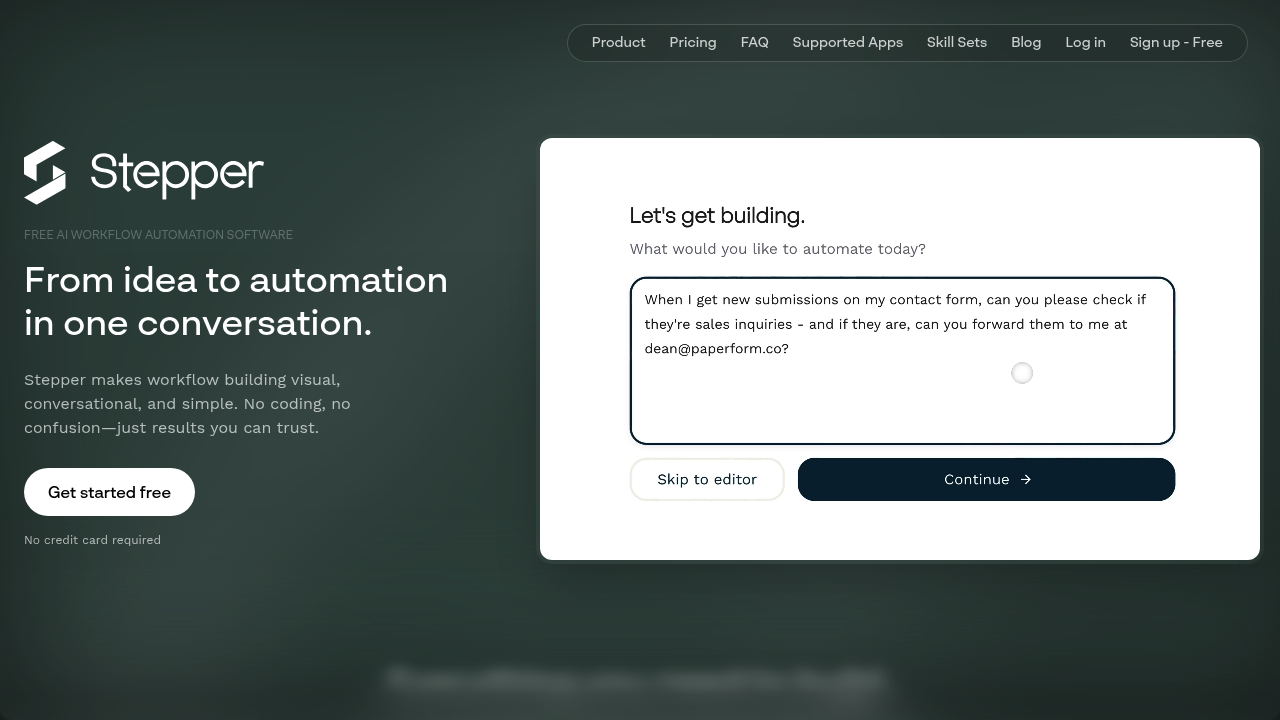
Building automated workflows traditionally requires either coding skills or wrestling with complex visual builders. Stepper takes a different approach by letting users describe what they want in plain language, then generating the workflow automatically. This tool combines a conversational AI editor with a visual interface for manual tweaking, allowing teams to create automation through natural language commands or drag-and-drop components. It connects to 227 applications including Gmail, Airtable, Slack, Asana, and ClickUp. The free plan includes unlimited workflows and 200 steps per month with 5,000 credits, while the $19 monthly Pro plan removes step limits and adds 15,000 credits. Users can bring their own API keys for AI services and email to cut costs further, and purchased credits never expire.
Stepper fits operations teams, sales coordinators, customer success managers, and small business owners who need to automate repetitive tasks but lack technical resources. It works for marketing teams handling content distribution and lead qualification, finance departments processing receipts and managing approvals, and support teams routing tickets and tracking responses. This solution suits companies looking for a more affordable alternative to traditional automation tools, particularly those running high-volume workflows where per-step pricing becomes expensive. Both technical and non-technical users can build workflows, though the conversational editor makes it especially accessible for those uncomfortable with traditional automation builders.
Stepper handles common business scenarios like qualifying inbound leads through AI analysis, automatically processing and categorizing expense receipts, sending notifications when tracked data changes, routing approval requests based on amount or type, and distributing meeting summaries to participants. Sales teams use it for pipeline automation and CRM updates, while customer success teams automate onboarding sequences and survey response analysis. HR departments build workflows for webinar registrations and employee onboarding, and legal teams manage contract reviews and signature routing. The modular component library means authentication flows, data lookups, and transformation logic can be built once and reused across multiple workflows, reducing setup time for similar processes.