
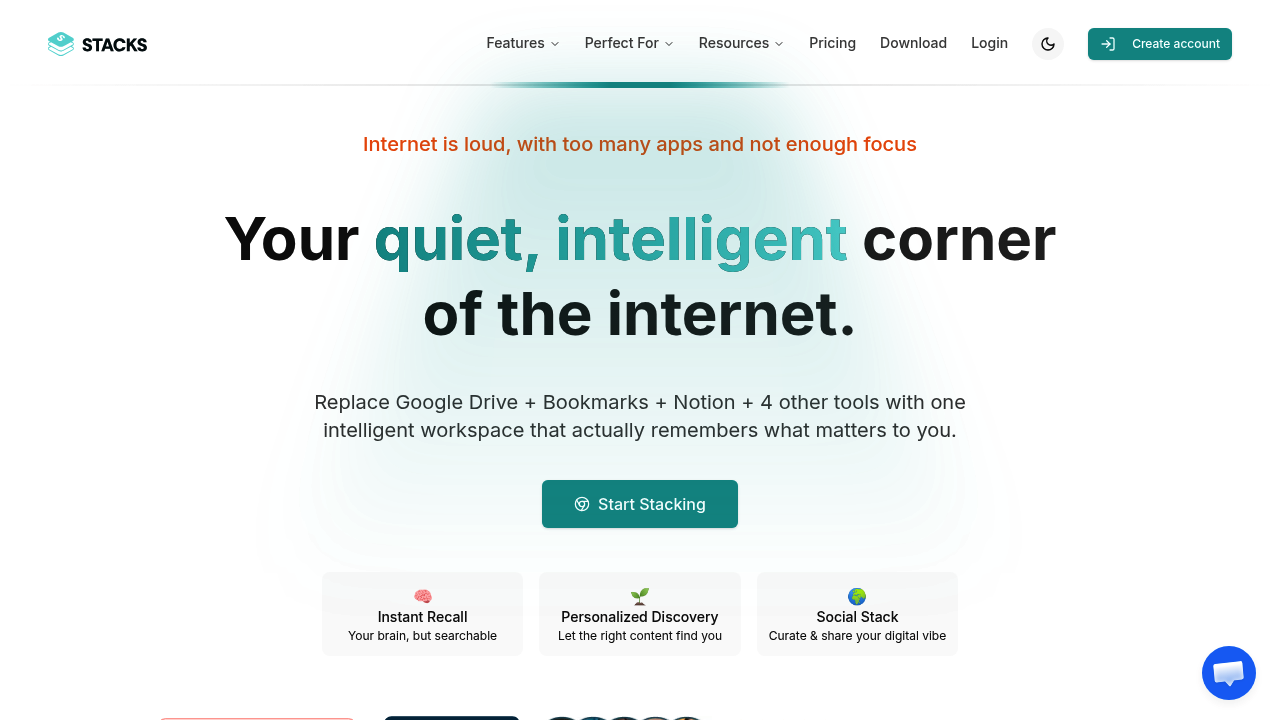
Stacks is a personal AI workspace that gathers what you find online into one searchable place. A browser extension saves pages, links, notes and files, and Stacks records the intent behind each save so later searches match what you meant rather than just a keyword. It aims to replace a mix of Google Drive, browser bookmarks, Notion, Pocket, Raindrop, Instapaper and screenshots folders. Collections can stay private or be shared publicly, and the AI surfaces links between items saved at different times.
Stacks suits people whose research happens across dozens of browser tabs. Students and academics writing a thesis can collect sources without building folder trees. Creators and indie builders can gather inspiration, references and competitor pages, then connect them into a body of work. Lifelong learners who follow niche topics can build a personal knowledge base just by browsing as usual. Small teams of two or twenty can use shared workspaces to keep a common library of links and notes instead of passing them around in chat.
A common routine is installing the extension, saving articles and pages while reading, and letting Stacks attach context to each one. Later, a natural-language search retrieves items by what you were trying to do, such as a startup idea, a literature topic or a gift list. Curators publish collections to share a reading list or reference set with an audience, while teams keep private stacks for project research. The mobile apps on the App Store and Play Store extend saving to a phone. Because content is organized by intent, scattered saves turn into reference material ready for writing or planning.