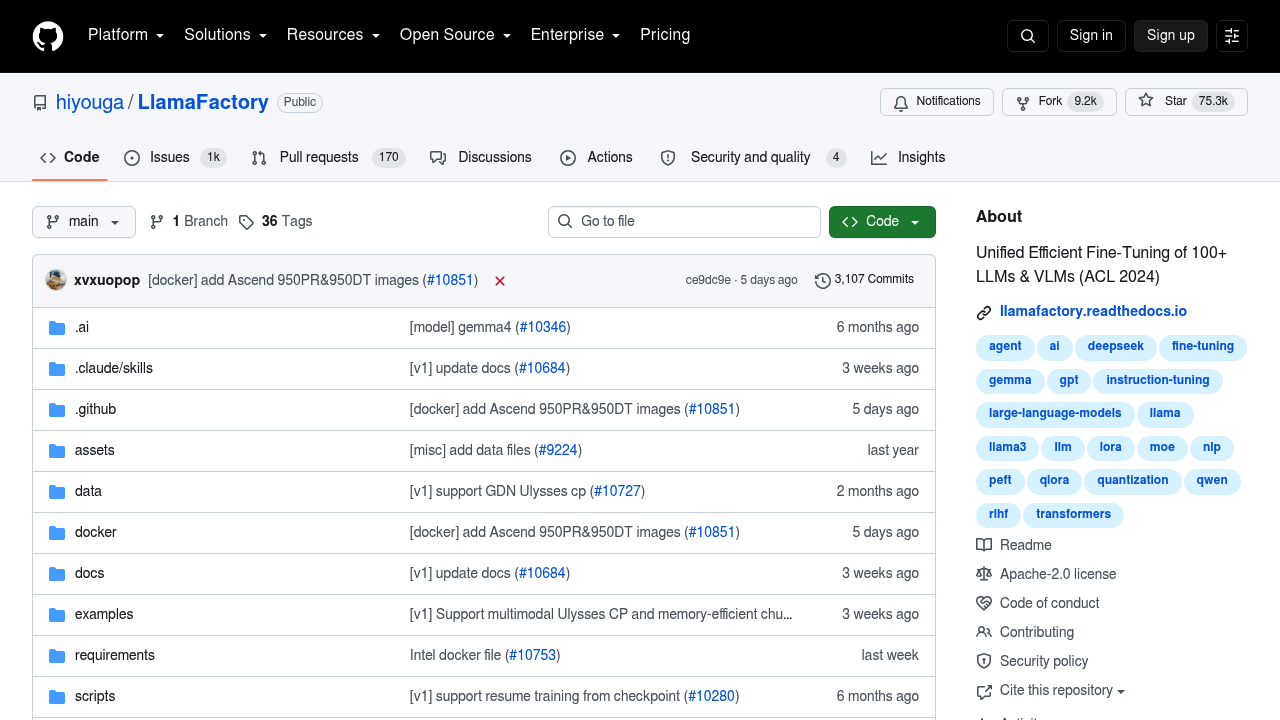
LLaMA-Factory is an open-source framework for fine-tuning more than 100 large language models and vision-language models. It offers a zero-code command line and a web interface called LLaMA Board built on Gradio. Supported training approaches include continuous pre-training, supervised fine-tuning, reward modeling, PPO, DPO, KTO and ORPO, with efficiency options such as full 16-bit tuning, freeze-tuning, LoRA and 2 to 8-bit QLoRA. The project is free to use from GitHub and the README lists Amazon, NVIDIA and Aliyun among its users.
It is built for machine learning engineers, applied researchers, startup developers and students who want to adapt open models to their own data without writing a training loop. People comfortable with a terminal can drive it by configuration files, while those who prefer a browser can use LLaMA Board. Teams with GPU, Ascend NPU or AMD hardware can run it locally, and those without can follow the Colab and cloud notebooks linked in the repository. Familiarity with datasets and model licensing helps.
A company can fine-tune Qwen3 or Llama on internal support transcripts, then deploy the result behind an OpenAI-style API using vLLM or SGLang. Researchers compare methods such as DPO, KTO and ORPO on the same base model, tracking runs in TensorBoard, Wandb, MLflow or SwanLab. Multimodal teams train on image, video or audio tasks with vision-language models like Qwen3-VL. Developers with limited memory use QLoRA, GaLore or Unsloth acceleration to fit larger models on small GPUs, and Docker images help reproduce setups across machines. Models can be downloaded from ModelScope or Hugging Face hubs.