
LangChain logo

LangChain

Framework for building with large language models
68 views
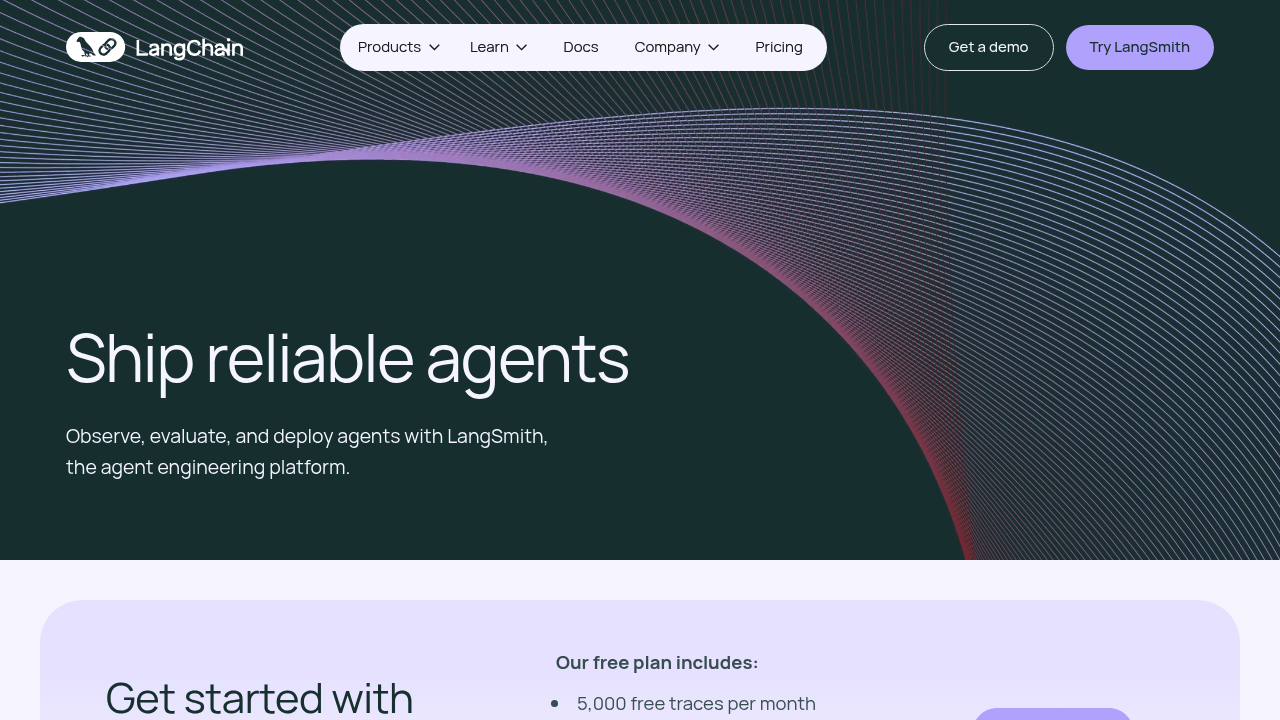
LangChain screenshot

Free. LangChain doesn't charge developers anything to use its open source framework for building AI agents. 90 million monthly downloads. Over 100,000 GitHub stars. It's the most downloaded agent framework available.

You get high-level abstractions that work with any model provider. OpenAI works. Anthropic works. Local models work too. LangChain handles the complexity of connecting different AI services through a unified interface. It supports over 1,000 integrations across various platforms and services.

Picture a DevOps engineer setting up automated incident response. They could use LangChain to build agents that pull data from monitoring tools, analyze logs with different language models, and escalate issues through Slack or PagerDuty. Less boilerplate code.

LangChain pairs with LangSmith for observability and evaluation — giving you visibility into how your agents perform. Part of a broader ecosystem that includes LangGraph for custom agents and Deep Agents for complex workflows. It serves over one million practitioners building everything from customer service bots to data analysis tools.

The popularity creates some noise in the community. Documentation can feel scattered across too many examples. But when you need to prototype quickly with multiple model providers, LangChain delivers the abstractions that save hours of integration work. Engineering teams pick it because it removes the friction of switching between different AI services while building production agents.

Frequently asked

6 questions
How does LangChain connect to different AI model providers like OpenAI and Anthropic?
LangChain gives you one interface that works with any model provider. Write your code once -- it'll work with OpenAI, Anthropic, or local models. No need to change your implementation when switching providers. The framework just handles all the API differences for you.
What's the difference between LangChain and LangSmith?
LangChain builds AI agents. LangSmith watches how they perform. Think of LangSmith as your production monitoring tool -- it tracks metrics, helps debug issues, shows you what's happening under the hood. They're separate tools that work great together.
Can I use LangChain with my existing Python codebase?
Absolutely. It's just a Python library you can drop into existing projects. You get over 1,000 integrations with platforms you're probably already using. Instead of rebuilding everything, it cuts down on the boilerplate code you'd normally write.
Why do some developers complain about LangChain's documentation?
Too much success, honestly. With 100,000+ GitHub stars and millions of users, there's content everywhere -- but it's scattered. The community creates tons of examples and tutorials. Sometimes you'll dig through multiple sources just to find the specific pattern you need.
What types of applications work best with LangChain?
Agent-based apps that connect multiple services work great. Automated incident response, customer service bots, data analysis tools pulling from various APIs. It's perfect when you're prototyping fast or need to switch between different AI providers without rewriting everything.
How does LangGraph fit into the LangChain ecosystem?
LangGraph handles the complex workflow stuff. LangChain gives you the basic building blocks for AI services. LangGraph focuses on sophisticated agent behaviors -- multi-step workflows, custom logic flows. Same toolkit, but LangGraph's for when you need more advanced agent architectures.

Traffic

Estimated monthly website visits · last 4 months

2.8M visits/mo
Monthly visits
2.8M
↓ 13.3% MoM
Global rank
#13,107
US #10,870
Category rank
#39
Development & Code
3.2M 3.1M 3M 2.9M 2.8M Nov 2025: 3M visits Nov 2025 Dec 2025: 2.9M visits Dec 2025 Jan 2026: 3.2M visits Jan 2026 Feb 2026: 2.8M visits Feb 2026

Data from SimilarWeb · Updated monthly.

Reviews (0)

Write review

No reviews yet. Be the first to share your experience.

Similar tools

See all →