
A training API that hands control of model fine-tuning to researchers while someone else deals with the servers and scaling headaches. Tinker focuses on LoRA fine-tuning for open source language models, letting developers write code that controls forward passes, backward passes, weight updates, and token generation without wrestling with infrastructure setup.
The core functions work like building blocks. forward_backward runs training passes with gradient accumulation. optim_step updates model weights. sample generates tokens for testing or reinforcement learning. save_state checkpoints progress so training can pick up where it left off. Behind these functions, Tinker schedules jobs, tunes hyperparameters, manages resources, and orchestrates distributed training across GPU clusters. The API also serves checkpoints for download once training wraps up.
LoRA makes this practical. Instead of retraining every parameter in a large model, LoRA trains a small add-on layer that sits on top of the frozen base model. The company claims this matches full fine-tuning performance while cutting compute requirements. That matters when models range from 1B parameters up to 235B parameters. The supported roster includes models like Llama-3.2-1B and Qwen3-235B-A22B-Instruct, covering supervised learning and reinforcement learning setups.
Full control over data and algorithms comes at a cost. Tinker only works with LoRA right now. No full fine-tuning. The model list limits options to specific open source models they've whitelisted. Can't just plug in any model. Access requires signing up first, so there's a barrier before even testing the API.
The abstraction works for a narrow audience. Researchers who know exactly what training loop they want but don't want to babysit GPU clusters. Developers building custom fine-tuning pipelines who'd rather write algorithm code than infrastructure code. Teams that need their data to stay under their control while still getting managed compute resources.
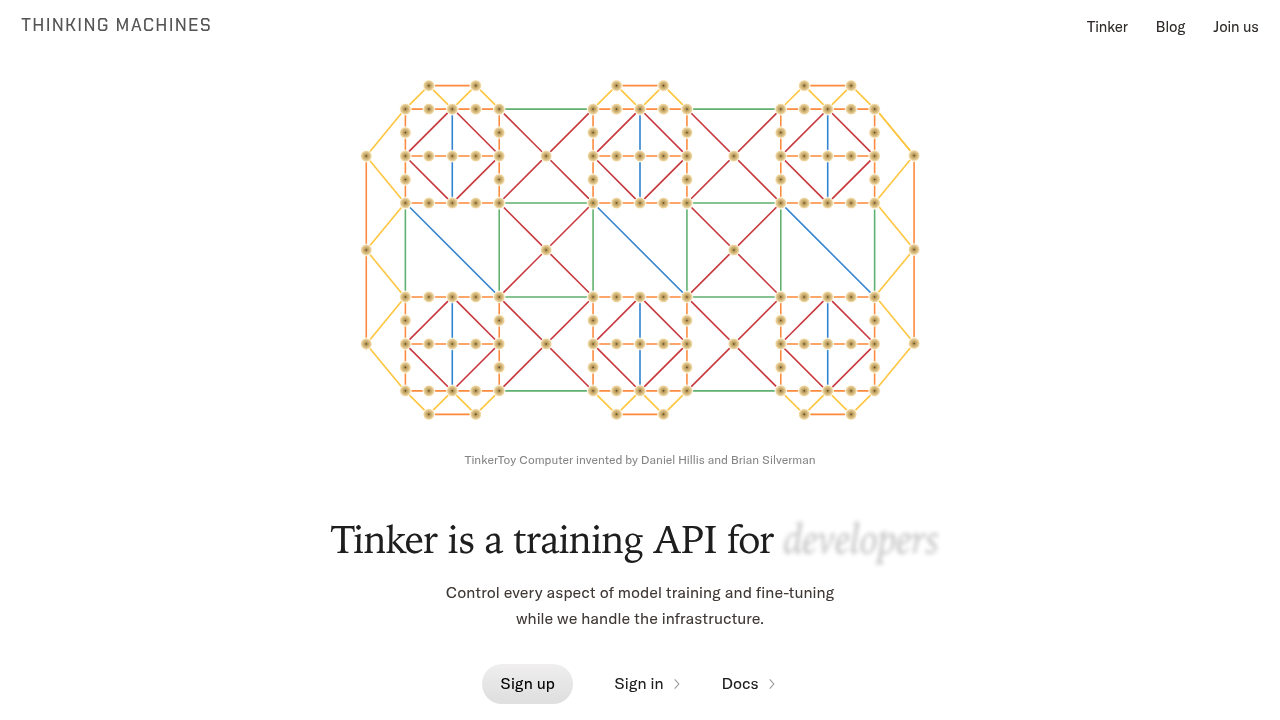
The name references the TinkerToy Computer, an old mechanical device that played tic-tac-toe. The parallel makes sense. Just as TinkerToys abstracted away the complexity of building logic circuits, this API abstracts away the engineering overhead of distributed training. Whether that abstraction holds up under production workloads depends on how well the managed infrastructure actually performs. The pitch sounds clean. Reality tends to introduce edge cases.
API access exists with team features aren't documented. No mobile app or browser extension. The focus stays purely on training workflows through code.