
RunPod logo

RunPod

Cheap GPUs on demand

63 views
Visit runpod.io
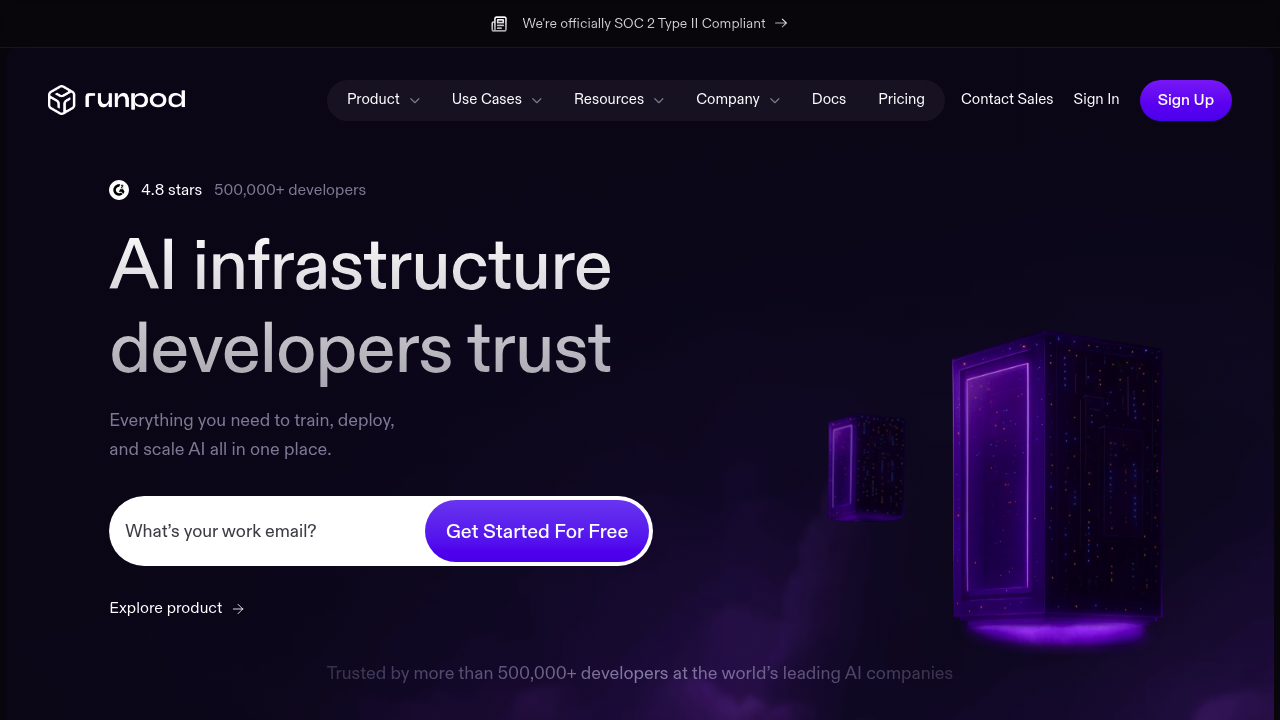
RunPod screenshot

Pay only for what you use down to the millisecond. RunPod bills GPU cloud computing by the millisecond — this matters when you're running inference workloads that spike unpredictably. Most cloud providers lock you into hourly minimums.

The learning curve isn't steep if you've worked with cloud infrastructure before. You can spin up serverless endpoints without managing servers. Deploy instant multi-node clusters when training demands scale. RunPod Hub makes discovery simple. It handles deployment of pre-configured environments too.

Machine learning engineers prototyping new models will appreciate the flexibility. Say you're testing different inference configurations for a computer vision pipeline. You can deploy multiple serverless endpoints. Run your tests. Shut everything down without paying for idle time.

Serverless endpoints handle the variable workloads that kill fixed pricing models. RunPod automatically scales based on demand.

RunPod targets developers, researchers, and AI companies who need GPU compute without the overhead of managing hardware. You're not buying servers or committing to long-term contracts. The pay-per-use model works well for experimental workloads but can get expensive if you're running consistent high-volume inference.

Cloud GPUs become available on demand through the instant clusters feature. You won't find the hand-holding that some managed AI services provide. RunPod expects you know what you're doing with GPU workloads and container deployments.


Frequently asked

6 questions
How much does RunPod actually cost compared to AWS or Google Cloud for GPU compute?
RunPod's millisecond billing can save you tons if you've got intermittent workloads -- you're not paying for idle time. Traditional cloud providers hit you with hourly minimums, so you'll pay for 60 minutes even if you only use 5. The savings really depend on how you use it though. Consistent high-volume workloads? You might actually pay more on RunPod than reserved instances elsewhere.
What GPU types can I access through RunPod's instant clusters?
You can get RTX series, Tesla, and A100s through their instant cluster feature. The specific models available change based on their network capacity and demand. Just check real-time availability and pricing in their dashboard before you spin up resources.
Can I run custom Docker containers on RunPod or am I limited to their pre-built environments?
You can totally deploy your own custom Docker containers -- you're not stuck with RunPod Hub's pre-configured environments. This gives you full control over your software stack and dependencies. The platform expects you to handle container configuration yourself though (there's no managed service layer hiding the technical details).
Does RunPod offer any data persistence between serverless function calls?
Nope -- RunPod's serverless endpoints are stateless by design. Data doesn't stick around between function calls. You'll need to set up your own storage solution using their network volumes or external storage services. That's pretty typical for serverless architectures, but definitely something to plan for.
What happens if my RunPod serverless endpoint gets a sudden traffic spike?
RunPod automatically scales your serverless endpoints based on incoming requests -- it'll spin up additional instances as needed. You only pay for the actual compute time used during the spike. The auto-scaling handles variable workloads without you lifting a finger, though cold starts might add some latency for the first requests.
How quickly can I deploy a multi-node training cluster on RunPod?
RunPod's instant clusters really live up to their name. You can typically deploy multi-node setups within minutes rather than hours. The exact time depends on GPU availability and your container size -- but once it's deployed, you get direct access to configure distributed training across nodes without platform restrictions.

Traffic

Estimated monthly website visits · last 4 months

1.9M visits/mo
Monthly visits
1.9M
↓ 2.3% MoM
Global rank
#21,835
US #17,503
Category rank
#42
Development & Code
1.9M 1.9M 1.9M 1.9M 1.8M Nov 2025: 1.8M visits Nov 2025 Dec 2025: 1.9M visits Dec 2025 Jan 2026: 1.9M visits Jan 2026 Feb 2026: 1.9M visits Feb 2026

Data from SimilarWeb · Updated monthly.

Reviews (0)

Write review

No reviews yet. Be the first to share your experience.

Similar tools

See all →