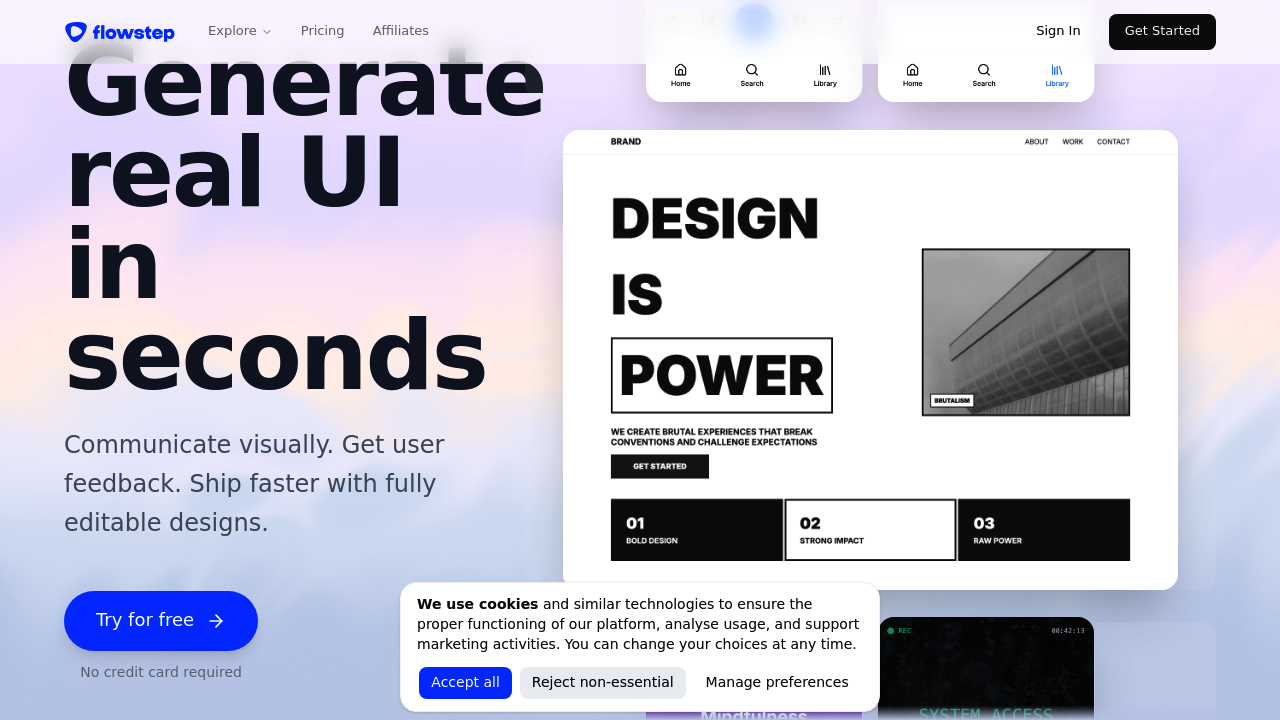
Flowstep turns text descriptions into fully editable, production-ready UI designs through an AI-powered chat interface. This platform generates complete user interfaces in seconds, handling everything from single screens to multi-screen flows like login pages, dashboards, and profile pages simultaneously. The generation happens through what the company calls its Imagination Algorithm, which processes natural language requests and outputs designs ready for immediate use.
The editing workflow combines AI assistance with manual control. Users can refine generated designs by chatting with the AI or making direct adjustments themselves. The design process accepts multiple input types as references — product requirement documents, uploaded images, or pasted links all help guide the AI toward specific visual directions. The infinite canvas workspace lets teams arrange and organize multiple screens without spatial constraints.
Collaboration happens in real time with visible cursors showing where team members are working. Edits sync across participants instantly, and feedback can be shared directly within the workspace. Flowstep positions itself as an eventual Figma replacement, though it currently integrates with Figma through a direct copy-paste mechanism. Users hit Command-C in Flowstep and Command-V in Figma without needing any plugin installation. Designs transfer immediately between the two platforms.
The code export capability produces React, TypeScript, and Tailwind CSS that matches the visual design one-to-one. Flowstep emphasizes that this code is production-ready and clean enough for engineers to actually use rather than just reference. This addresses a common gap where design-to-code tools generate output that developers discard in favor of building from scratch.
The free plan provides access to core functionality but caps messages, multi-screen generation capacity, and project counts. Starter plan costs fifteen dollars monthly and includes eighty messages per month with unlimited multi-screen generation, unlimited projects, unlimited exports, and unlimited Figma transfers. Enterprise pricing follows custom arrangements for larger teams needing advanced security, compliance features, dedicated support, or volume discounts. Monthly quotas reset on the first of each month while daily limits reset at midnight UTC.
Message limits affect how much users can interact with the AI generation system. Free users hit walls faster when iterating on designs or generating multiple variations. The eighty-message cap on Starter plan means heavy users might exhaust their quota before the month ends if they are running extensive design explorations or working on multiple projects simultaneously. Multi-screen generation restrictions on the free tier limit the ability to create complete user flows in single operations.
Product managers benefit from rapid prototyping without design skills. They can describe features in plain language and get visual representations that communicate concepts to stakeholders or development teams. Product designers gain speed on initial explorations and variations, though they'll likely want the unlimited multi-screen generation that comes with paid plans. Software engineers can generate UI scaffolding and receive code that integrates into existing React projects without translation work. Teams working across these roles get shared workspace benefits where everyone sees changes as they happen and can contribute feedback without switching tools or waiting for file exports.