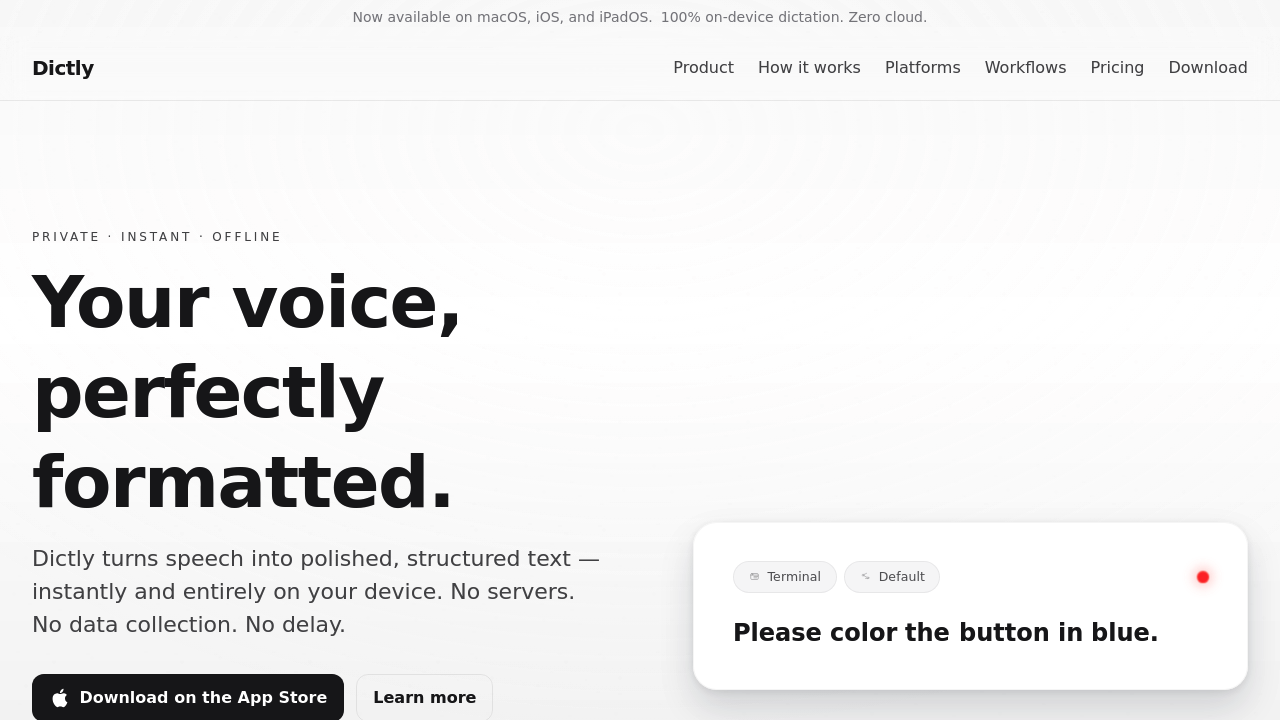
A consultant records meeting notes while switching between her email client and Notion workspace. She hits ⇧⌘D mid-thought, speaks naturally with a few "umms" scattered in, and watches structured text appear in real time—fillers stripped out, sentences formatted to match whichever app she's typing in. The Quick Capture overlay disappears after she pauses, text already inserted. She works on a plane with no WiFi. Same speed, same quality.
Dictly runs speech recognition entirely on-device for macOS and iOS. No cloud processing. The app converts speech to polished text in about 100 milliseconds on Apple Silicon, using roughly 50 MB of RAM and zero network bandwidth. A developer dictates code comments in VS Code, then switches to Mail to draft a response. Per-App Profiles detect the context switch and adjust formatting automatically—technical snippets get minimal processing, emails get full sentence structure and punctuation cleanup.
The processing pipeline works in stages. Raw speech chunks get cleaned first, then assembled into sentences, finally formatted at document level. Users customize this workflow through a visual pipeline editor, deciding which transformations apply when. Multiple insertion modes handle different scenarios: Type-out simulates keystrokes for apps that need it, Paste works for standard text fields, Clipboard copies without inserting. Auto-Submit pushes completed dictation into chat apps and productivity tools without manual confirmation.
Custom dictionaries let users add names, domain terms, and jargon that standard recognition misses. Full transcription history sits local with search functionality. Optional analytics track dictation trends and goals, also stored on-device. Markdown formatting support means technical writers can speak structure directly.
The app runs offline with identical performance. A macOS Network Inspector shows zero network calls during operation. Download size hits under 5 MB.
This works only on Apple Silicon for advertised latency, though Intel Macs run it slower. iOS and iPadOS supported, but no Android or Windows versions exist. CloudKit sync between devices isn't available yet, listed as coming soon. Users who need cross-platform dictation or already have cloud-based workflows won't find compatibility here. Teams looking for shared vocabularies or collaborative features should look elsewhere—this targets individual users who prioritize privacy and offline capability.
A security researcher dictates sensitive notes between air-gapped sessions. A writer drafts on long flights. Both get consistent results without connectivity dependencies. People comfortable with cloud services or needing Windows support should skip this entirely.