Defapi logo

Defapi

You know how managing multiple AI provider integrations usually means maintaining separate codebases for each vendor

? Defapi consolidates access to models from OpenAI, Anthropic, and Google through one API. Instead of juggling three different authentication systems and documentation sets, you write to a single endpoint. This service…

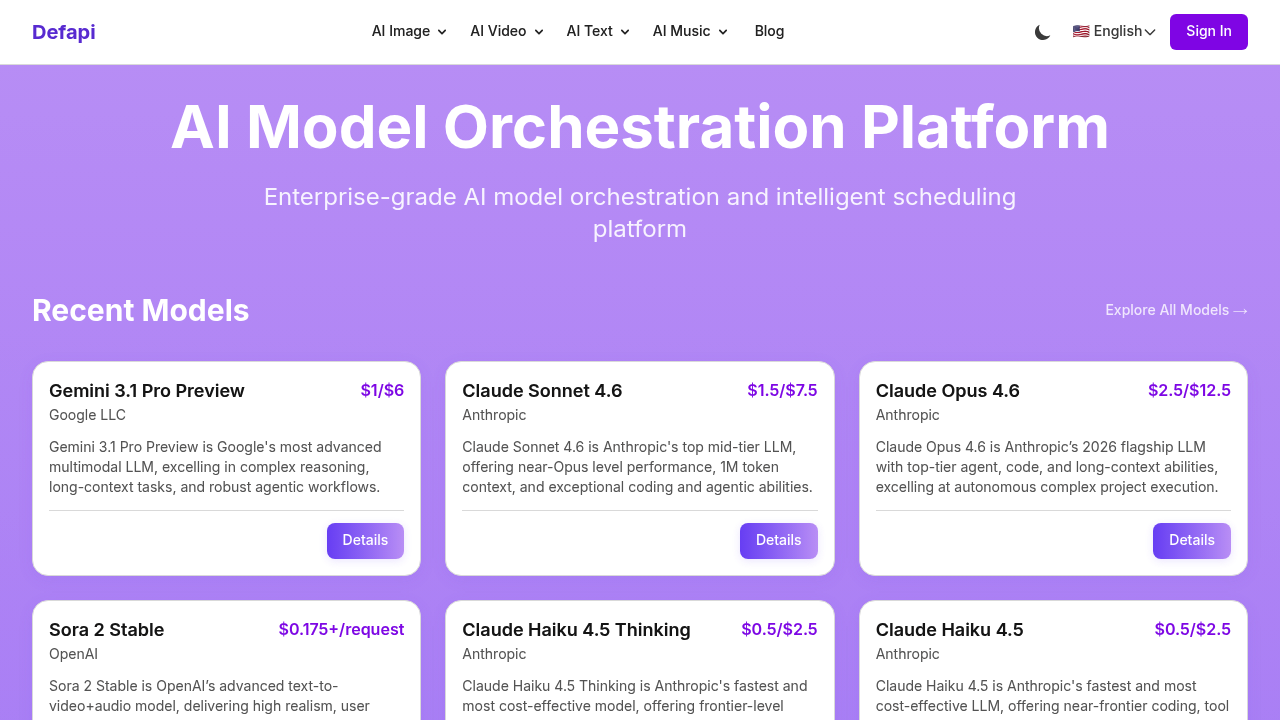
Defapi screenshot

You know how managing multiple AI provider integrations usually means maintaining separate codebases for each vendor? Defapi consolidates access to models from OpenAI, Anthropic, and Google through one API. Instead of juggling three different authentication systems and documentation sets, you write to a single endpoint.

This service handles intelligent routing and load balancing automatically. If one provider goes down or hits rate limits, your requests get rerouted without manual intervention. That's paired with multi-region deployment, so latency stays reasonable regardless of where your users are located. Real-time monitoring shows usage statistics across all providers, which beats logging into separate dashboards to track spending.

The unified API covers text generation, vision models for image tasks, and audio models for speech work. You get full-featured SDKs that abstract away provider-specific quirks. One customer claims they cut AI integration time by 80 percent. Another mentions building and launching an application in two weeks. Those numbers suggest the abstraction layer actually saves development cycles rather than adding overhead.

Does the abstraction hold up?

Multi-provider orchestration introduces a dependency layer. You're betting Defapi stays current with upstream API changes from all three vendors. When providers ship new parameters or model versions, there's lag time before they appear in Defapi's interface. This service also becomes a single point of failure—if their routing layer hiccups, you lose access to all providers simultaneously.

Enterprise security features are mentioned but not detailed in specifics. For regulated industries, you'd need to verify compliance certifications independently. The documentation quality matters here since you're learning a proprietary abstraction rather than native provider APIs.

The per-request pricing model is unusual. Rather than monthly subscriptions, you pay per API call with rates varying by model. Entry-level models start at one dollar per request. More capable options run up to twelve fifty. Audio generation begins at seventeen cents. This structure works if your usage is sporadic or you're prototyping across multiple models. It gets expensive fast with production-level traffic.

The math makes sense for developers evaluating which AI models fit their use case before committing to a specific provider. Startups building proof-of-concept applications benefit from the flexibility. Enterprises already locked into volume contracts with individual providers probably shouldn't add a middleman. Teams that hate vendor lock-in get genuine optionality. Just run the numbers against your expected request volume before assuming the convenience fee pays for itself.

Defapi alternatives

See all →

Frequently asked

6 questions
Does Defapi have a free plan or trial?
There's no free tier or trial period. The platform uses per-request pricing where you pay for each API call, starting at around one dollar for entry-level models. This structure works if you're running occasional tests or prototypes, but you're paying from the first request. Volume users with consistent traffic might find traditional provider subscriptions cheaper than accumulating per-call charges.
Can I use Defapi with OpenAI and Anthropic at the same time?
You access models from OpenAI, Anthropic, and Google through the same unified API. Write to one endpoint and the platform handles routing to whichever provider you specify in the request. That means you can test Claude against GPT without maintaining separate integration code for each vendor. The intelligent routing also switches providers automatically if one hits rate limits.
How much does it cost to use Claude or GPT through Defapi?
Pricing runs per request rather than monthly subscriptions. Claude Sonnet 4.6 costs $1.5 to $7.5 per call, while Claude Opus 4.6 runs $2.5 to $12.5. Entry-level models like Claude Haiku start at fifty cents. You'll need to calculate expected request volume against these rates—frequent production use gets expensive compared to buying credits directly from providers.
What happens if OpenAI or Anthropic changes their API?
This is where the abstraction layer creates risk. When upstream providers ship new features or change parameters, Defapi needs to update their interface to expose those changes. There's always lag time between a provider's release and when it appears in the unified API. You're also adding a dependency—if Defapi's routing layer has issues, you lose access to all providers instead of just one.
Who should use Defapi instead of connecting to AI providers directly?
Developers evaluating multiple AI models before committing to one provider get the most value. Startups building proof-of-concept applications save integration time without locking into a single vendor. One customer mentioned building and launching an app in two weeks instead of months. Enterprises with existing volume contracts probably shouldn't add a middleman unless avoiding vendor lock-in justifies the markup.
Does Defapi work for image generation and speech recognition?
The platform supports text, vision, and audio models through the unified API. You can handle image generation, speech recognition, and text synthesis alongside language model requests. All capabilities route through the same authentication and monitoring system. Just check which specific vision or audio models from each provider are available, since not every model variant might be exposed yet.

Traffic

Estimated monthly website visits · last 9 months

2.4K visits/mo
Monthly visits
2.4K
↓ 42.6% MoM
Global rank
#4,650,820
FR #497,863
Category rank
#62
AI API
17.7K 13.9K 10.1K 6.2K 2.4K Dec 2025: 11.1K visits Dec 2025 Jan 2026: 13K visits Jan 2026 Feb 2026: 12.4K visits Feb 2026 Mar 2026: 17.7K visits Mar 2026 Apr 2026: 9.4K visits Apr 2026 May 2026: 6.2K visits May 2026 Jun 2026: 7.6K visits Jun 2026 Jul 2026: 4.2K visits Jul 2026 Aug 2026: 2.4K visits Aug 2026

Reviews (0)

Write review

No reviews yet. Be the first to share your experience.