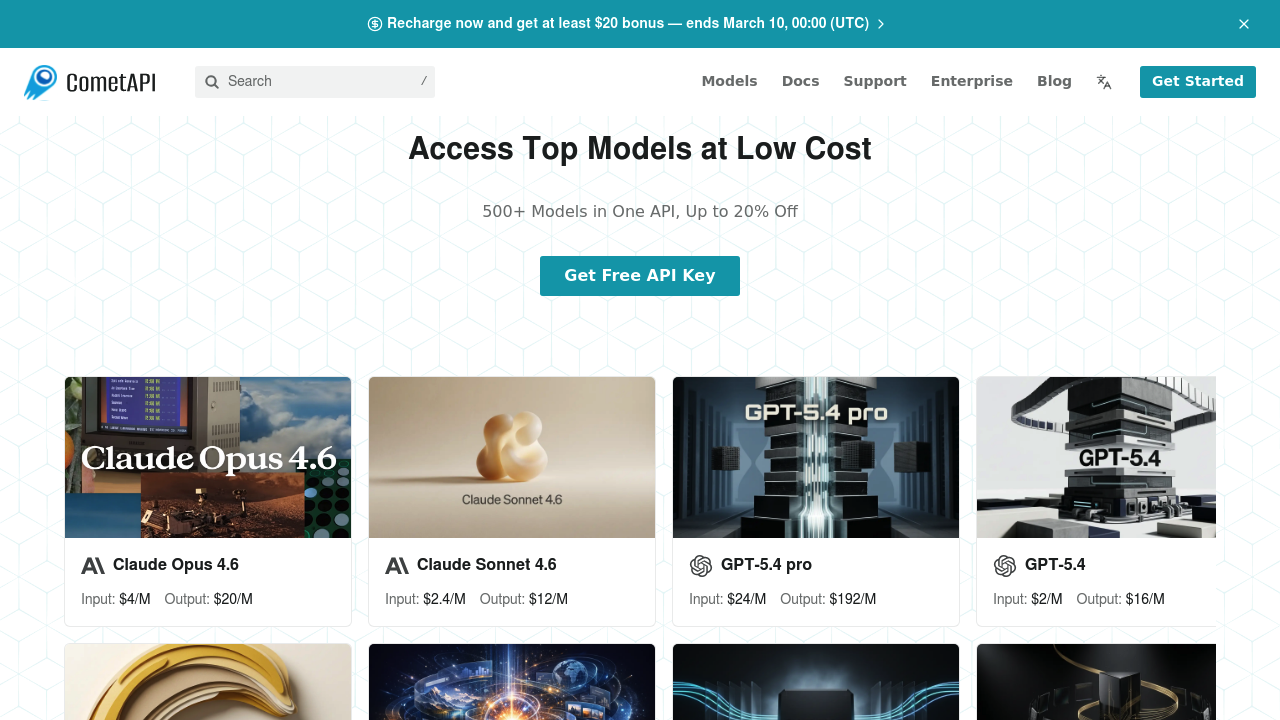
CometAPI functions as an aggregation layer that sits between your application and hundreds of AI model providers. Instead of managing separate API keys and authentication flows for each provider, you integrate once and access over 500 models through standardized endpoints. This system normalizes request and response formats across providers, which means you can switch from one text generation model to another without rewriting integration code.
The data pipeline works through a unified REST API. You send requests in OpenAI Chat format, which CometAPI translates into provider-specific formats behind the scenes. When you call an image generation endpoint, CometAPI routes your request to the appropriate provider, handles authentication, processes the response, and returns standardized output. This abstraction layer removes the need to learn different API schemas for each provider.
Model swapping happens at the configuration level. You can test different models against the same prompt through the built-in playground, compare outputs side by side, and analyze usage patterns without deploying new code. CometAPI includes response visualization tools that let you examine how different models handle identical inputs. This matters for prototyping because you can identify the optimal model for your use case before committing to production.
The SDK and Postman collection provide pre-built request templates for text generation, image creation, video synthesis, and music composition. Sample projects demonstrate integration patterns for common scenarios like chat interfaces, content generation pipelines, and multimodal applications. The playground environment allows you experiment with parameters before writing code.
For image generation, CometAPI routes requests to models including Nano Banana Pro and FLUX 2. Video generation connects to providers like Sora 2 and Veo 3.1, with pricing calculated per second of output. Music generation supports multi-segment composition and theme variations, producing royalty-free audio files. The multimodal capabilities combine these functions through the same API surface.
Pricing varies substantially by model and modality. Text generation runs from $0.2 per million input tokens for Nano Banana 2 up to $24 per million input tokens for premium models. Output tokens cost more, ranging from $1.2 to $192 per million depending on the model. Image generation with FLUX 2 MAX costs $60 per million requests. Video synthesis pricing ranges from $0.04 per second for basic models to $2 per request for premium options. A free API key gives you access to test CometAPI, and the pay-per-use structure means you only pay for actual model calls. There's currently a promotion offering at least $20 in bonus credit for recharges before March 10.
CometAPI integrates with OpenAI, Anthropic, Google, Aliyun, xAI, DeepSeek, Moonshot AI, and Black Forest Labs. Each integration maintains the provider's native capabilities while exposing them through CometAPI's standardized interface. You're still calling the actual provider models, just through a unified gateway.
The technical trade-off here is latency. Every request passes through an additional network hop compared to calling providers directly. For applications where milliseconds matter, this overhead might be substantial. CometAPI also introduces a single point of failure. If CometAPI experiences downtime, you can't access any of your integrated models even if the underlying providers are operational. You're dependent on CometAPI's uptime and their relationships with model providers. Advertised discounts of up to 20% offset some costs, but you're still paying CometAPI's markup on top of base model pricing.