OpenRouter logo

OpenRouter

Every model, one endpoint

67 views
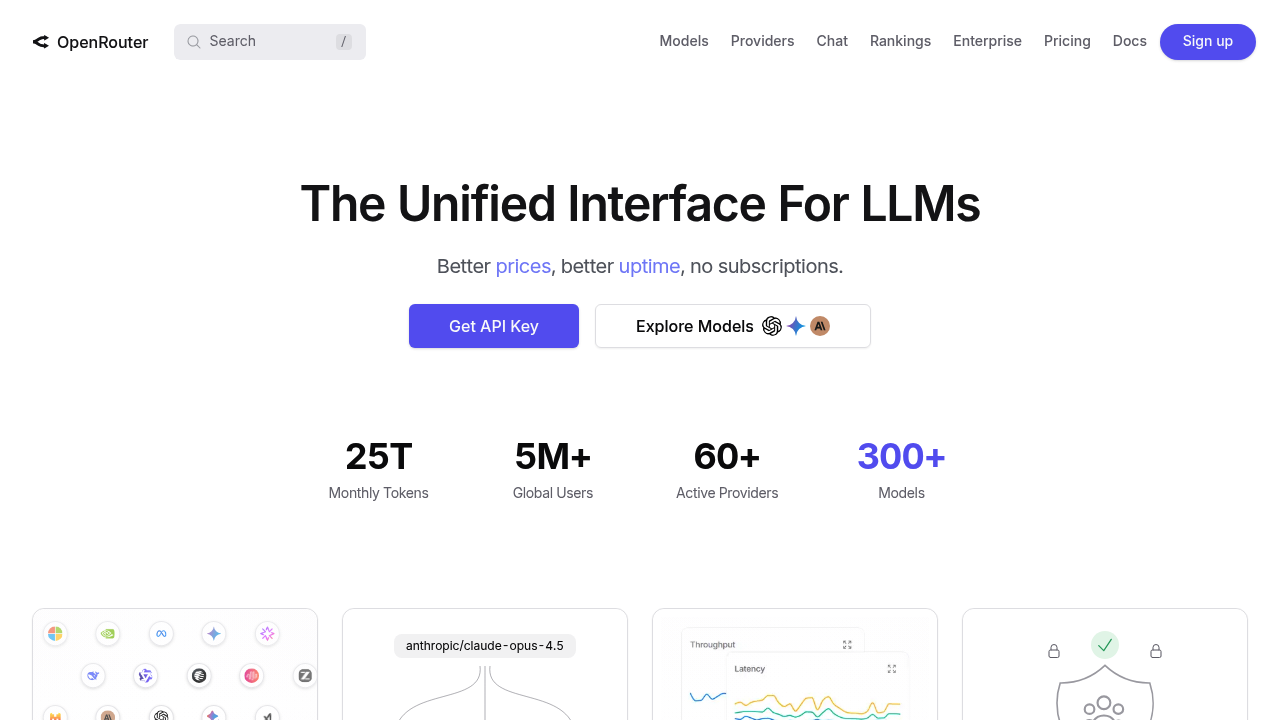
OpenRouter screenshot

Model responses from different providers vary wildly in quality and format. OpenRouter tackles this with Response Healing — it automatically fixes broken JSON responses before they hit your application. JSON defects drop by over 80%. No more malformed outputs crashing your code.

Getting started takes minutes if you're already using OpenAI's SDK. OpenRouter maintains full compatibility. You can switch providers without rewriting integration code. Drop in a new endpoint and API key. Done.

The learning curve stays flat even as your needs grow complex. Say you're a backend engineer at a fintech startup and your primary LLM provider goes down during peak trading hours. OpenRouter's automatic fallback kicks in. It switches to backup providers without any code changes on your end.

Access to 300+ models from 60+ providers means you can test different options without managing separate API keys. No separate billing accounts either. Credits work across any model or provider. Edge deployment keeps latency low regardless of which model you're hitting.

The credit system removes subscription headaches. Pay for what you use across any combination of models. OpenRouter handles the complexity of routing requests and managing provider relationships while you focus on building features.

Some developers might find the unified approach less granular than working directly with individual providers. For most teams juggling multiple AI services though, OpenRouter simplifies what's typically a mess of different APIs and billing systems.

Frequently asked

7 questions
How does OpenRouter's Response Healing actually work?
Response Healing spots broken JSON from AI models and fixes it automatically -- before it hits your app. It cuts JSON defects by over 80%. Here's what happens: it parses the response, finds structural problems, then corrects them instantly. No more crashes from wonky model outputs.
Can I use my existing OpenAI code with OpenRouter?
Yep! OpenRouter works with OpenAI's SDK completely. Just swap your endpoint URL and API key -- that's it. Your existing code doesn't need any changes.
What happens if my primary AI provider goes down while using OpenRouter?
OpenRouter's fallback system jumps in automatically. It switches to backup providers without you changing any code. This happens behind the scenes during outages, so your app keeps humming. Super helpful for mission-critical stuff that can't go down.
Do I need separate API keys for each of the 300+ models on OpenRouter?
Nope -- just one OpenRouter API key gets you into all 300+ models from 60+ providers. OpenRouter deals with all the individual provider relationships and API stuff for you. Plus you get one bill instead of juggling separate accounts everywhere.
How does OpenRouter's credit system work compared to monthly subscriptions?
You buy credits upfront and use them across any model or provider. Pay only for what you actually use (no fixed monthly fees). This rocks if you're testing different models or your usage bounces around.
What are the main downsides of using OpenRouter instead of direct provider APIs?
You lose some granular control compared to going direct with individual providers. Some advanced provider-specific features might not be available through the unified interface. Teams needing deep customization with specific providers -- direct integration could be better.
Does OpenRouter add latency to my AI requests?
OpenRouter uses edge deployment to keep latency low no matter which model you're hitting. The routing layer adds barely any overhead. Often performs better than managing multiple direct connections yourself -- response times stay competitive with direct access.

Reviews (0)

No reviews yet. Be the first to share your experience.

Similar tools

See all →