
ChatNode logo
AI Customer Service FREE TRIAL from $35/mo

ChatNode

ChatNode builds AI customer service agents that handle support queries and execute actions through API calls

The system crawls websites and ingests documentation to build a knowledge base, then uses this data to train conversational agents that can answer questions and perform specific tasks like booking calendar appointments,…

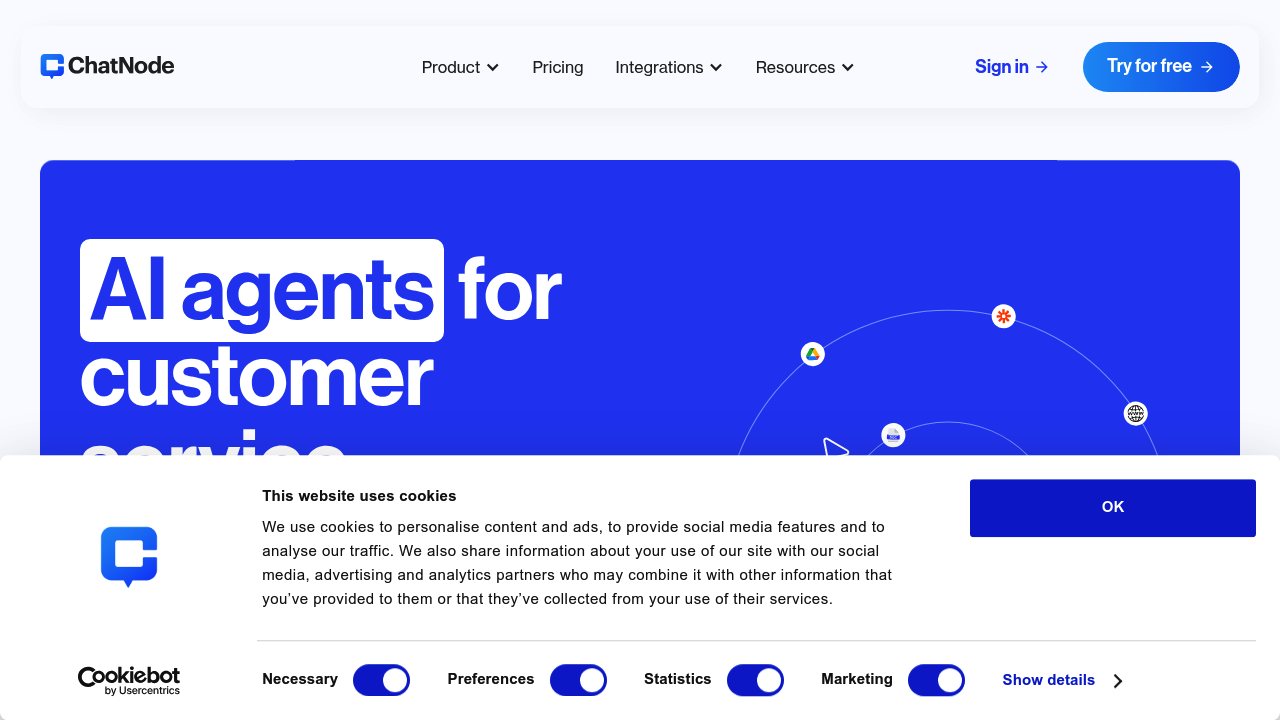
ChatNode screenshot

ChatNode builds AI customer service agents that handle support queries and execute actions through API calls. The system crawls websites and ingests documentation to build a knowledge base, then uses this data to train conversational agents that can answer questions and perform specific tasks like booking calendar appointments, pulling Stripe invoices, or updating CRM records.

The system works through a visual designer where you configure AI Actions, which are custom API endpoints the agent can call. When a customer asks to schedule a meeting, the agent doesn't just provide a link. It actually triggers a Calendly or Cal.com integration to show available slots and complete the booking. Same concept applies to billing queries where it pulls real invoice data from Stripe rather than giving generic answers. This action-oriented approach differentiates it from basic chatbots that only retrieve pre-written responses.

Training happens automatically. You point the system at your website URLs or upload documents up to 20 MB each, and it processes up to 12,500,000 characters per agent. The auto-retrain feature continuously updates the knowledge base as your content changes, though this capability is limited to Standard tier and above. The system doesn't require manual retraining cycles when you publish new documentation or update policies.

Context preservation works well during human handoffs. When the AI can't resolve something, it transfers the conversation to a human agent with full chat history intact. The human sees everything discussed so far, which eliminates the frustrating "let me start over" experience customers typically face with traditional support tools.

Multi-channel deployment means the same agent works across website embeds, Slack workspaces, and Notion pages. You're not maintaining separate configurations for each channel. The agent maintains consistent behavior and knowledge regardless of where customers interact with it.

Analytics track deflection rates, time saved per interaction, action success rates, customer satisfaction scores, popular topics, and geographic distribution of queries. These metrics help identify knowledge gaps and measure how often the AI resolves issues without human intervention.

Integrations connect through Stripe for billing operations, Calendly and Cal.com for scheduling, Slack and Notion for deployment channels, and unspecified CRM systems. API access lets you build custom integrations if the pre-built options don't cover your needs. This API capability is available across all paid tiers starting at the Lite plan.

The Lite plan costs $35 monthly and includes one AI agent with five actions and 1,250 credits per month. Standard runs $89 monthly with three agents, ten actions each, 12,500 credits, and three team members. Scale costs $377 monthly for eight agents, twenty actions each, 50,000 credits, five team members, custom domains, and white-label options that remove ChatNode branding. Enterprise pricing is custom with unlimited agents and team members. Yearly subscriptions save 17% and add two free months. A seven-day trial is available.

Over 3,500 companies use ChatNode. User ratings sit at 4.7 out of 5 and 4.5 out of 5 across review platforms.

Technical constraints include the per-file size cap of 20 MB and character limits per agent. Lower tiers restrict the number of AI Actions you can configure, which directly limits how many automated tasks each agent can perform. Team member limits on Standard and Scale plans may require workflow adjustments for larger support teams.


ChatNode alternatives

See all →

Frequently asked

7 questions
Does ChatNode have a free plan?
ChatNode doesn't offer a free plan, but there's a 7-day free trial to test the platform before committing. The cheapest paid option is the Lite plan at $35 monthly, which includes one AI agent with five actions and 1,250 credits per month. If you pay yearly instead of monthly, you'll save 17% and get two additional months free. All paid tiers from Lite upward include API access and unlimited file uploads, though individual files can't exceed 20 MB.
Can ChatNode book appointments and process payments automatically?
ChatNode executes real actions through API integrations rather than just providing links or instructions. When a customer requests a meeting, the agent directly calls Calendly or Cal.com APIs to display available time slots and complete the booking within the conversation. For billing queries, it connects to Stripe to pull actual invoice data, refund status, or subscription details instead of giving generic responses. These AI Actions work through custom API endpoints you configure in the visual designer, letting the agent perform tasks like updating CRM records or capturing lead information. The number of actions you can set up per agent depends on your plan, ranging from five actions on Lite to twenty on Scale.
How does ChatNode learn from my website content?
ChatNode crawls URLs you provide and ingests uploaded documents to build a knowledge base that powers the conversational agent. The system processes up to 12,500,000 characters per AI agent from sources like help documentation, product pages, and policy files, with individual file uploads capped at 20 MB each. On Standard tier and above, the auto-retrain feature continuously updates the agent's knowledge when your content changes, eliminating manual retraining cycles. Training data gets processed into a format the language models can reference during conversations, though the specific embedding methodology isn't disclosed in the documentation.
What happens when ChatNode can't answer a customer question?
The system transfers conversations to human agents while preserving full chat context, so the person taking over sees everything discussed up to that point. This handoff mechanism prevents customers from repeating their issue, which is a common frustration with traditional chatbot-to-human transitions. The analytics dashboard tracks how often these escalations occur through deflection rate metrics, helping identify knowledge gaps where the AI consistently struggles. Human agents can work alongside the AI across the same channels, whether that's the website widget, Slack workspace, or Notion page where the conversation started.
Can I use ChatNode on Slack and my website simultaneously?
The same AI agent deploys across website embeds, Slack workspaces, and Notion pages without requiring separate configurations for each channel. You're maintaining one knowledge base and one set of AI Actions that work consistently regardless of where customers start the conversation. This multi-channel approach means a customer could begin a support interaction on your website and later continue it in your Slack community with the agent maintaining context. The number of agents you can create depends on your plan, with Lite limited to one agent, Standard allowing three, and Scale supporting eight.
What are the credit limits on ChatNode plans?
Credits function as usage units that get consumed with each AI interaction, though the exact credit-to-message conversion rate isn't specified in the documentation. The Lite plan includes 1,250 credits monthly at $35, Standard provides 12,500 credits at $89, and Scale offers 50,000 credits at $377. Enterprise plans have unlimited message volume with custom pricing. These credit caps represent hard limits on your monthly usage, so you'll need to estimate your support volume and upgrade tiers if you consistently hit the ceiling. There's no rollover mechanism mentioned for unused credits between billing periods.
How is ChatNode different from regular chatbots?
Traditional chatbots follow pre-scripted decision trees and retrieve static FAQ responses, while ChatNode agents make API calls to execute actual tasks during conversations. When a customer needs an invoice, a regular chatbot might link to a billing portal, but ChatNode pulls the specific invoice from Stripe and displays it inline. The auto-retrain capability continuously updates the knowledge base as your documentation changes, whereas traditional chatbots require manual updates to their response libraries. Context-aware handoffs to humans preserve conversation history, and the analytics go beyond basic message counts to track metrics like deflection rates and action success rates that measure how often the AI actually resolves issues independently.

Traffic

Estimated monthly website visits · last 9 months

7.9K visits/mo
Monthly visits
7.9K
↓ 56.0% MoM
Global rank
#1,061,283
US #278,663
Category rank
#36
AI Customer Service
18K 14.7K 11.3K 8K 4.6K Dec 2025: 11.7K visits Dec 2025 Jan 2026: 6.7K visits Jan 2026 Feb 2026: 10K visits Feb 2026 Mar 2026: 9.2K visits Mar 2026 Apr 2026: 4.6K visits Apr 2026 May 2026: 10.4K visits May 2026 Jun 2026: 10.6K visits Jun 2026 Jul 2026: 18K visits Jul 2026 Aug 2026: 7.9K visits Aug 2026

Reviews (0)

Write review

No reviews yet. Be the first to share your experience.