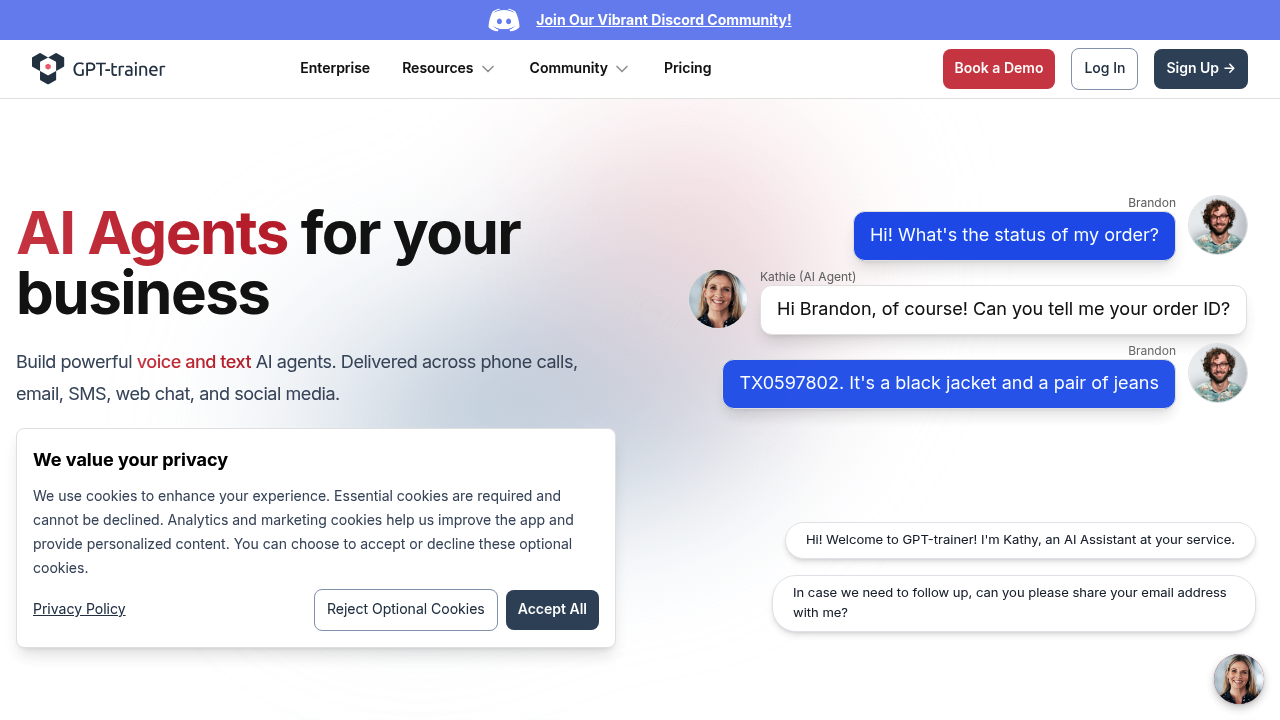
Build AI agents that actually talk to customers without writing code. GPT Trainer lets businesses deploy voice and text agents across phone calls, email, SMS, web chat, and social media. Over 1000 companies use it for customer support, lead qualification, employee training, and document analysis.
The voice capability impresses most. Under 500ms latency means conversations feel natural instead of clunky. You can run batch calling campaigns with managed concurrency for outbound work. The system handles follow-ups automatically and remembers context between interactions. When things get complicated, agents transfer to humans based on criteria you set.
The multi-agent framework works through a no-code interface. Feed it documents and it extracts insights. Connect your CRM through webhooks and get structured JSON data flowing out. You can integrate custom models if you want (fine-tuned or open source). White label support means you can brand it as your own tool.
Does the automation actually deliver? GPT Trainer claims 70% average resolution for automated support inquiries. That's solid but not perfect. Companies reportedly save over $250K annually when scaling customer success teams with these agents. The 99.9% accuracy number sounds impressive, though context matters. Accuracy at what exactly?
Here's where it gets restrictive. The Self-Serve tier caps you at 2 chatbots and 4 collaborators. That's tight for growing teams. You get 12000 message credits and 30000 voice credits monthly, but heavy usage will burn through those fast. Scale tier bumps you to 8 bots and bigger credit pools, yet neither tier includes an SLA commitment. Support on Self-Serve is minimal — just email and Discord.
The credit system itself creates planning friction. You need to estimate monthly conversation volume before you know if a tier fits. Run a sudden campaign and you might hit limits mid-month. Enterprise removes these caps entirely but pricing goes custom, which usually means expensive.
The free plan includes a 2-week Pro trial with pay-as-you-go afterward. You get API access from the start. That's useful. Self-Serve starts at $150 monthly, Scale runs $600. Enterprise brings dedicated hosting, full white label, forward-deployed engineers to build custom connectors, and compliance badges like SOC II and ISO 27001. Even source code availability.
Who actually needs this? Customer support teams drowning in repetitive inquiries benefit immediately. Sales teams qualifying leads can automate first-contact screening. HR departments handling common IT questions save hours weekly. Training programs can deploy teaching assistants that answer student questions around the clock.
The omnichannel approach matters more than it sounds. Customers start conversations on web chat, continue via SMS, then call in. Context carries through. That continuity prevents the frustrating "let me transfer you" loop where you repeat everything.
Document analysis and data standardization feel like add-ons but they are practical. Pull insights from contracts or invoices without manual review. Convert messy unstructured data into consistent formats. Not flashy. Just useful.
The real test is whether your use case fits the credit limits. Light usage on Self-Serve works fine. Heavy support volume or aggressive outbound calling pushes you toward Scale or Enterprise fast. Calculate your expected monthly interactions before committing. The system handles complexity well when you've got the right tier.