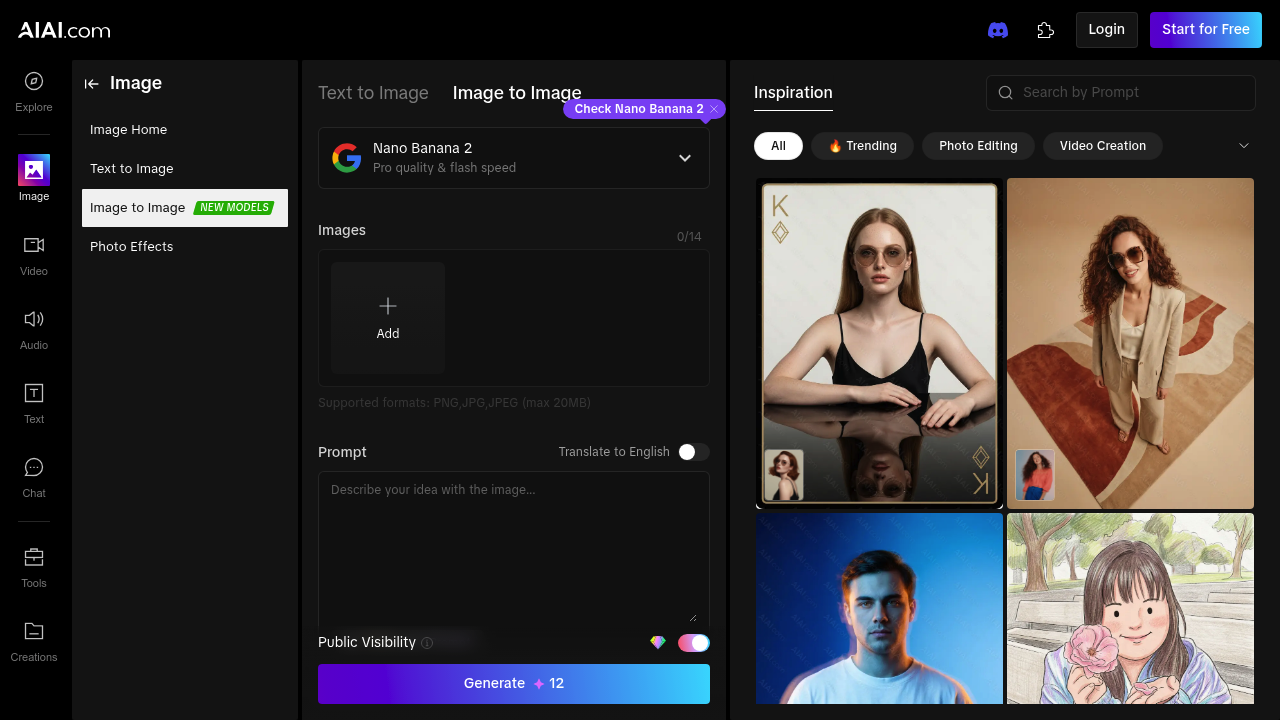
This tool processes uploaded photos through AI models to generate artistic transformations. You upload an image in PNG, JPG, or JPEG format up to 20MB, select a target style like anime, Pixar, Disney, oil painting, watercolor, or sketch, and the system outputs a stylized version. The underlying architecture uses LoRA models, which are fine-tuned adaptations that allow precise control over specific artistic characteristics without retraining entire base models. This approach lets the system handle diverse style transfers while maintaining detail fidelity.
The data pipeline starts with image ingestion and preprocessing. The system accepts aspect ratios from 1:1 to cinematic 21:9, plus a match-image option that preserves original proportions. Resolution selection happens before generation. Three tiers are available: 1K, 2K, and 4K. Higher resolutions demand more compute time but preserve finer details in the output. This application also includes prompt translation to English and a polishing feature that restructures user text into formats the model interprets more effectively.
Beyond single transformations, this service generates image variations. This creates multiple distinct outputs from one source photo and style selection. Each variation interprets the prompt and style parameters differently, producing alternatives without manual re-prompting. The variation engine works alongside the main image-to-image pipeline, using the same LoRA infrastructure but introducing controlled randomness in latent space sampling.
Output quality depends on resolution choice and source image clarity. 4K generations capture texture and detail better than 1K, but processing takes longer. The LoRA integration means style application can be quite specific. An oil painting style won't just add brush strokes but mimics lighting and composition patterns from actual oil paintings. Users can toggle public visibility for generated images, controlling whether outputs appear in community galleries.
The free tier provides access to core transformation features with a 14-image generation limit. Usage resets aren't specified in the technical documentation. No integrations with external platforms or APIs are documented. The system operates as a standalone web application.
Technical limitations are straightforward. File size caps at 20MB, which excludes very high-resolution source photos without compression. Format support stops at common web standards. No video or GIF input. The 14-image limit on free accounts constrains experimentation. Style options are predefined. You can't train custom styles or upload reference images for new artistic directions. Processing happens server-side, so generation speed depends on queue length and selected resolution. No batch processing for multiple images simultaneously.