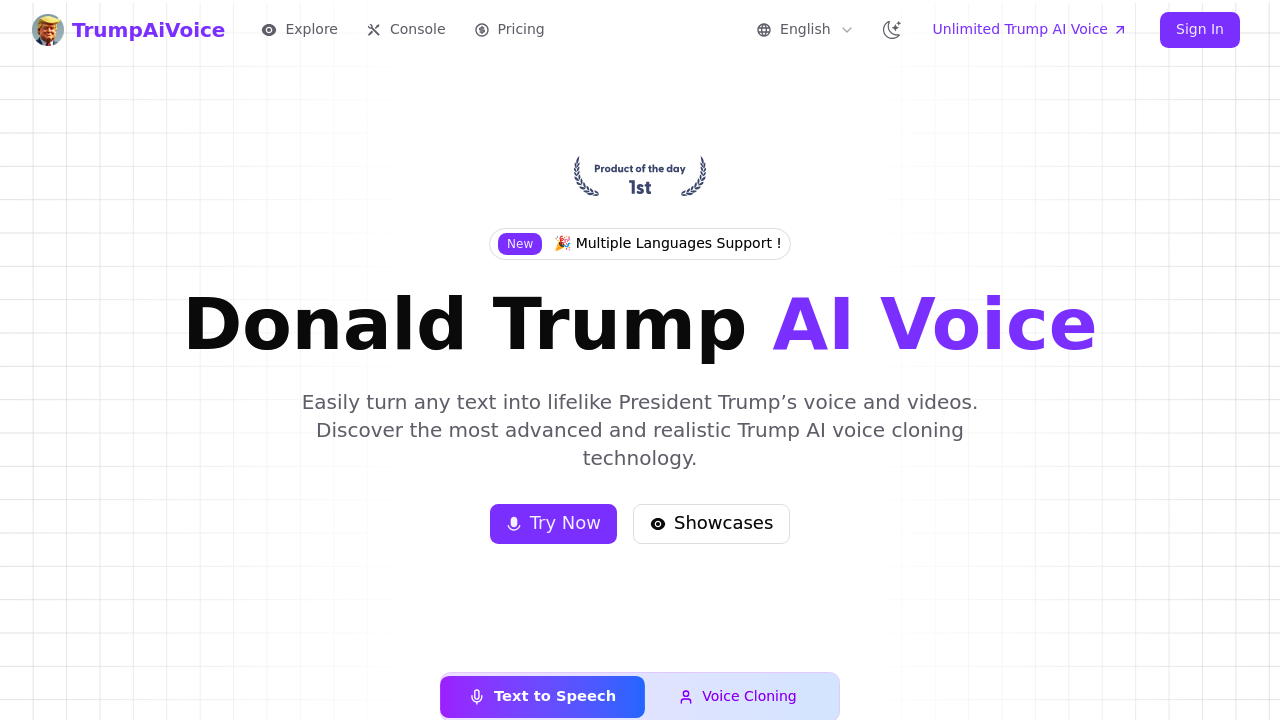
This service converts written text into audio and video content using AI-generated celebrity voices, with particular focus on Donald Trump's distinctive speech patterns. The system processes text input through neural networks trained on extensive speech datasets, analyzing phonetic patterns, intonation, and speaking cadence to produce synthetic voice output that claims 95% or higher accuracy in replicating Trump's vocal characteristics.
The technical pipeline starts with text optimization. Users can manually insert pauses using specific syntax markers or let the system automatically adjust phrasing. The voice synthesis engine then generates audio, matching not just the sound but the rhythm and emphasis patterns specific to each voice option. For video generation, this service offers multiple template environments including presidential office settings and outdoor scenarios. The system synchronizes generated audio with facial animations, mapping mouth movements and expressions to match the synthesized speech. This requires real-time rendering of facial geometry based on phoneme timing.
Processing happens server-side. Standard mode prioritizes speed, generating content in seconds. Eco Mode reduces computational intensity by 20% to save credits, extending processing time but maintaining output quality. The service reports 99.9% uptime for its generation infrastructure.
Beyond Trump, the voice library includes dozens of celebrity and politician options. Each voice model requires separate training on speech samples to capture unique vocal signatures. The system handles multiple languages, though the underlying methodology for cross-language synthesis isn't detailed in available information.
Generated content includes metadata tracking through a dashboard showing usage statistics and generation history. All data transmission uses encryption protocols, though specific implementation details aren't disclosed. Users can remove watermarks from output, but this requires upgrading to a Pro tier.
Video generation requires authentication. You can't produce video content without signing in. The Eco Mode trade-off is straightforward: slower processing for reduced credit consumption. This suggests the service operates on a credit-based system where computational resources directly correlate with user costs.
The voice cloning technology relies on neural network architectures that map text to acoustic features, then synthesize waveforms matching target voice characteristics. Accuracy depends heavily on training data quality and quantity. The 95% accuracy claim likely refers to listener perception tests rather than acoustic measurements.
The AI News Rewrite feature adapts existing content for voice generation, presumably reformatting text to better suit spoken delivery. The technical mechanism for this transformation isn't specified but likely involves text analysis and restructuring algorithms.