
A YouTube creator records 40-minute tutorials weekly but hates the sound of her own voice on camera. She's tried robotic text-to-speech tools before, but they made her educational content sound like a GPS system. She needs something that sounds human, can handle technical explanations without weird pauses, and won't require her to read scripts for hours to train it.
VoiSpark creates AI-generated voices that actually sound like people talking. Upload 15 seconds of any voice — yours, a friend's, or pick from 700+ options including celebrity voices — and it'll clone that voice for your content. This platform handles text-to-speech, voice cloning, and voice changing all in one place.
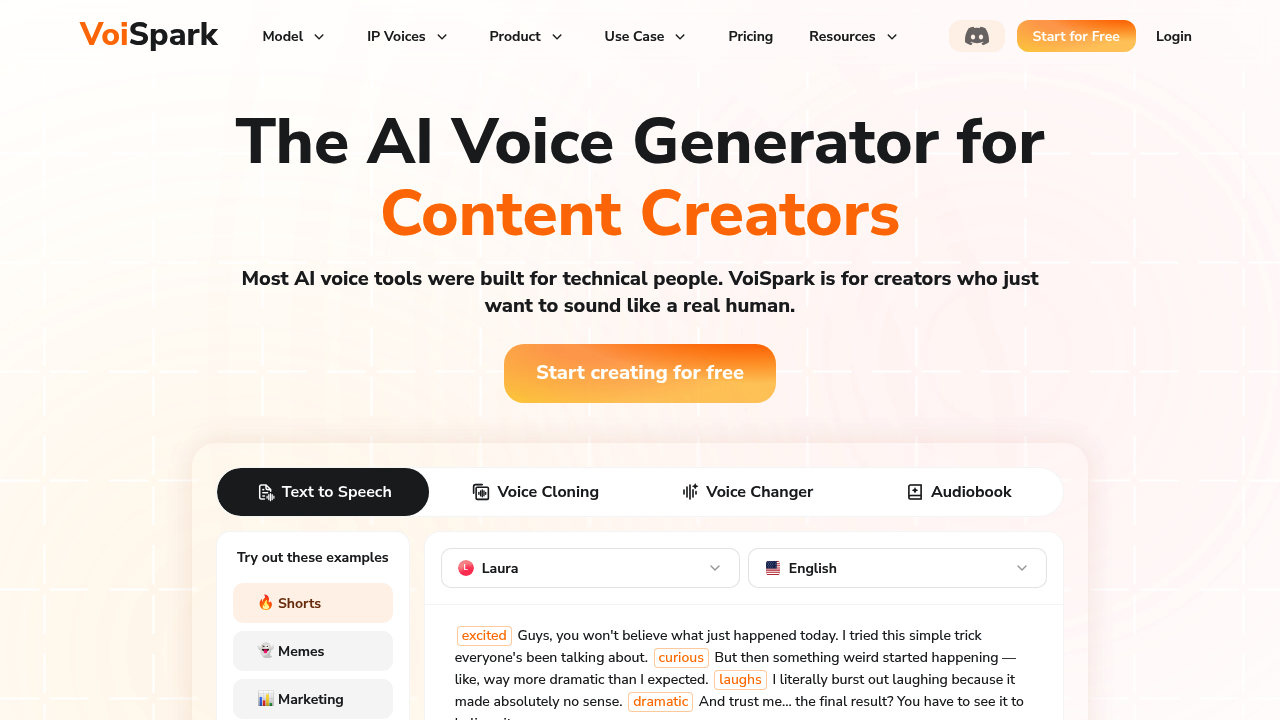
The emotion controls matter more than they sound. Add tags to individual sentences to make the AI voice sound excited, serious, or conversational. A marketing team creating product demos can make their AI narrator emphasize key features with enthusiasm, then switch to a calmer tone for technical specs. That sentence-level control means you're not stuck with one flat delivery for a 20-minute video.
The multi-character narration feature lets audiobook producers assign different voices to different characters without hiring multiple voice actors. An e-learning company building training modules can have a "host" voice introduce topics and a different voice for example scenarios. VoiSpark pulls from seven different AI model providers, so if one voice doesn't sound right for your project, you've got hundreds of alternatives.
It handles long-form content without the 10,000-word limits that competitors impose. Podcasters can convert entire episode scripts. Event planners can generate voiceovers for hour-long presentations. The credit system means 1,000 characters converts to roughly one minute of audio, depending on which AI model you pick.
The voice cloning breaks down fast. That 15-second requirement sounds great until you realize the quality depends heavily on your source audio. Background noise, inconsistent volume, or accents can produce clones that sound off. Professional voice clones — supposedly higher quality — show as "coming soon," so you're stuck with instant clones that work well for some voices and poorly for others.
The credit system gets confusing. One character costs between 1-4 credits depending on which AI model you choose, but there's no clear guidance on which models work best for which situations. A TikToker on the free plan gets 15,000 credits monthly, which sounds generous until they burn through it testing different voices and emotion tags. The $9.90 Pro plan jumps to 120,000 credits, but heavy users will hit that ceiling quickly if they're producing daily content.
Concurrent request limits hurt teams. The free plan allows one request at a time, so a small production company can't have multiple people generating voiceovers simultaneously. Even the $199.90 Business plan caps at 20 concurrent requests, which might bottleneck larger operations.
The free plan includes commercial use rights, 3 instant voice clones, 1 custom voice, and access to the full voice library. Pro costs $9.90 monthly. Premium runs $33.30. Business hits $199.90.
VoiSpark doesn't work for creators who need consistent voice quality across months of content — those instant clones can vary. It's wrong for anyone needing real-time voice generation during live streams. Skip it if you're building products that need API reliability guarantees that are not specified. VoiSpark fits creators making pre-recorded content who can test outputs before publishing.