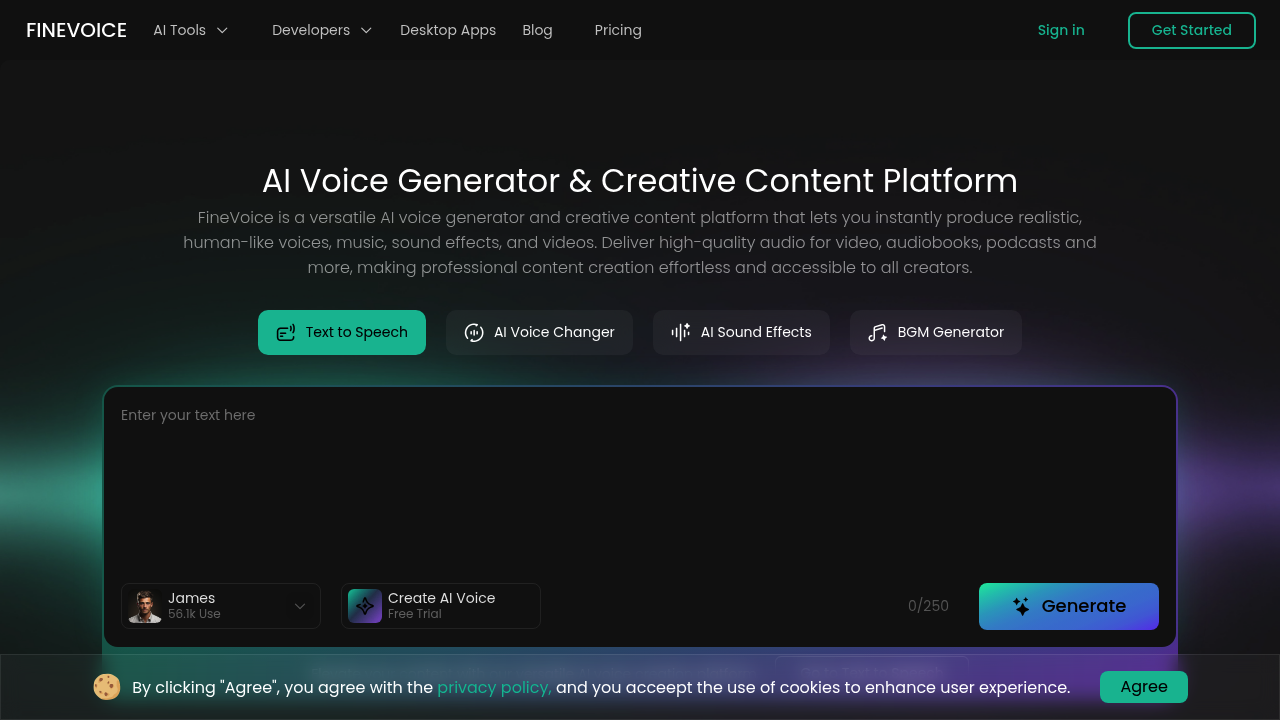
Voice generation tools typically force creators to choose between realistic output and creative control, but FineVoice tackles both angles with a system built for serious content production. The service converts text into speech across 1,500 distinct voices spanning 154 languages and accents, giving podcasters, educators, and video creators access to vocal variety that'd otherwise require hiring dozens of voice actors. Beyond basic text-to-speech, it handles voice cloning through two methods: instant cloning that replicates any voice in seconds, and professional cloning for higher accuracy when brand consistency matters.
The voice changer works without duration limits on paid plans, letting users transform existing audio recordings into different vocal styles. This matters for creators who've already recorded content but want to experiment with different character voices or presentation styles without re-recording everything. The emotion control system adjusts tone, speed, and style parameters so generated speech doesn't sound flat. A voice named James has been used 56,100 times according to usage metrics, suggesting certain voices gain traction with users.
FineVoice extends beyond voice work into full audio production. The sound effects generator creates audio from text descriptions or video input, producing royalty-free effects creators can use commercially. The BGM generator handles background music creation. The AI Talking Photo feature animates still images with synchronized speech. The podcast generator bundles multiple audio tools into a workflow designed specifically for podcast production. Speech-to-text transcription runs in the opposite direction, converting audio into written text.
Custom voice design offers unusual functionality. Users describe a desired voice through text prompts, and the system generates a unique voice matching those specifications. This enables brands create signature voices for characters or company audio identities without recording sessions. The voice translator converts speech between languages while maintaining vocal characteristics.
The free plan provides 250 characters of text-to-speech input but restricts downloads to preview-only, making it useful for testing voices but not for production work. Basic tier costs $5.99 monthly when billed annually, jumping to $8.99 on monthly billing. It includes 100,000 TTS characters per month, 24 hours of voice changing, five professional voice clones, 50 instant clones, and 100 sound effect generations. The Pro plan runs $12.99 annually or $17.99 monthly, tripling character allowances to 300,000 and removing duration caps on voice changing. It also doubles professional clones to 10 and instant clones to 100, plus adds 250 sound effects monthly. Enterprise tier hits $32.99 annually or $47.99 monthly with one million characters, 20 professional clones, 500 instant clones, and unlimited voice-over capacity.
Character limits reset monthly across all paid tiers. Voice clone slots define how many different voices you can save and reuse, not how often you can apply them. The AI Voice Enhancer processes 40 to 120 minutes of audio depending on tier, while Speech to Text handles 120 to 600 minutes monthly. These caps affect users processing long-form content like feature-length audiobooks or extensive podcast backlogs.
The service works for content creators across YouTube, e-learning courses, business presentations, advertisements, games, animations, and audiobooks. The 10 million user count and 4.9 out of 5.0 rating suggest broad adoption. Annual billing adds bonus months — one extra on Basic, three on Pro and Enterprise —, reducing effective monthly costs for committed users.