
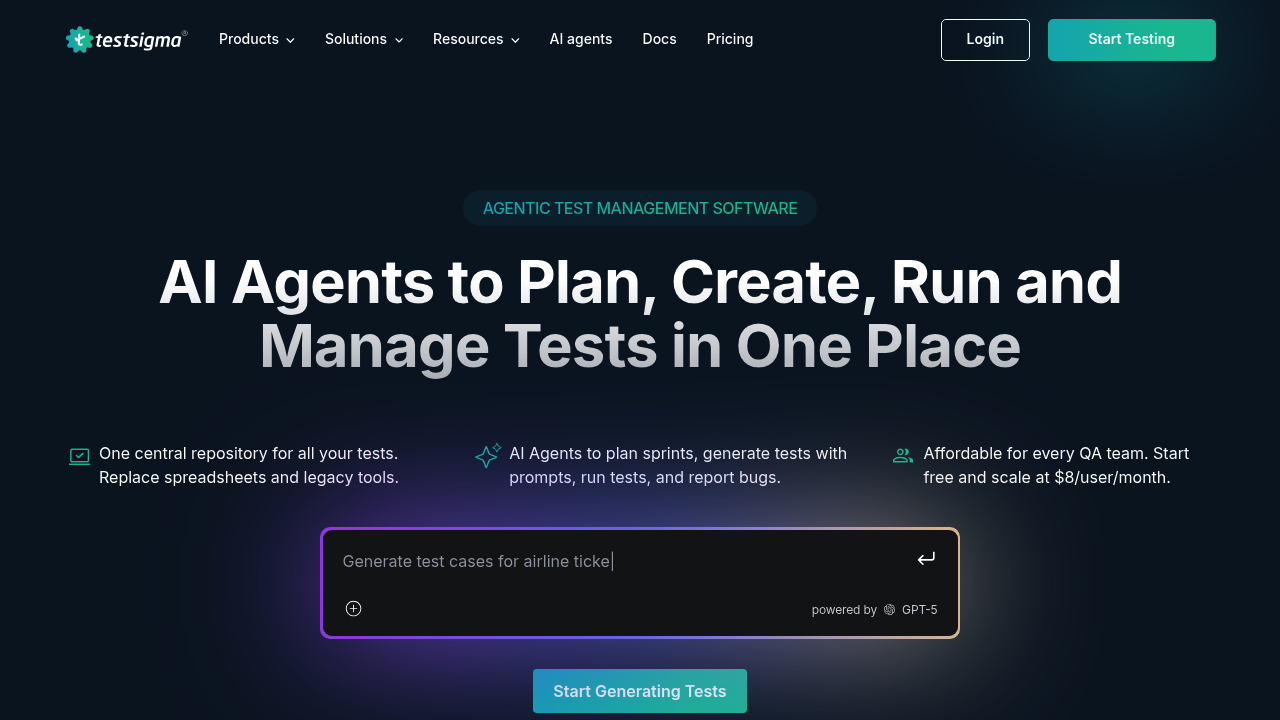
TestManagement by Testsigma replaces spreadsheets and legacy test management tools with an AI agent system powered by GPT-5. This solution coordinates four specialized agents that handle different parts of the testing workflow while maintaining human oversight at decision points.
The Sprint Planner agent monitors connected project management tools and automatically detects when new sprints start. It pulls user stories without manual intervention. The Generator agent then creates test cases from multiple input types including Jira tickets, Linear issues, Figma designs, screenshots, videos, and text prompts. This removes the manual test case writing step entirely.
The technical architecture centers on a unified repository that stores all test artifacts with built-in traceability. Every test case links directly back to its source requirement through two-way Jira sync. When stories change in Jira, TestManagement reflects updates in real time. The system auto-maps relationships between stories, test cases, and bug reports so teams can trace any test back to its originating requirement and forward to any bugs it uncovered.
The Runner agent handles test execution automatically. It works across 3000 plus browsers and devices. After execution completes, the Bug Reporter agent analyzes failures and drafts bug reports. It doesn't file bugs autonomously. Instead it presents draft reports for human review before submission. This human-in-the-loop design lets QA teams pause agent actions, refine outputs, or trigger re-runs when results don't match expectations.
This system processes 25 million plus tests across 10,000 plus QA teams. Setup takes two minutes according to provided metrics. Guided onboarding walks teams through initial configuration. Test creation time drops by 95 percent compared to manual workflows. Teams report 70 percent reduced testing effort overall and 400 percent faster automation speed. Some teams run 5000 plus test cases overnight with 80 percent automated coverage.
Integration depth varies by tool. Native connections exist for Jira, Linear, and ClickUp on the project management side. Teams can pull requirements from Figma for design-based test generation. CI/CD pipelines connect through Jenkins, GitHub, GitLab, and Azure DevOps. The integrations enable end-to-end workflows where code commits trigger test runs and results flow back into issue trackers automatically.
TestManagement addresses specific pain points from spreadsheet-based testing. Spreadsheets offer zero setup but create chaos at scale with no traceability and offline collaboration through email. Legacy tools provide partial traceability but require weeks of prep work before each sprint. TestManagement starts test planning immediately when sprints go live because the Sprint Planner agent detects new work automatically.
Real-time collaboration happens within this environment rather than through tool switching. Multiple team members see the same test repository simultaneously. Story-to-test mappings update live as requirements change. Bug links appear as soon as the Bug Reporter agent files them.
The system presents itself through Atto, described as an AI coworker that mobilizes the specialized agents. Atto doesn't replace human judgment. It handles repetitive detection, generation, and execution tasks while keeping humans in control of strategic decisions.
Pricing starts at eight dollars per user monthly with a fourteen dollar tier also available. A free forever plan exists for teams wanting to test the service long-term. A seven-day trial lets teams evaluate paid features before committing.
This solution assumes teams already use supported project management and CI/CD tools. It enhances existing workflows rather than replacing them entirely.