SREDSimplify logo
AI Tax Assistant FREEMIUM from $149/mo

SREDSimplify

This system handles the documentation pipeline for Canadian SR&ED tax credit claims by ingesting project artifacts and running them through structured eligibility scoring before generating T661 nar...

Ratives. You upload PDFs, Jira exports, code diffs, or logs into an IDE-style workspace where everything stays visible on one screen. The system indexes these files asynchronously and builds a searchable evidence base…

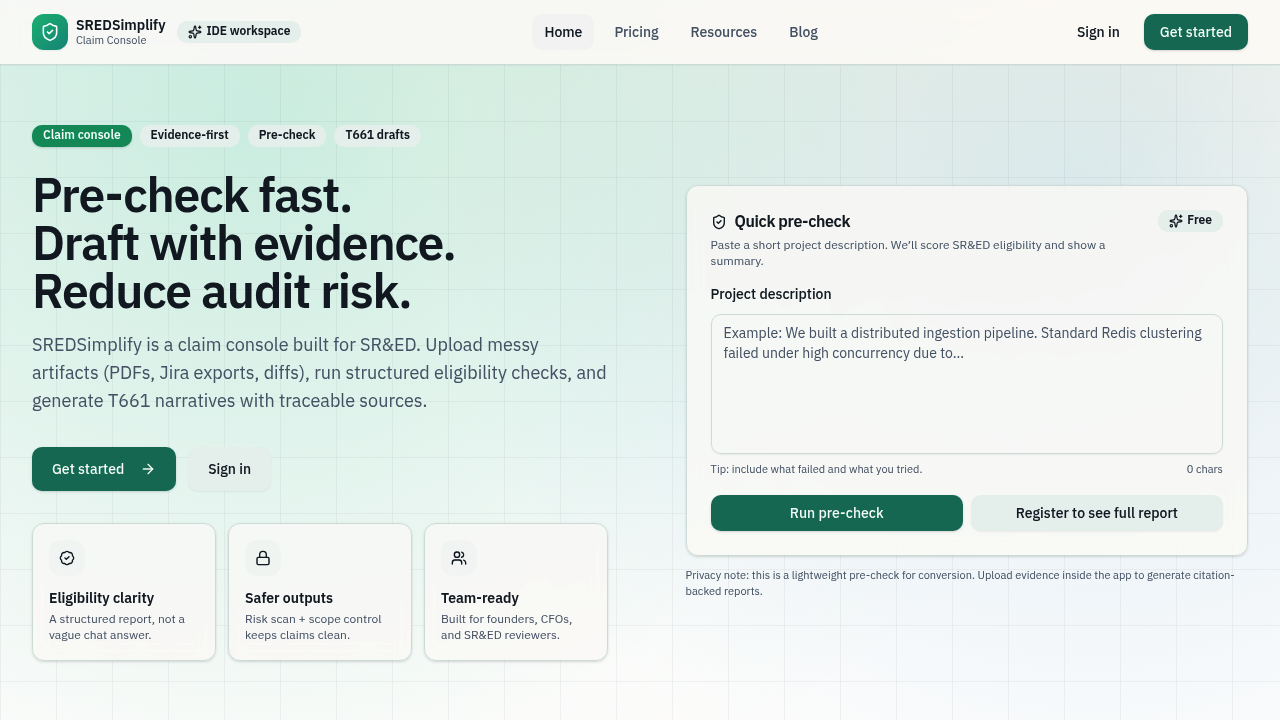
SREDSimplify screenshot

This system handles the documentation pipeline for Canadian SR&ED tax credit claims by ingesting project artifacts and running them through structured eligibility scoring before generating T661 narratives. You upload PDFs, Jira exports, code diffs, or logs into an IDE-style workspace where everything stays visible on one screen. The system indexes these files asynchronously and builds a searchable evidence base that backs every claim with traceable citations.

The core workflow starts with evidence ingestion. Files get processed through an indexing pipeline that extracts content and metadata. Once indexed, you can run a structured eligibility pre-check that scores your work against the three SR&ED pillars. This isn't a binary yes-no scan. It breaks down technical uncertainty, systematic investigation, and technological advancement into separate scores with specific evidence gaps flagged.

After eligibility checks, the system generates T661 draft narratives. These aren't generic descriptions. Every statement in the output links back to specific source documents through a citation system. You see which PDF page or Jira ticket supports each claim. This evidence trail matters for audits because CRA reviewers can trace assertions to original artifacts without hunting through file folders.

The workspace includes batch processing for multiple projects and an API interface for programmatic access. Time extraction outputs CSV files that map hours to specific activities. The logbook generation pulls together chronological records of experiments and iterations. Risk scanning identifies weak spots in your claim where evidence looks thin or methodology appears unclear.

Technical limitations are straightforward. The free plan caps you at one project with five files and restricts AI workspace runs. That's enough for initial eligibility checks but not full claim preparation. The Starter plan at 149 CAD monthly gives you five projects, 25 files per project, and 50 AI runs per month. Professional tier at 399 CAD monthly removes project limits and pushes file counts to 100 per project with unlimited AI runs. Enterprise pricing is custom.

File count caps matter more than they might seem. A typical SR&ED claim pulls from sprint retrospectives, architecture docs, failed experiment logs, and technical specifications. Five files cover basic eligibility checks. Twenty-five files handle small team claims. One hundred files support larger organizations with multiple concurrent R&D streams.

The system integrates with Jira through export support. You export your Jira data and upload it rather than connecting via live API. This means you're working with snapshots, not real-time feeds. No other integrations are documented.

Output quality depends entirely on input quality. The citation system prevents hallucination by tying every claim to source material, but it can't create evidence that doesn't exist. If your documentation has gaps, the system identifies them but won't fabricate details to fill holes. This is a feature for audit compliance but means you can't generate strong narratives from weak documentation.

The evidence-first approach differs from traditional claim preparation where consultants interview teams and reconstruct timelines from memory. Here, everything starts with existing artifacts. That makes the process faster but requires decent documentation habits during development. Teams that don't log experiments or track failed approaches won't have much to feed the system.

An optional Expert Review add-on costs 399 CAD one-time and brings human review to generated drafts. This connects automated output with submission-ready claims.

No guarantee of CRA compliance is mentioned anywhere. The system produces audit-friendly documentation with traceable sources, but acceptance depends on the underlying work meeting SR&ED criteria and your evidence supporting that case convincingly.


SREDSimplify alternatives

See all →

Frequently asked

7 questions
Does SREDSimplify have a free plan for SR&ED claims?
The free plan provides one project with up to five files and includes SR&ED eligibility pre-check functionality with limited AI workspace runs. This covers initial eligibility assessment but won't handle full claim preparation since most SR&ED filings require sprint retrospectives, architecture docs, experiment logs, and technical specifications that quickly exceed five files. Paid plans start at 149 CAD monthly for the Starter tier with five projects, 25 files per project, and 50 AI runs per month. The Professional plan at 399 CAD monthly removes project limits and supports up to 100 files per project with unlimited AI runs.
How does SREDSimplify generate T661 narratives from project files?
The system ingests PDFs, Jira exports, code diffs, and logs through an asynchronous indexing pipeline that extracts content and metadata into a searchable evidence base. When generating T661 narratives, every statement links back to specific source documents through a citation system that references exact PDF pages or Jira tickets. This prevents hallucination by tying claims directly to uploaded artifacts, but it means output quality depends entirely on input quality. Teams with sparse documentation will get narratives that identify evidence gaps rather than fabricated details to fill holes.
Can SREDSimplify guarantee my SR&ED claim will be accepted by CRA?
No guarantee of CRA compliance is documented for the system. SREDSimplify produces audit-friendly documentation with traceable citations linking every claim to source artifacts, but acceptance depends on your underlying work meeting SR&ED criteria and your evidence supporting that case. The structured eligibility pre-check scores technical uncertainty, systematic investigation, and technological advancement as separate pillars with specific evidence gaps flagged. An optional Expert Review add-on at 399 CAD one-time connects human review with generated drafts, but final compliance remains dependent on the quality of your R&D activities and documentation.
What file limits apply to different SREDSimplify pricing tiers?
File count caps create practical constraints for claim preparation across tiers. The free plan limits you to one project with five files, which covers basic eligibility checks but not full claims. Starter at 149 CAD monthly provides five projects with 25 files each and 50 AI runs per month, suitable for small team claims. Professional at 399 CAD monthly removes project limits and pushes file counts to 100 per project with unlimited AI runs, supporting larger organizations with multiple concurrent R&D streams. Most SR&ED claims pull from sprint retrospectives, architecture docs, failed experiment logs, and technical specifications, so file limits matter more than they initially appear.
Does SREDSimplify integrate with project management tools like Jira?
Integration with Jira works through export support rather than live API connections. You export your Jira data and upload it as a file, which means you're working with snapshots instead of real-time feeds. The system processes these exports through the same indexing pipeline as PDFs and code diffs, building them into the searchable evidence base. No other integrations are documented beyond Jira export support.
What's the difference between SREDSimplify's approach and traditional SR&ED consultants?
Traditional claim preparation involves consultants interviewing teams and reconstructing timelines from memory, while this system takes an evidence-first approach starting with existing artifacts. Everything begins with uploaded documentation like PDFs, Jira exports, logs, and diffs that get indexed into a searchable evidence base. This makes the process faster but requires decent documentation habits during development since the citation system won't fabricate details to fill gaps. Teams that don't log experiments or track failed approaches during R&D won't have much material to feed the system, making the evidence-first model less effective than memory-based reconstruction.
How does the SR&ED eligibility pre-check scoring work?
The eligibility pre-check runs uploaded artifacts through a structured assessment that scores technical uncertainty, systematic investigation, and technological advancement as three separate pillars rather than a binary yes-no determination. Each pillar receives its own score with specific evidence gaps flagged where documentation appears thin or methodology seems unclear. This breakdown shows exactly where your claim is strong or weak before you invest time in full T661 narrative generation. The risk scanning component identifies weak spots where assertions lack supporting evidence in your uploaded files.

Traffic

Estimated monthly website visits · last 0 months

Not enough historical data for a chart yet.

Reviews (0)

Write review

No reviews yet. Be the first to share your experience.