
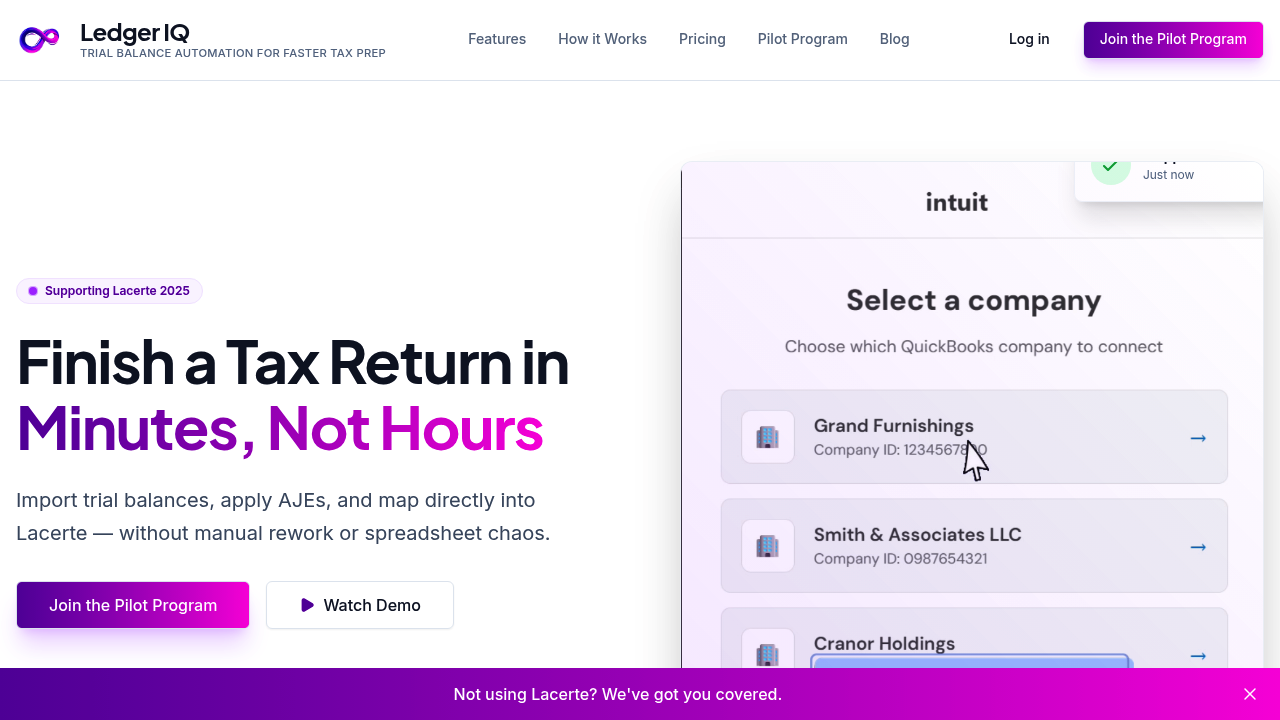
Trial balance work during tax season usually means Excel hell. You're normalizing accounts, tracking adjusting entries in scattered sheets, then re-keying everything into Lacerte while praying you didn't flip a sign or drop a digit. Ledger IQ automates that entire chain, upload the TB, apply your AJEs through templates, then map straight into Lacerte without touching a keyboard for manual entry.
The workflow is built around three steps. First, you import trial balances via Excel or CSV and the software normalizes accounts and balances automatically. Second, you apply adjusting journal entries using smart templates for standard stuff like depreciation, meals, payroll, and tax adjustments. Third, you map everything directly into Lacerte and export tax-ready files with clean PDFs and structured workpapers. The firm-level Lacerte mapping is reusable across all clients, so you're not rebuilding the wheel every time.
Does it actually cut down errors? The direct Lacerte integration removes the re-keying step where most mistakes happen. You're not copying numbers from Excel into tax software by hand. AJE templates standardize adjustments so your team isn't inventing new methods for the same entries every month. The binder-ready output means less scrambling to format workpapers when a partner asks for backup.
Weak spots are real though. Right now it only works with Lacerte 2025. If you're on UltraTax CS, ProSystem fx Tax, Drake, or CCH Axcess Tax, those integrations are being built but aren't live yet. That's a blocker for multi-software firms or anyone not using Lacerte. The Firm Plan locks you into 12 months, which is fine if you're confident but risky if you're testing workflows mid-season. The Pay-Per-Return option has a $99 setup fee on top of the $25 per return, so occasional users pay more upfront than they might expect.
Pricing splits into two paths. The Firm Plan runs $99 a month with a 12-month commitment, includes up to three users, and gives you unlimited trial balance imports, unlimited AJEs, and unlimited exports to Lacerte. Additional users cost $29 per month. You get a 14-day pilot period before billing starts and white-glove onboarding with a 30-minute guided setup. The Pay-Per-Return Plan charges $25 per return plus that $99 setup fee, no monthly commitment, unlimited users, and full platform features. You pay only when you use it, which works for firms with unpredictable volume or seasonal spikes.
Who actually benefits here? High-velocity firms processing multiple returns monthly will recover the $99 subscription cost fast if it saves even two hours of manual TB cleanup and Lacerte data entry per week. Seasonal practices might lean toward the pay-per-return model to avoid paying during slow months. Solo practitioners or small teams already deep in the Lacerte ecosystem could justify the cost if they're drowning in spreadsheet chaos. But if you're using different tax software or your volume is too low to justify recurring fees, this doesn't solve your problem yet.
The value proposition is narrow but clear. It removes manual rework between trial balances and Lacerte. That's it. If that's your bottleneck and you're on Lacerte 2025, it works. If not, wait for your software to get supported.