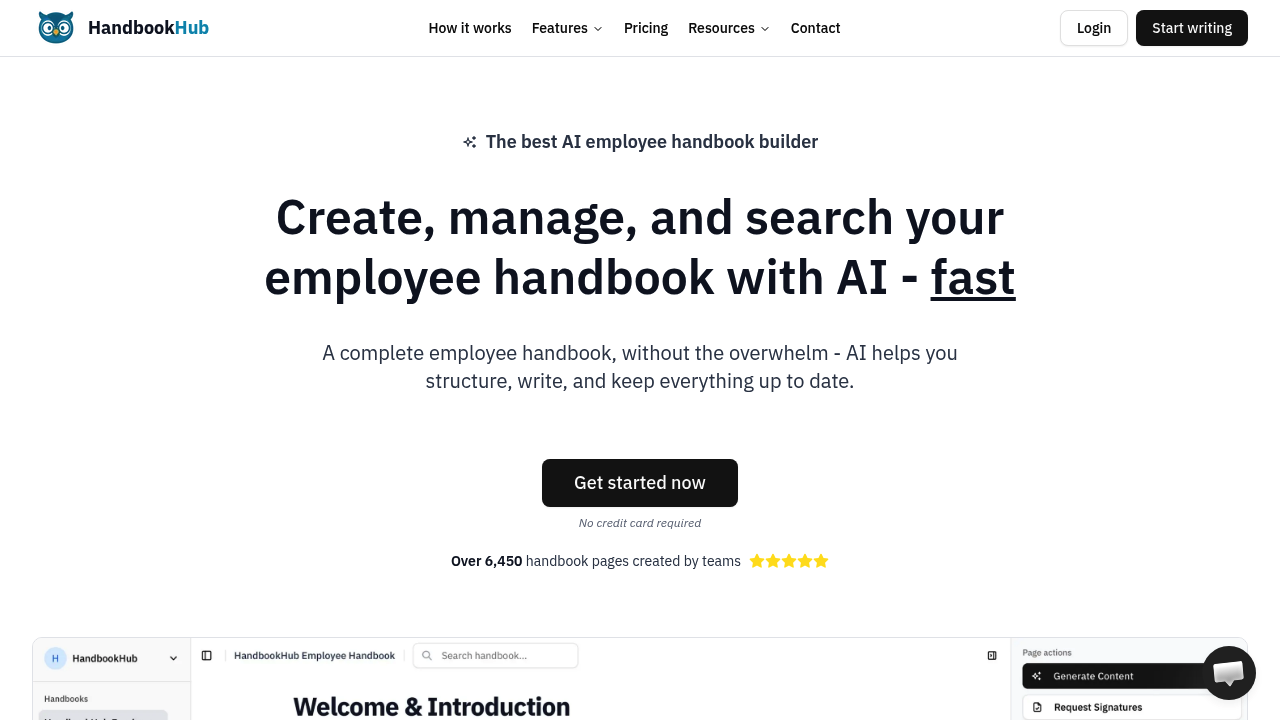
HandbookHub AI generates employee handbook structures from scratch in under three minutes using AI. Its core technical approach centers on two pipeline stages. First, it creates a skeleton framework based on company type and size. Second, it fills sections using a context-aware language model trained on handbook conventions and employment law patterns.
The smart autocomplete works differently than standard text prediction. When you start typing a policy or procedure, the system pulls context from three sources: your company profile data, previously written sections in the same handbook, and any PDFs you've uploaded. These documents get processed through a text extraction pipeline that feeds into the AI's context window. The system can handle up to 100 document uploads on paid plans, though the free tier caps at one. This limitation matters if you're trying to migrate complex existing policies.
Natural language search runs queries against a vector database of your handbook content. You can ask questions in plain English rather than keyword matching. The search doesn't just find sections, it interprets intent. Ask "what's our vacation policy" and it'll surface relevant passages even if they're labeled "time off" or "PTO."
Content generation operates on a token-based system. The free plan allocates 10,000 AI words, which translates to roughly 13,000 tokens depending on vocabulary complexity. That's enough for maybe 15-20 policy sections before you hit the limit. Paid plans remove this cap entirely.
The Slack integration uses a slash command architecture. Type /handbook followed by a query and it searches your documentation without leaving Slack. This works through a webhook that authenticates against your HandbookHub account, runs the search, and returns results in-thread. It doesn't require separate authentication once you've connected the integration initially.
Digital signatures use a tracking database that logs who signed what and when. You can export this audit trail as CSV, which matters for compliance documentation. The system distinguishes between page-level signatures and handbook-level signatures. Page signatures work for individual policies. Handbook signatures cover the entire document set.
Role-based access control splits users into managers and members. Managers can edit and publish. Members can only view. This is basic compared to granular permission systems but covers most use cases. The free plan restricts you to one team member total, making collaboration impossible without upgrading.
PDF export generates documents page-by-page or as complete handbooks. The export pipeline converts your content to a formatted layout with table of contents and page numbers. Export quality depends on how much custom formatting you've applied, since complex tables sometimes render inconsistently.
HandbookHub has created over 6,450 handbook pages across its user base. That number suggests moderate adoption but doesn't indicate active users or company count.
Pricing starts at $39 monthly when billed annually for unlimited AI generation, up to 100 team members, and unlimited handbooks. The free tier includes AI assistance, one handbook, one team member, and 10,000 AI words. Custom enterprise pricing exists for organizations needing higher limits or dedicated support. No credit card required to start.
The single-member restriction on free accounts makes it impractical for actual team use. You're locked into solo mode unless you pay. The document upload limit also constrains migration scenarios where you'd want to feed existing policies into the AI for context.