
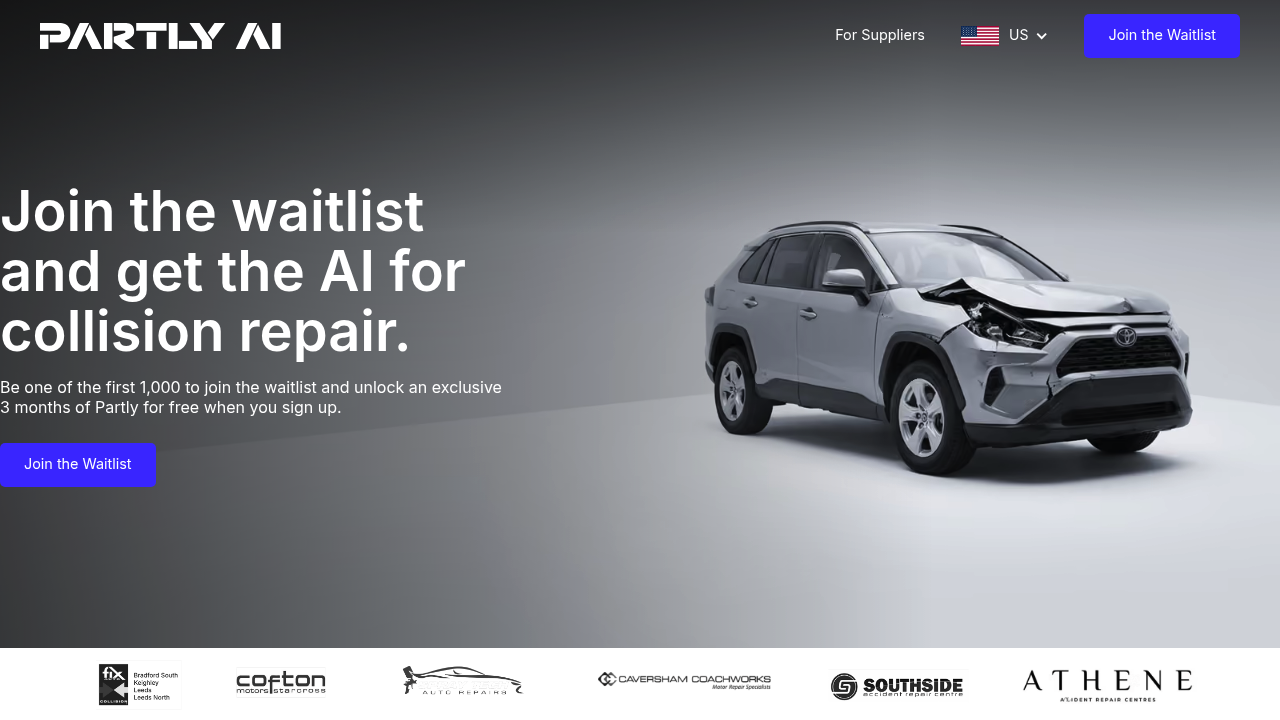
Collision repair shops lose time and money on administrative tasks that pull staff away from actual repairs. Partly automates this work by reviewing estimates, sourcing parts across multiple suppliers, and handling post-order reconciliation. The system checks every part in an estimate to catch errors or missing components, then builds optimized parts baskets based on true net costs while accounting for factors like labor, return risk, delivery times, and shop capacity. It consolidates options from OEM, aftermarket, and recycled suppliers in one interface and automatically applies carrier and DRP rules to ensure compliance. Partly also manages invoice matching and catches pricing leakage that would otherwise eat into margins. The first 1,000 waitlist members in the USA receive three months free when they sign up.
Partly targets collision repair shops of varying sizes, from independent operations to larger facilities managing multiple repair bays. Parts managers and estimators benefit most directly since they handle the daily grind of sourcing components and verifying estimates. Shop owners gain visibility into cost optimization and supplement reduction. The system also serves suppliers in the automotive repair ecosystem who need to integrate with shop workflows. Users don't need technical expertise—the conversational AI interface lets staff ask questions about vehicles or repair details in plain language rather than navigating complex databases or multiple supplier portals.
Shops use Partly throughout the repair lifecycle, starting when an estimate arrives. The system reviews the estimate for accuracy before parts ordering begins, reducing the 20% supplement and return rate many shops experience. During parts procurement, it compares pricing and availability across supplier networks to find the best combination for that specific shop's contracts and relationships. After ordering, it matches invoices to purchase orders and flags discrepancies for review. Partly integrates with existing estimating software rather than replacing current systems, fitting into established workflows. Powered by Interpreter—an AI model built specifically for automotive repair—Partly provides a documented paper trail showing why particular parts were selected, useful for insurance carrier audits or internal quality checks.