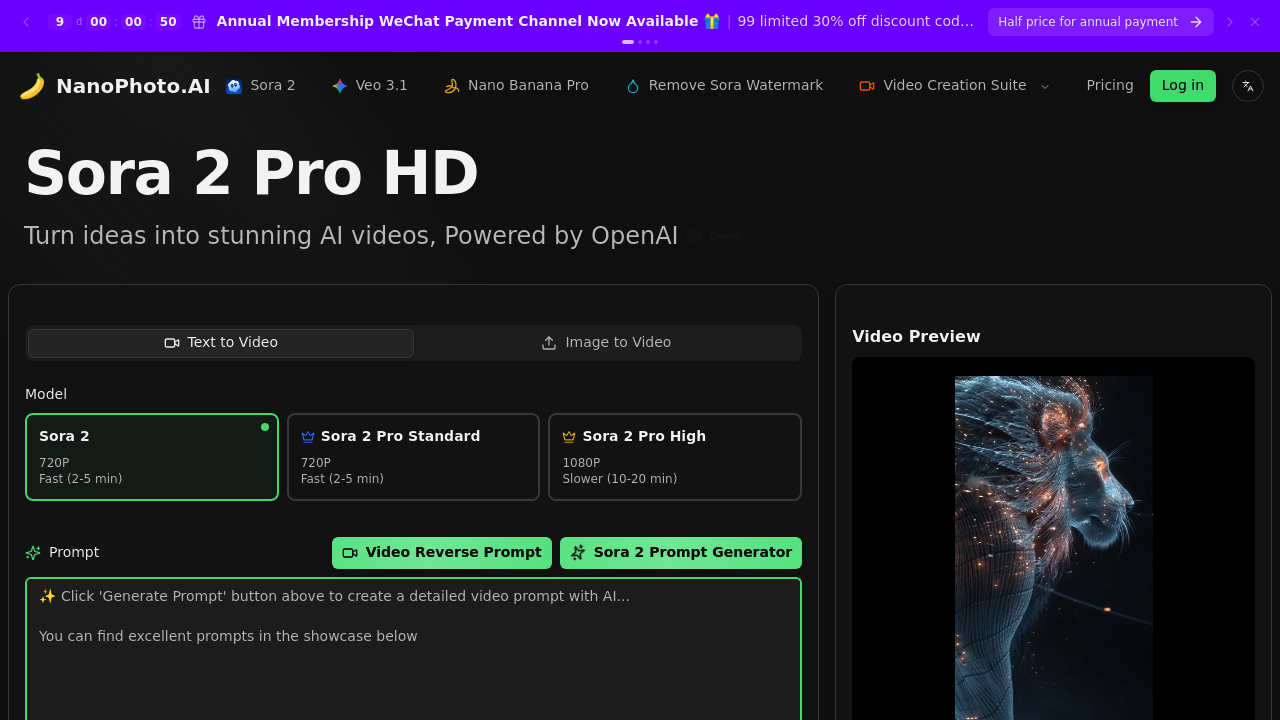
A marketing director needs video ads for three product launches but doesn't have time for traditional video production. She writes text descriptions of each concept, uploads her product photos, and generates videos in 720P within minutes. The Sora 2 model handles quick turnarounds, while Sora 2 Pro High creates 1080P versions for the main campaign when she's got 10-20 minutes to wait. She removes watermarks from final cuts and downloads them ready for social media.
NanoPhoto.AI generates videos from text prompts or converts existing images into motion. This service runs on multiple AI models including Sora 2, Veo 3.1, and Nano Banana Pro. Users select aspect ratios like 9:16 for vertical video, choose duration options around 10 seconds, and pick quality levels that trade processing speed for resolution. The Sora 2 Prompt Generator helps users write better descriptions when they're stuck on how to phrase their vision. Video Reverse Prompt Generator works backward from existing videos to create similar prompts.
A freelance content creator building a portfolio hits limits fast. The credit system means each plan caps how many videos she can generate monthly. Basic annual at $7.50 gives 150 credits translating to 75 standard Sora 2 videos or just 5 Sora 2 Pro videos. She burns through credits testing different prompts and quality settings. Professional work demands high resolution, but those renders take 10-20 minutes each and consume more credits. She upgrades to Pro annual at $19.50 for 800 credits monthly, which gets her commercial licensing and 400 standard videos or 26 high-quality ones.
A YouTube channel producer runs a team creating educational content. They need dozens of background videos weekly. Max plan at $40 monthly — annual billing — provides 2000 credits for 1000 standard videos plus dedicated support when renders fail. The team splits work across Sora 2 for quick drafts, Veo 3.1 for specific styles, and Nano Banana Pro for editing touches. Unlimited prompt generators help five team members experiment without additional costs.
NanoPhoto.AI blocks violent, pornographic, or copyrighted content. A history teacher can't generate footage of actual historical battles. A musician can't create videos featuring copyrighted songs or celebrity likenesses. Users must comply with local laws, which vary widely and aren't clarified within the interface. Someone creating content for international distribution faces uncertainty about what's acceptable.
Monthly billing costs double what annual plans charge. Basic monthly runs $15 versus $7.50 annual. Pro jumps to $39 monthly from $19.50 annual. That 50% discount matters for professional creators budgeting long-term. Ultra tier reaches $888 monthly or $444 annual for 25000 credits and 12500 standard videos, targeting studios with massive output needs.
Processing time creates workflow bottlenecks. A social media manager working on deadline can't afford 10-20 minute waits per video when she needs 15 variations tested. She sticks with fast 720P renders but sacrifices quality her brand guidelines require. No integrations with editing software, project management tools, or asset libraries mean manual downloads and uploads at every step.
The credit system penalizes experimentation. Testing three prompt variations on high quality burns credits equivalent to 15 standard videos. New users learning what prompts work best waste credits on failed attempts. NanoPhoto.AI suits creators with clear visions who nail prompts quickly, not those iterating toward creative breakthroughs through trial and error.