
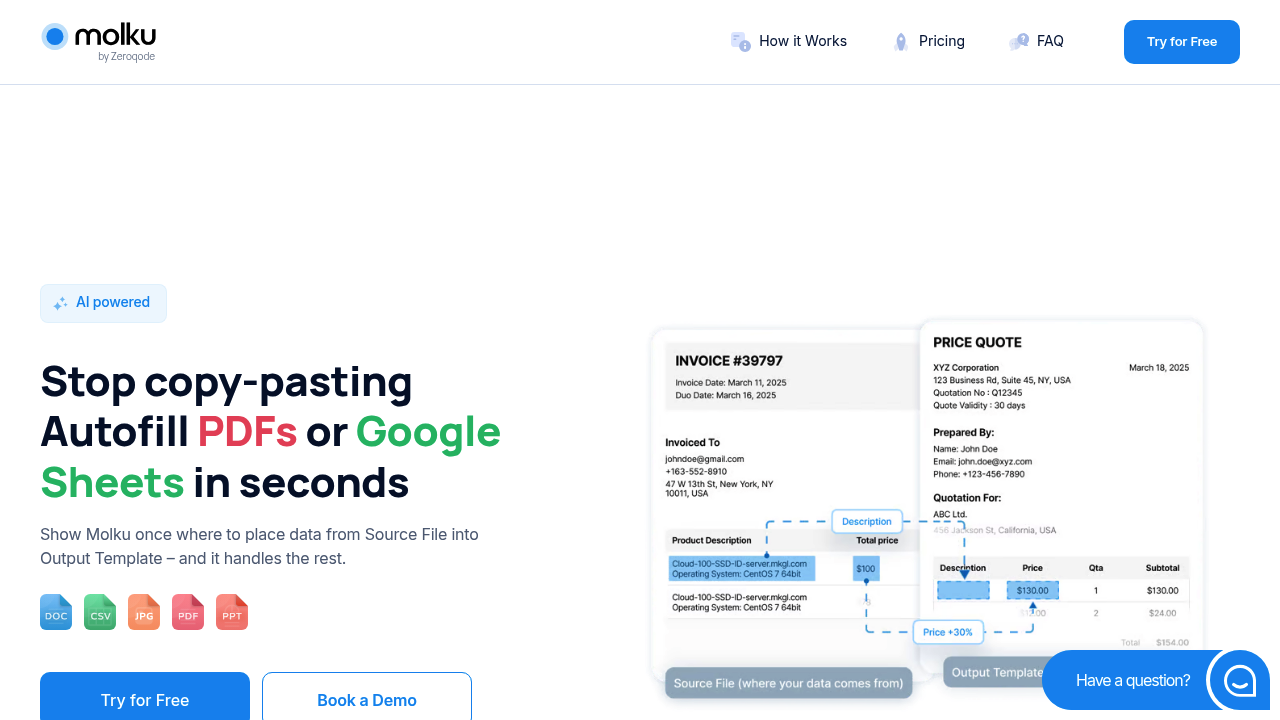
You open Molku and drop in a source document (maybe an insurance application or an invoice with messy formatting). The interface asks you to show it where data should go by dragging fields from your source to spots in your output template, which can be a PDF form or a Google Sheet. You're teaching it once. After that initial mapping, you can throw in hundreds of similar documents and Molku pulls the data automatically.
The extraction works across handwritten notes too. If someone filled out a form by hand, Molku reads it and pulls the information into your template. This matters for industries still dealing with paper forms or scanned documents where text isn't searchable.
During mapping, you can modify data on the fly. Need to reformat dates, run calculations between fields, or merge information from multiple spots? You write custom prompts that tell Molku how to transform the data before it lands in the template. Replace abbreviations with full terms, standardize addresses, convert currencies — it handles these tweaks as part of the extraction process.
The system deals with documents that have complex layouts or run dozens of pages long. It also standardizes messy PDFs, turning inconsistent source files into clean structured templates you can reuse. Works in over 100 languages and translates automatically if your source and output do not match.
Once extraction finishes, you download the filled template, share it via link or email, or collaborate with teammates directly on the output files. You can push results to over 8000 apps through Zapier and Make integrations, or build custom workflows using the API. Google Sheets connects directly if you prefer spreadsheet outputs.
The friction shows up during that initial mapping phase. You need to get the field matching right the first time because that is what drives every future extraction. If your source documents vary in structure, you'll need separate workflows for each layout type. Molku doesn't guess at mappings — you have to demonstrate them.
Storage uses 256-bit AES encryption through Amazon S3, so extracted data sits in secure infrastructure. But you're still uploading potentially sensitive documents to a cloud service, which won't work for organizations with strict on-premise requirements.
Insurance agencies reportedly save over 60 hours monthly using Molku. Finance and accounting firms see 70% reductions in document processing time. Those numbers depend on how much manual data entry you're currently doing and how consistent your document formats are.