
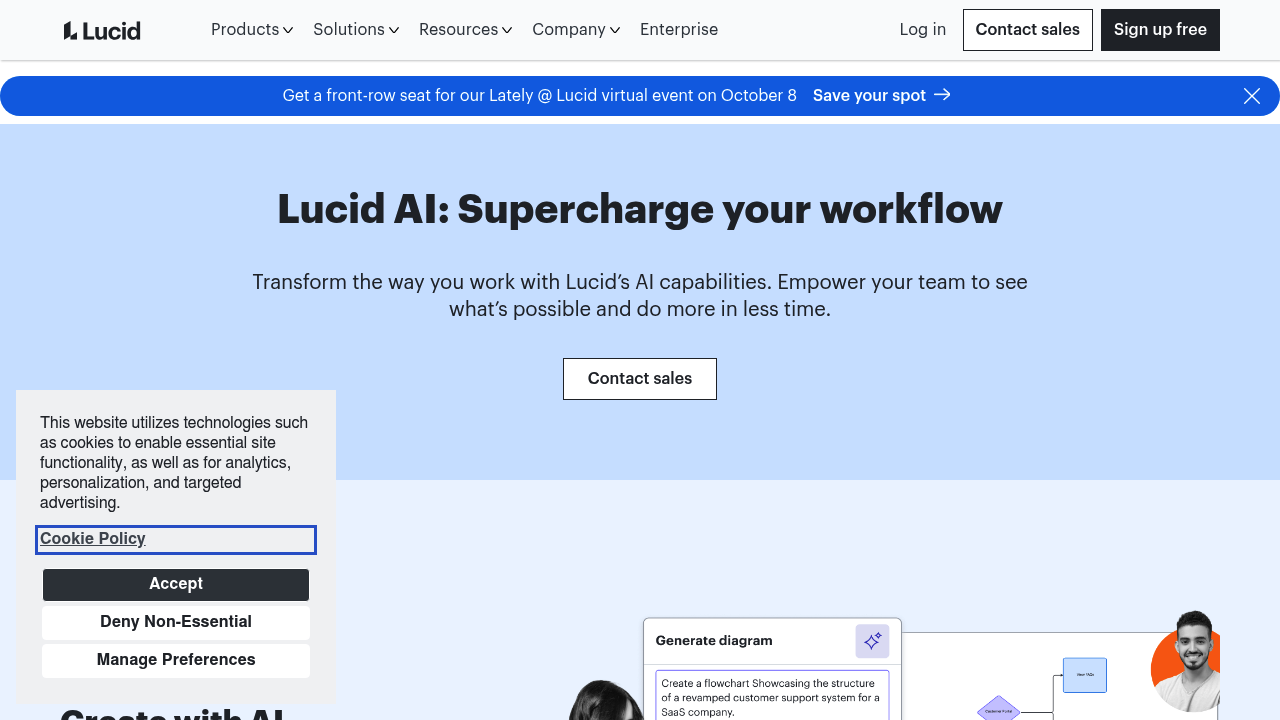
Lucid AI is the set of AI features built into Lucidchart and Lucidspark, Lucid's diagramming and collaborative whiteboard products. It generates diagrams from text prompts and lets you iterate on them until the visual is right. The Lucid AI agent is aware of your canvas, so answers and outputs reflect what is already on it. Beyond diagrams, it creates brainstorming boards, summarizes content, writes conditional formatting rules and builds mind maps. Process Capture records your screen while you work and produces an editable process diagram and a written SOP.
Process owners, operations managers, business analysts and team leads get the most from it, because it removes the blank-canvas problem and drafts documentation automatically. Facilitators running retrospectives and workshops can start with a populated board instead of empty frames. Developers and technical teams can use AI Prompt Flow to test models, prompts and inputs on the canvas using their own API key. Admins will also note that AI use is optional, and that customer data is not used to train third-party generative models.
Typical scenarios include documenting how a process really runs by recording it and refining the generated diagram, answering clarifying questions from the Process Agent to define triggers, owners and steps, and turning a messy brainstorm into themed groups by sorting ideas into containers. Teams add summaries to diagrams so colleagues can get aligned quickly, and use conditional formatting to highlight patterns in data-backed diagrams. Integrations extend this to Slack and Microsoft Graph Connector, and the Lucid MCP server connects diagrams to other AI tools so they can be found, edited, shared and referenced.