
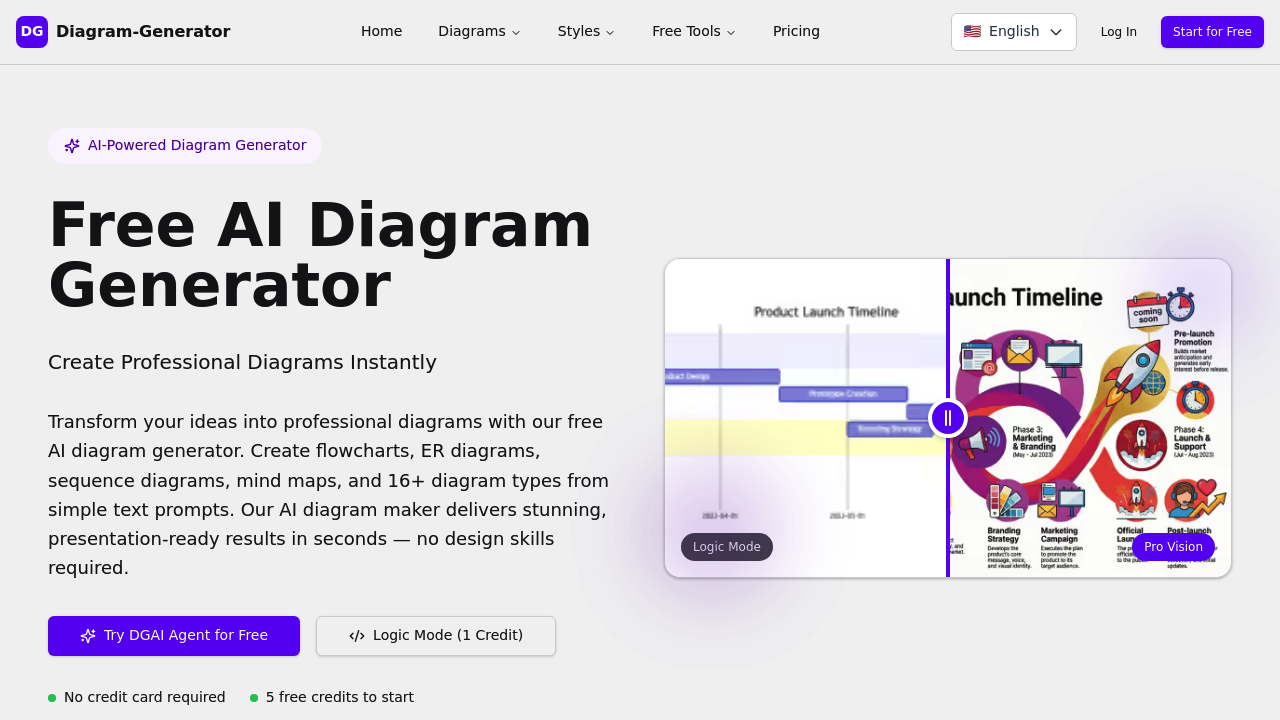
Transforming text descriptions into professional diagrams usually requires either specialized software skills or settling for basic auto-generated output. DG Diagram-Generator tackles this through a two-stage workflow that separates logical structure from visual polish. Users first create diagrams in Logic Mode, which costs one credit and produces editable Mermaid code. This text-based format lets them refine structure through natural language commands before committing to a high-resolution render. Once the logic feels right, Pro Vision mode transforms that foundation into professional graphics at 2K resolution for three credits or 4K for six credits.
This system supports 16 different diagram types spanning technical and business needs. Flowcharts, sequence diagrams, class diagrams, and state diagrams handle software architecture. ER diagrams and UML diagrams serve database design. Gantt charts, timelines, and organizational charts manage project planning. Mind maps, Venn diagrams, and quadrant charts organize concepts. Network diagrams, AWS architecture diagrams, Sankey diagrams, funnel charts, and even Lewis diagrams for chemistry round out the options.
Visual presentation gets controlled through the Style Picker, which offers 10 distinct aesthetic approaches. Content-Based adapts to diagram type automatically. Corporate Clean and Modern Tech suit business presentations. Editorial and News styles work for publications. 3D Isometric and Blueprint provide technical visualization. Hand-Drawn adds approachability. Cyberpunk, Paper Cutout, Retro Pixel, and Academic styles serve specialized contexts.
The DGAI Agent handles document conversion, turning product requirement documents and technical specifications directly into diagrams without manual prompt writing. Search Grounding pulls in real-world data to populate diagrams with actual information rather than placeholder content. Complex reasoning capability means the system can visualize abstract concepts that don't map to simple node-and-edge relationships.
Credits work differently. They're spent.
The Developer plan provides five one-time credits at signup. Every Logic Mode generation costs one credit regardless of complexity. Pro Mode rendering to 2K resolution costs three credits. Diagrams created on this tier carry watermarks, get stored in a public-only gallery, and remain owned by Diagram-Generator rather than the user. No commercial use allowed. Resolution caps at 2K.
Starter tier costs nine dollars monthly and includes 100 credits. Watermarks disappear. Users get commercial licensing and private gallery storage. Resolution still maxes out at 2K, meaning 4K rendering stays unavailable even if credits remain.
Professional tier runs 35 dollars monthly with 400 credits. This enables 4K generation capability alongside priority support. All Starter features carry over.
The credit math matters for budget planning. Creating a diagram in Logic Mode and rendering it at 2K costs four credits total. The same workflow ending in 4K costs seven credits. A user on the Starter plan could produce 25 diagrams monthly at 2K quality or 14 at 4K quality if that tier supported 4K, which it doesn't. Professional tier users get roughly 57 complete workflows at 2K or 57 at 4K.
This tool targets technical professionals who need diagram quality beyond what basic auto-generators produce but don't want to master specialized software. Software architects documenting systems, product managers visualizing workflows, designers creating information architecture, and anyone converting dense documentation into visual formats fit the use case. The document-to-diagram feature specifically serves teams working from written specifications who need visual representations for stakeholder communication.