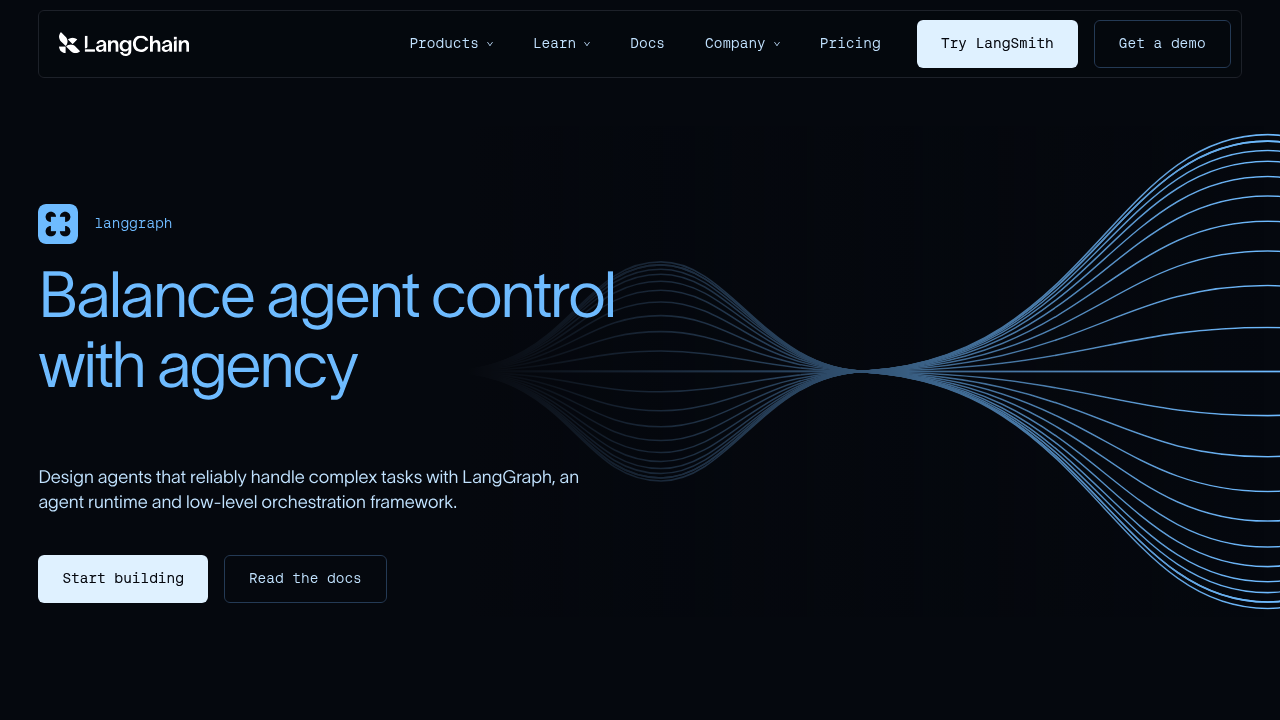
LangGraph is an open-source agent runtime and low-level orchestration framework for building AI agents that behave reliably on complex tasks. Developers define agent workflows as graphs with explicit state, then add human approval steps, persistent memory and token-by-token streaming. The library carries an MIT license and is free to use. Teams that want tracing, evaluation and hosted deployment can pair it with LangSmith, whose Plus plan costs $39 per seat per month and whose Developer plan starts at $0.
Software engineers and ML teams who have outgrown simple prompt chains are the natural audience. It suits developers who want fine-grained control over each agent decision instead of a black-box cognitive architecture, and it works with any model provider. Platform teams at larger companies use it to standardize how internal agents are built, moderated and monitored, while newcomers can start with the free LangChain Academy introduction course.
Common projects include conversational agents that remember users across sessions, multi-step task automation that pauses for a person to approve an action, and hierarchical setups where a supervisor agent delegates to specialist agents. Streaming lets a front end show reasoning and tool calls as they happen, which helps customer-facing assistants feel responsive. Companies in finance, hospitality and other sectors describe using it for multi-actor workflows, and LangSmith traces make it easier to debug why an agent took a given path before shipping it to production. Because the framework is model-agnostic, teams can swap providers without rewriting orchestration logic, and the same graph definitions carry from a local prototype to a deployed service. Developers who want visibility into runs can add LangSmith traces and evaluations alongside it.