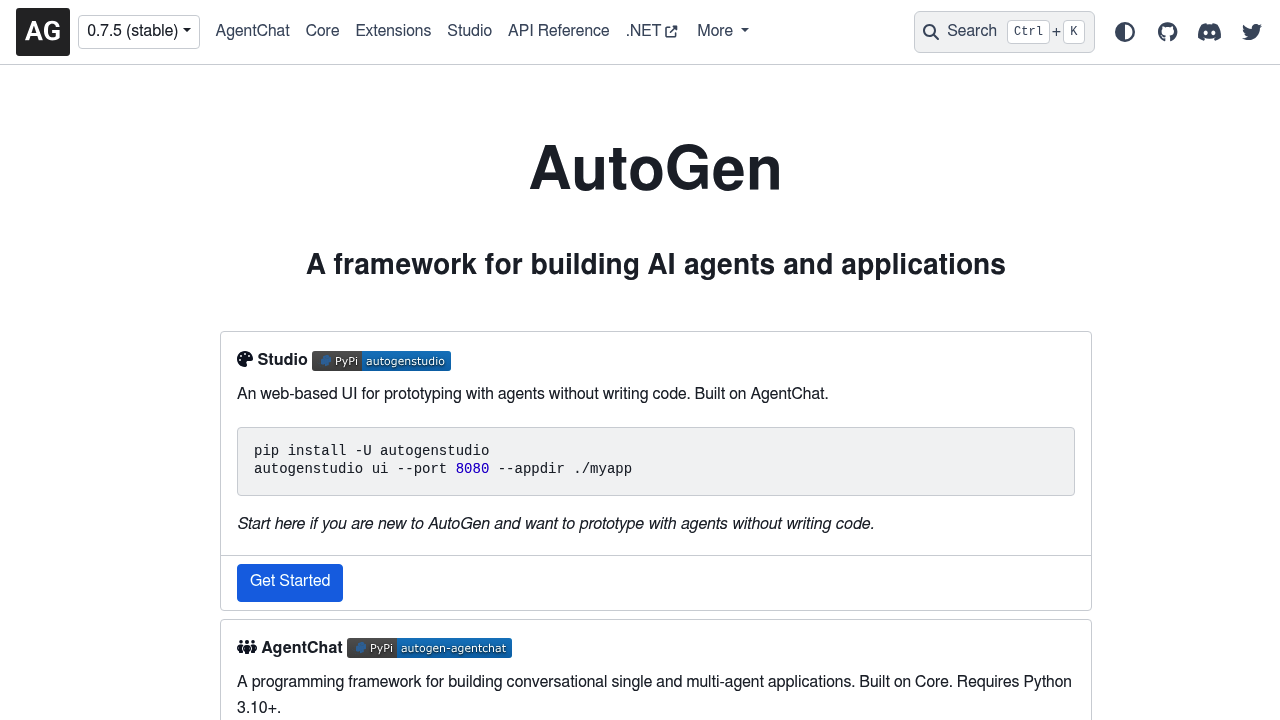
AutoGen is an open-source framework from Microsoft for building AI agents and multi-agent applications. It is organized in layers: AgentChat for conversational single and multi-agent apps, Core for event-driven, scalable multi-agent systems, Extensions for external services, and AutoGen Studio, a web interface for prototyping agents without writing code. It installs with pip, requires Python 3.10 or later, and also ships a dotnet version. Using the framework is free, and the current stable release is 0.7.5.
Python developers and AI engineers building agent applications are the primary audience, along with researchers studying multi-agent collaboration. Beginners who want to experiment without coding can start in Studio, while teams building serious production systems move to Core for more control. Developers migrating from AutoGen 0.2 will find a migration guide. Familiarity with Python async programming is helpful, because agents run through asynchronous calls.
Typical projects include assistant agents that complete tasks through a model client, deterministic or dynamic agentic workflows for business processes, and distributed agents running across multiple languages. Extensions add McpWorkbench to connect Model Context Protocol servers, an OpenAI assistant agent, and a Docker command-line code executor that runs model-generated code safely in a container. A gRPC worker runtime supports distributed deployments. Researchers use the event-driven Core to experiment with how agents cooperate, and community extensions let teams add their own components. A stable release line and a documented migration path from the older 0.2 versions give teams a clear route when they upgrade existing projects. The API reference covers each layer, which helps developers choose between quick AgentChat prototypes and lower-level Core systems.