
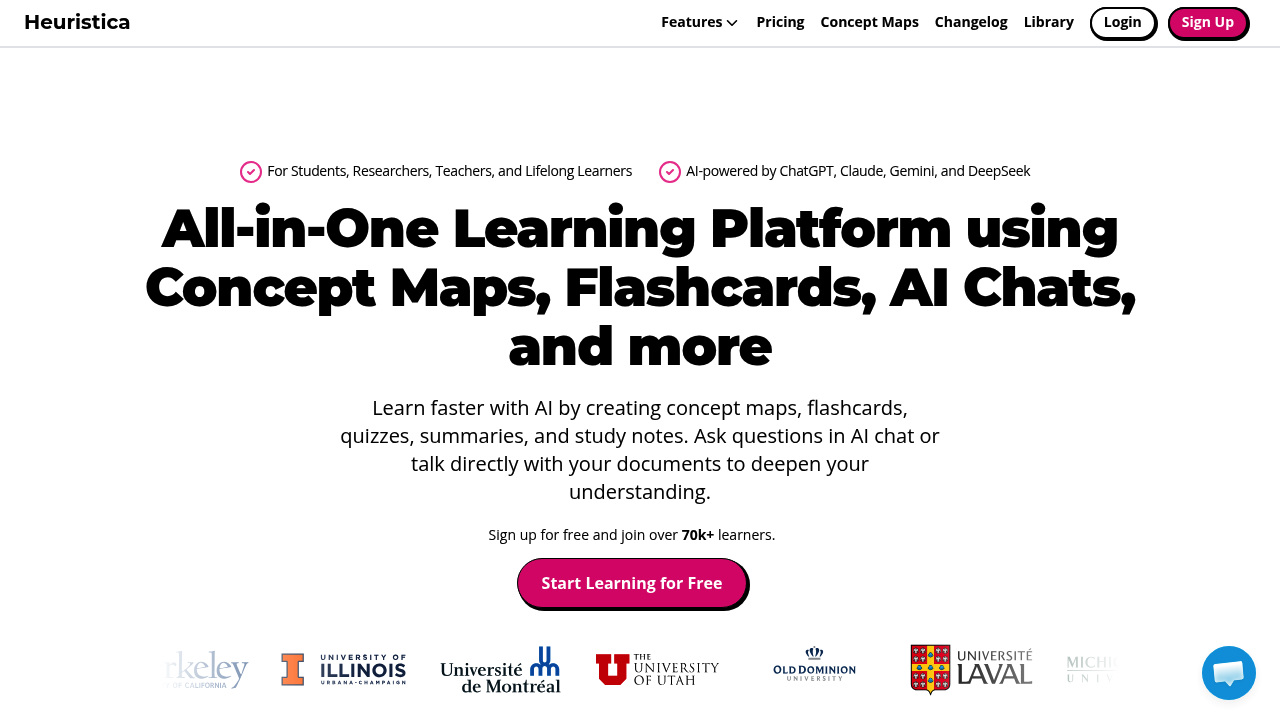
Upload a research paper or YouTube video. Concept maps appear on your screen within seconds. Heuristica turns these visual learning aids into flashcards with one click. Quizzes too. Study notes as well. You're not just chatting with an AI about content — you're building structured knowledge maps that convert into whatever study format you need.
Drop a PDF about quantum mechanics. Watch Heuristica extract the key concepts into an interconnected web. Click once and those same concepts become spaced repetition flashcards. Click again for a quiz. It pulls from academic sources like PubMed and arXiv directly, so a graduate student researching neuroscience can map complex papers without switching between tools.
Free users hit a wall quickly. Just three saved concept maps.
Heuristica connects to multiple AI models. GPT-4o. Claude. Gemini. You can chat with your uploaded documents using any of these models, then instantly convert those conversations into visual maps. YouTube videos become transcript summaries, then concept maps, then whatever study material you prefer.
The 70,000+ learners using Heuristica aren't just highlighting PDFs or asking ChatGPT questions. They're creating visual knowledge structures that morph into different learning formats. Upload a lecture recording, generate the concept map, convert to flashcards, then share with classmates. That workflow doesn't exist elsewhere.
Cross-format conversion happens instantly. Maps become notes become quizzes become essays. Custom prompts let you fine-tune how Heuristica processes your content across Wikipedia, academic databases, and personal documents.