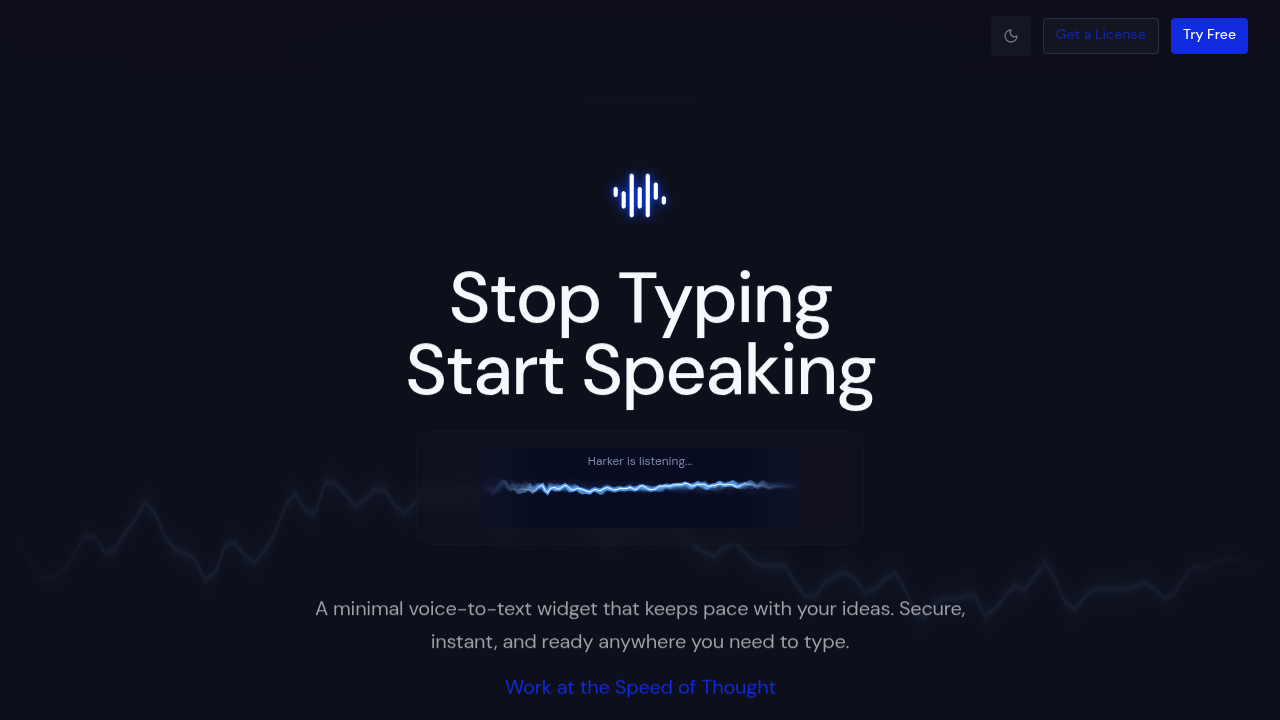
Press command-shift-space and start talking. Whatever you're saying gets transcribed directly into whatever text field you've got open. Email, code editor, chat window, doesn't matter. The text just appears where your cursor sits.
Harker runs entirely on your machine. No audio leaves your computer. Everything processes locally, which means your voice recordings stay private and the transcription happens fast. You can speak naturally and it figures out punctuation and context without you spelling things out.
The whole thing lives as a lightweight widget that activates with that global shortcut. You're not switching between apps or opening a separate interface. Hit the keys, speak, and the text flows into whatever you're working on. No copying from one window and pasting into another.
Most people type around 70 words per minute when they're moving quickly. Speaking clocks in above 150 words per minute without much effort. That gap matters when you're drafting documentation, writing emails, or explaining something complex. Harker lets you outpace your keyboard by using your voice instead.
The offline processing means there's zero lag from sending audio to a server and waiting for a response. Everything happens on device, so transcription keeps up with how fast you're actually speaking. You see words appearing in real time rather than watching a progress bar.
Where things get tricky: Intel-based Macs aren't supported. If you're on older hardware, you're out of luck. The Windows situation isn't clear either, so this seems built specifically for Apple Silicon machines.
The one-time purchase model is notable since most transcription tools run on subscriptions. You buy it once and own it. There's a seven day trial to test whether the transcription quality and speed work for your voice and accent before committing.
Harker targets people who write constantly. Developers documenting code, designers explaining concepts, anyone juggling multiple apps throughout the day. It's built for workflows where you're already thinking out loud or talking through problems, just channeling that into text instead of letting it evaporate.
The privacy angle matters more than it might seem. Voice data staying local means you can transcribe sensitive work stuff, client information, or personal notes without wondering where that audio ends up. No cloud storage, no third party processing, no data retention policies to worry about.