
Gemma logo

Gemma

Gemma is Google DeepMind's family of open models that developers use to build AI applications running on phones, laptops and cloud servers.

The latest generation, Gemma 4, is described as byte for byte the most capable open model line and is aimed at advanced reasoning and agentic workflows. It comes in compact E2B and E4B versions for mobile and IoT…

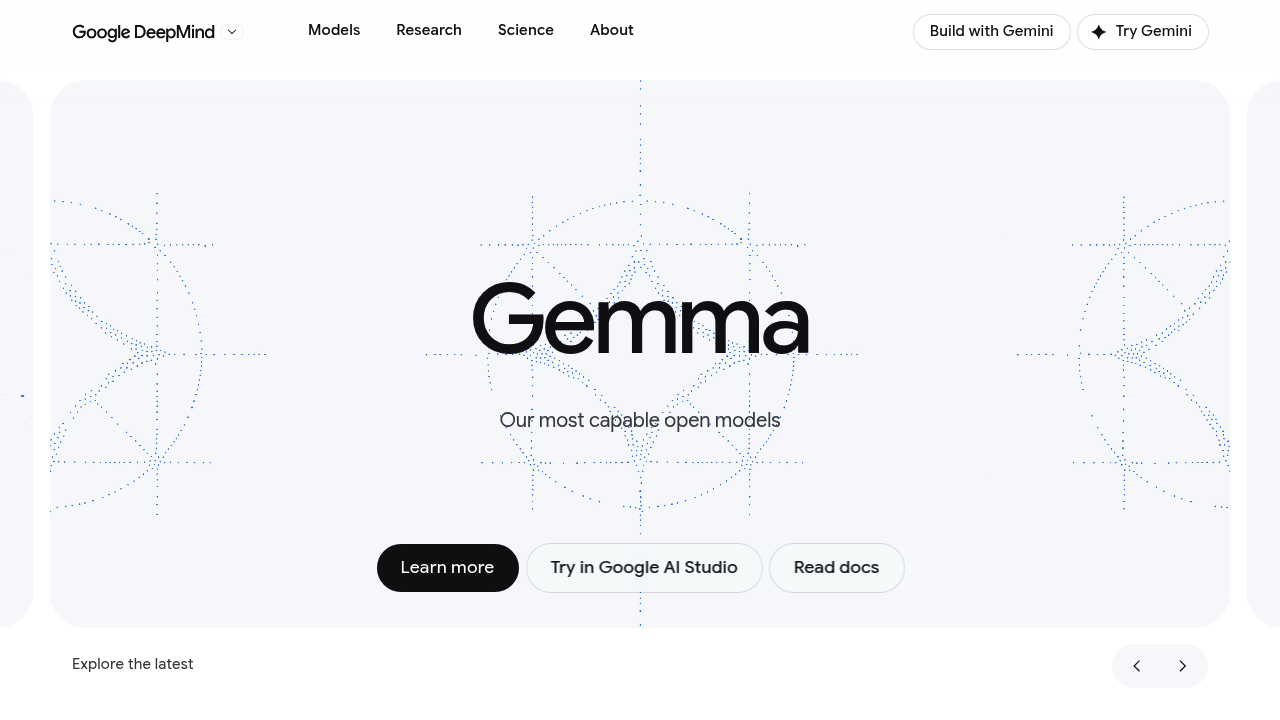
Gemma screenshot

Gemma is Google DeepMind's family of open models that developers use to build AI applications running on phones, laptops and cloud servers. The latest generation, Gemma 4, is described as byte for byte the most capable open model line and is aimed at advanced reasoning and agentic workflows. It comes in compact E2B and E4B versions for mobile and IoT devices and in 12B, 26B and 31B versions for personal computers. Official variants include DiffusionGemma for fast text generation, MedGemma for medical text and images, TranslateGemma for 55 languages, FunctionGemma for function calling, EmbeddingGemma for on-device embeddings and ShieldGemma 2 for content classification.

The models are meant for developers and researchers: mobile engineers who need compact on-device intelligence, machine learning teams fine-tuning a model for a domain, health AI groups working with medical imaging, and safety researchers studying model behavior with Gemma Scope 2. Startups and nonprofits can adapt the weights for local languages, as the Swahili-focused Crane AI Labs project shows. Educators have used offline setups as well, such as the Lentera microserver for classrooms.

Typical use cases include running a small model offline on a phone, building an agent that calls functions at the edge, adding multilingual translation to an app, generating embeddings for on-device search, and screening images or text for policy violations. Researchers can try the models in Google AI Studio, read the documentation and explore community projects in the Gemmaverse, including DolphinGemma for studying dolphin communication. Quantization-aware versions such as Gemma 4 QAT compress models for mobile and laptop efficiency, and multi-token prediction drafters speed up inference.

Gemma alternatives

See all →

Frequently asked

6 questions
What kinds of models are in the Gemma family?
Gemma covers general-purpose Gemma 4 models along with variants such as DiffusionGemma, MedGemma, TranslateGemma, FunctionGemma, EmbeddingGemma, ShieldGemma 2 and T5Gemma. Each variant targets a specific task.
Who is Gemma intended for?
Developers and researchers who build AI applications are the main audience. Sizes range from small on-device models to larger ones for personal computers and cloud servers.
How could Gemma be used for translation?
TranslateGemma is a collection of translation models that helps people communicate across 55 languages. Developers can embed it in apps that need multilingual support.
Can Gemma run on a phone or laptop?
E2B and E4B versions of Gemma 4 target mobile and IoT devices, while 12B, 26B and 31B target personal computers. Gemma 4 QAT adds model compression for mobile and laptop efficiency.
Is Gemma a ready-to-use chat app?
It is a set of open models for developers rather than a finished consumer app. You can try models in Google AI Studio and read the docs, but building an application requires development work.
How do I start experimenting with Gemma?
Open Google AI Studio to try the models, or read the documentation to download and integrate them. The Gemmaverse section also gathers community projects and integrations.

Reviews (0)

Write review

No reviews yet. Be the first to share your experience.